Key Takeaways:
- Poor maternal and infant health outcomes cost North Carolina more than $2.2 billion annually in excess medical spending, lost productivity, travel expenses and societal losses from preventable deaths.
- Researchers and maternal health advocates hope the report’s findings strengthen the case for investments and policy changes to improve maternal and birth outcomes.
By Rachel Crumpler
Poor maternal and infant health outcomes are costing North Carolina more than $2.2 billion a year, according to a report released last week.
The report, from Nurture NC and the Systems Strengthening Hub for Public Health at the UNC Gillings School of Global Public Health, is the first to quantify the economic burden of some key pregnancy and birth outcomes in North Carolina.
The report identifies $1.03 billion in annual excess spending associated with preterm and low weight births, travel for maternity care and lost workforce productivity.
Researchers calculated another $1.18 billion in estimated societal losses annually from preventable maternal and infant deaths.
The price tag is “staggeringly expensive,” said Jessica Simon, one of the report’s authors and an assistant professor in the Department of Health Policy and Management at UNC Gillings.
“[The report] adds really concrete evidence about what the current level of investment is costing families, payers and employers,” she said.
Kristen Hassmiller Lich, another author of the report and professor at UNC Gillings, hopes the report is a call to action. “There is tremendous evidence about ways that we can improve these outcomes… We just need to get people willing to do it, to invest in this, to prioritize this.”
Maternal, infant health crisis
The economic analysis comes as North Carolina struggles with maternal and infant health outcomes — challenges underscored by March of Dimes’ annual report card released on Nov. 17. The national nonprofit, which tracks how the United States is handling maternal and infant health, gave North Carolina a D, worse than the D+ it gave the United States as a whole. The grade also marks a slight decline from last year, when North Carolina received a D+.
“Behind that static letter grade lies a troubling truth: our nation remains stuck in a maternal and infant health crisis,” the March of Dimes report reads.
North Carolina has higher maternal and infant mortality rates than the national average.
An average of 49 pregnancy-related deaths occurred each year from 2018 to 2021, according to the latest report from North Carolina’s Maternal Mortality Review Committee. The state’s infant mortality rate was 6.3 deaths per 1,000 live births in 2024, which translated to 770 deaths, according to state data.
Meanwhile, access to maternity care keeps shrinking.
Of the state’s 100 counties, 18 are maternity care deserts, according to an August report from the March of Dimes. That’s defined as an area having no hospitals or birth centers offering labor and delivery services, and no practicing OB-GYNs, nurse midwives or family physicians who reported delivering babies. Another 12 counties have only one obstetric clinician.
That leaves thousands of women across North Carolina traveling long distances to deliver their babies — and, in some cases, even for routine prenatal and postpartum appointments.
The impact is not spread evenly: Black, rural and Medicaid-covered families have higher rates of adverse maternal and infant health outcomes.
Betsey Tilson, executive director of Nurture NC, said there’s broad consensus that maternal and infant health need to improve.
“We’ve been banging the drum about these health outcomes for a long time, and that hasn’t really moved the needle,” said Tilson, who served as North Carolina’s state health director and chief medical officer before taking the helm of Nurture NC in October 2025 to focus on improving maternal and infant health in the state.
“We need this economic lens,” Tilson said. “This report brings that leverage of, ‘We can’t actually afford not to change it because it’s costing us so much.’”
A billion-dollar price tag
Tilson said she initiated the economic evaluation, titled “The Economic Case for Investing in Maternal Health in North Carolina,” because poor maternal and infant health outcomes are more than a health issue.
“Sometimes conversations around economic vitality and workforce are separate from health, but those two are inextricably linked,” Tilson said. “Our economy and our workforce is completely dependent upon our people, the health of people.”
For example, adverse health outcomes for mothers and infants can lead to higher health care costs for insurers and families, a measurable outcome that became part of the analysis. Those poor outcomes often translate into reduced workforce participation that affects working parents and employers.
The report, for the first time, was able to put a price tag on some of these effects, detailing direct financial burdens on North Carolina families, insurers, employers and state coffers.
It is modeled after a 2024 economic analysis conducted by Heartland Forward, a nonprofit policy think tank focused on accelerating economic growth. That analysis quantified the savings from preventing adverse maternal and infant health outcomes in the heartland region of the United States.
The largest economic burden researchers tallied in North Carolina stems from excess medical costs associated with preterm and low birth weight infants, who have more medical needs than babies born full-term or at healthy weights.
Nationally, health care spending during the first six months of life averages $103,646 to $155,751 per preterm or low-weight infant, compared with $8,670 to $9,177 for full-term, normal-birth-weight infants.
In North Carolina, more than 1 in 8 babies are born preterm and/or low birth weight. Researchers found that the excess medical costs for these infants during the first six months of life total more than $988 million a year.
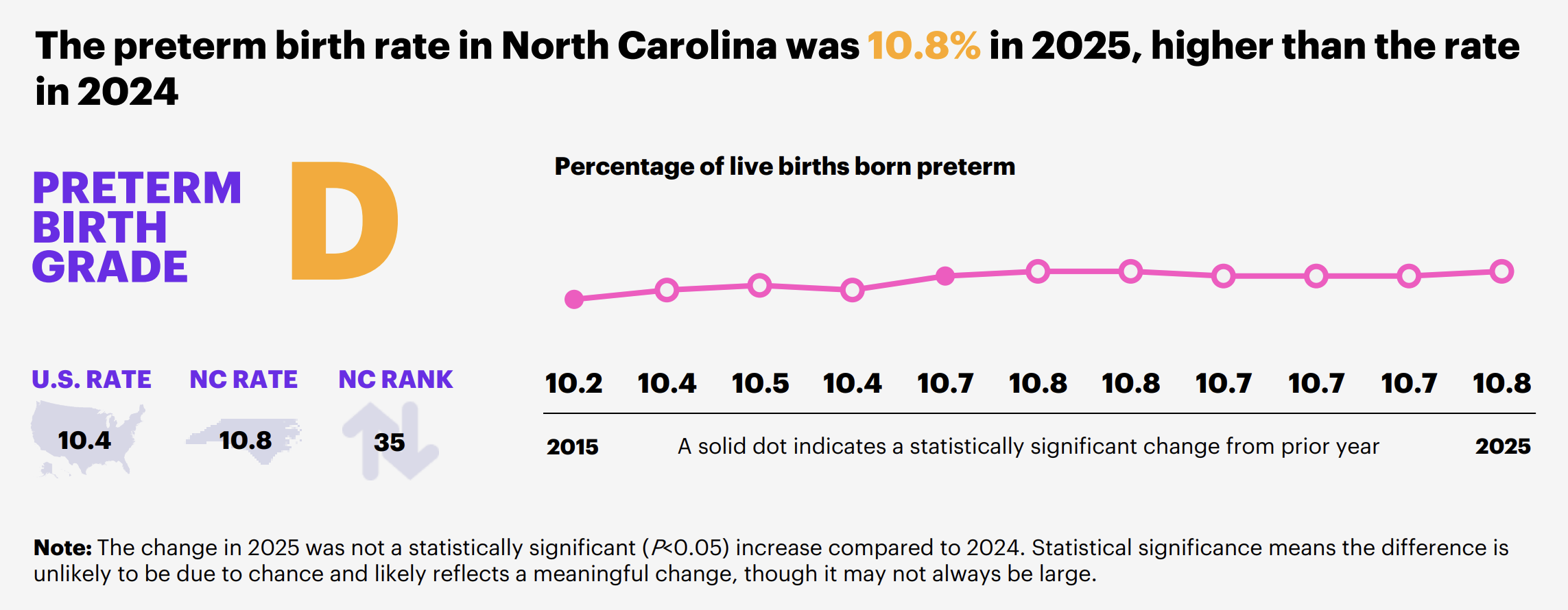
Reducing North Carolina’s rates of preterm birth and low birth weight to the March of Dimes’ nationwide goal of less than 5.5 percent would save public and private health insurance payers and families over $415 million a year, the report found — about $126,000 in avoided costs for each averted preterm or low weight birth.
“There’s such a clear and compelling case to prevent many of those preterm, low birth weights through investing in better prenatal care,” Hassmiller Lich said.
The report also measured:
- $21.7 million a year in lost productivity through medical absenteeism and disability leave: Mothers of preterm infants lose, on average, an additional seven work days during the year after delivery, resulting in $1,666 in lost productivity per mother.
- $22.5 million a year in non-medical travel expenses and lost wages: More than one in three North Carolina families travel out of county to give birth, averaging 49 miles (about 68 minutes) and $488 per family in transportation and wage losses.
- $1.18 billion in societal losses tied to preventable maternal and infant deaths: North Carolina has about 67 infant deaths above the Healthy North Carolina 2030 infant mortality goal of 6 deaths per 1,000 live births. The societal loss from these deaths is calculated at more than $921 million a year. Preventable maternal deaths, averaging roughly 21 a year, amount to more than $255 million in societal loss.
“These costs are not inevitable,” said Meghan O’Leary, another of the report’s authors and an assistant professor in the Department of Health Policy and Management at UNC Gillings.
The figures for adverse maternal and infant health costs documented in the report aren’t exhaustive, she said, meaning the costs likely run even higher.
“There’s many adverse consequences to not supporting moms and babies and families, and we only captured a handful of specific ones,” Hassmiller Lich said.
For example, the cost of travel to NICUs wasn’t tallied, nor were the costs of untreated perinatal mood and anxiety disorders. And for preterm birth-related productivity loss, researchers calculated only the mother’s lost productivity, even though a partner was likely affected as well.
Improving outcomes
Tilson said she hopes the economic analysis spurs greater urgency in investing in maternal health.
“The optimistic piece of this analysis is that it doesn’t have to be that way,” Tilson said. “There is so much of this that is preventable. We already know there’s a lot of evidence-based strategies that we can do.”
Tilson said maternal health is a bipartisan issue and the report strengthens the fiscal case for action.
“As our legislators are thinking about maternal health as a bipartisan issue, this [report] is going to give them even more data to say, ‘Okay, it is a fiscally responsible thing to do as well because it’s costing our state so much.’”
Some efforts are already underway to improve outcomes and expand access to care across North Carolina. For example, several rural family physicians are starting to provide prenatal and postpartum care at community health centers to minimize travel distances. North Carolina is also working to expand midwifery care as one of 10 states participating in the Midwifery Policy Collective, as state leaders look for ways to expand the maternity care workforce.
“There is a ton of work that we can do, and that is already going on,” Tilson said. “There is so much opportunity.”
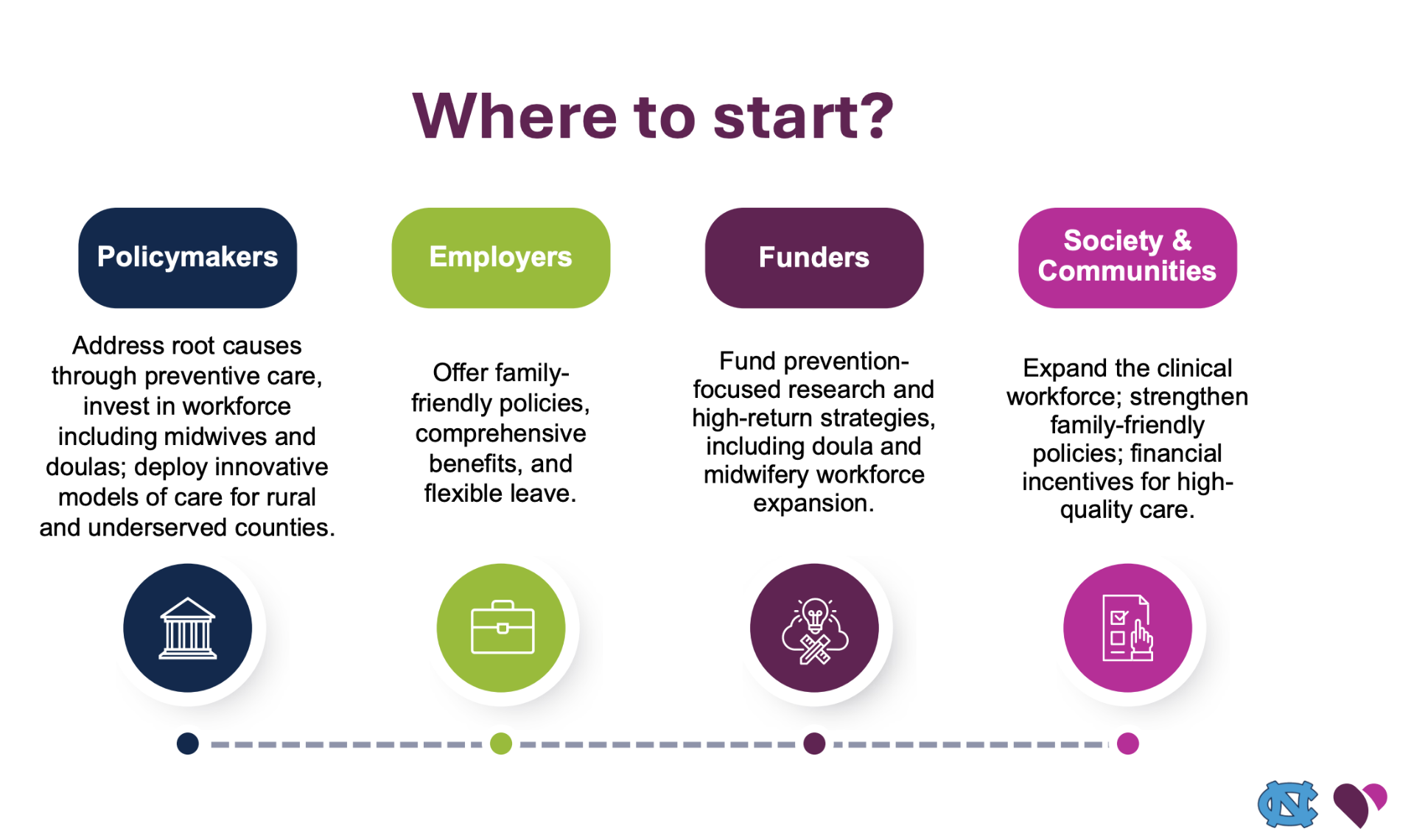
The researchers plan to release another report analyzing the economic return of specific interventions to help guide investments to advance maternal and infant health. Those could include expanding the doula and midwife workforce and reimbursement for those providers, as well as strategies employers could implement, such as paid time for pregnant women to attend prenatal appointments and paid family leave.
They haven’t yet decided which strategies they will examine. Researchers plan to shape their work around community and state priorities and focus on interventions that are most promising or in need of more evidence.
“Maternal health is an economic issue,” Tilson said. “Maternal health is a workforce issue.”
“We can turn the corner on these costs,” she said. “By changing the trajectory of our health outcomes, then we also are advancing our economic vitality and our workforce vitality. It’s really a win-win.”
This article first appeared on North Carolina Health News and is republished here under a Creative Commons Attribution-NoDerivatives 4.0 International License. 
Source: www.northcarolinahealthnews.org