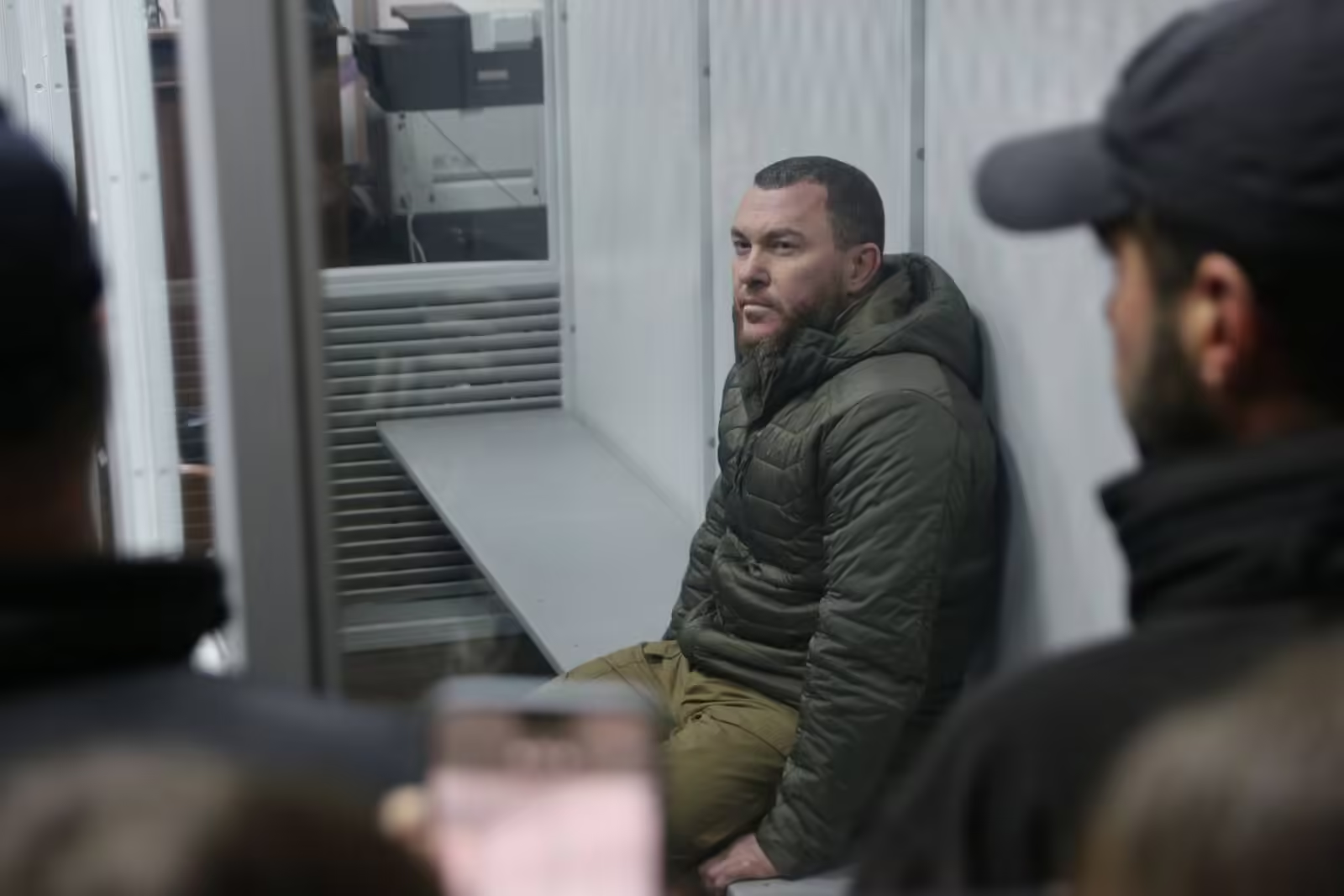

The High Anti-Corruption Court considers a preventive measure for Serhii Duka, the former first deputy head of the SBU’s Department for the Protection of National Statehood, in Kyiv, Ukraine, on Nov. 6, 2026. (Oleksii Arunian / Suspilne Ukraine / JSC “UA:PBC” / Global Images Ukraine via Getty Images)
Ukraine’s latest corruption scandal has exposed an unlikely alliance between organized crime and the law enforcement officials meant to fight it.
Two men from the criminal underworld allegedly wielded influence over senior Ukrainian law enforcement officials, paying bribes in exchange for protection for their illicit businesses.
The latest revelations stem from a sweeping investigation by the National Anti-Corruption Bureau (NABU) and the Specialized Anti-Corruption Prosecutor’s Office (SAPO), known as Operation Carthage, into fraudulent call centers. The probe led to the ouster of Prosecutor General Ruslan Kravchenko in September and implicated senior officials in his office.
But the alleged criminal network extended far beyond call-center scams. According to Ukraine’s anti-corruption agencies, the network also trafficked drugs, produced counterfeit currency, and used violence to intimidate critics and opponents.
“It resembles Russia, where criminal groups and law enforcement agencies are completely intertwined,” a former Security Service (SBU) official told the Kyiv Independent on condition of anonymity.
“These are purely Russian-style schemes. I don’t think these people invented anything new,” the source continued. “They simply took what they already knew and brought it to Ukraine. This is a tumor that needs to be cut out.”
Five people have been charged in the case, including senior National Police officers and Security Service officials. Four have already been placed in pre-trial detention, with one of them having since been released on bail.
For the SBU, the scandal is another blow to an already troubled reform record. The agency remains one of Ukraine’s least-reformed law enforcement institutions, despite President Volodymyr Zelensky‘s promises to clean it up.
The recent allegations have renewed questions about its extensive powers and the lack of effective oversight.
Drugs, call centers, violence
At the center of the alleged criminal network were two men with ties to Russia and the criminal underworld.
They were identified by the media as Andrii Osipov and Yehor Burkin. In the recordings published by the Anti-Corruption Bureau, they were referred to as “Criminal” and “Mexican,” respectively.

Russian-born Burkin is reportedly the founder of the transnational drug ring known as Khimprom. Investigators say he headed the criminal group from 2022 to 2026, while Osipov acted as an intermediary, using his connections with Ukraine’s law enforcement to protect the group.
Burkin moved from Russia to Ukraine in 2016 before later fleeing to Latin America. His whereabouts are currently unknown. Zelensky imposed sanctions on him in 2023.
Recordings released by NABU suggest that Burkin maintained contact with the Russian Federal Security Service (FSB) even during Russia’s all-out war.
Osipov was detained this summer in connection with a separate NABU case. Data extracted from his seized phone helped uncover the Khimprom scheme.
SAPO previously said that Osipov had close ties to former SBU Chief Vasyl Maliuk, citing recorded conversations between the two. Both are from Korostyshiv, a city in Zhytomyr Oblast.

In a 2023 statement on its efforts to combat cross-border drug trafficking, the SBU said Khimprom had been seeking to establish a foothold in Ukraine with Russian intelligence backing since 2014.
Khimprom’s activities continued to grow during Russia’s full-scale war, both in Ukraine and abroad, anti-graft agencies said.
According to investigators, Burkin and Osipov were behind U420, a retail chain selling synthetic cannabinoids and psychotropic substances at purported “souvenir shops.” To bypass restrictions, they repeatedly changed the chemical structure of the substances, producing compounds that were not formally included on lists of controlled drugs, the Anti-Corruption Bureau said.
The group allegedly planned to bribe then-Interior Minister Ihor Klymenko and Health Minister Viktor Liashko to prevent the compounds from being added to lists of banned substances.
The plan failed to materialize. The Anti-Corruption Bureau said Klymenko was not implicated in the scheme.

Police dismantled the network following an investigation by Ukrainian media outlet Bihus.Info. Released tapes show Burkin and Osipov discussing a possible acid attack on or kidnapping of the outlet’s founder, Denys Bihus, over its investigation.
Ihor Klymenko, secretary of Ukraine’s National Security and Defense Council, warned on Nov. 6 that Khimprom could continue trying to “destabilize the situation” in Ukraine, posing a threat to national security even after the war.
“There have always been two camps within the service. Some used their positions to make money, and we knew which departments they were in. Others did the hard work and served the state.”
Days after the revelations, on Nov. 7, Zelensky commented on the case for the first time, saying a full investigation would require support from international partners, including the U.S. He added that Osipov had reportedly begun operations in Poland and was seeking to enter the German synthetic drug market.
Scam call centers were another part of the group’s alleged business.
According to NABU, it controlled at least 52 offices that targeted people in Ukraine and abroad, each bringing in around $7,000 a month.
For years, a network of scam call centers has operated in Ukraine, defrauding both Ukrainians and foreigners. The profits generated by these operations across Ukraine could reach $1 billion a month, according to the Global Initiative Against Transnational Organized Crime.
Some 2,700 people worked at the call centers controlled by the criminal group uncovered by NABU, the agency said.
The money was allegedly shared with officials from the SBU, the National Police and the Prosecutor General’s Office. They were paid in cryptocurrency, with more than 3.75 million USDT ($3,7 million) transferred to a single wallet over several months, according to NABU.
The scheme began to wind down in late July, after Ukrainian authorities came under pressure from international partners to crack down on scam call centers, the bureau said. In October, parliament passed legislation proposed by Zelensky to toughen penalties for those involved in scam call centers.
Violence was another tool the group allegedly used to lead its illegal business, hiring people to carry out beatings, including abroad, NABU said. A video released by NABU shows some victims being beaten with hammers. Osipov allegedly maintained subordinates to carry out such tasks.
To track its targets, the group allegedly relied on state surveillance systems, including the “Safe City” municipal camera network, access to which was provided by law enforcement officials, the Anti-Corruption Bureau said.
The recordings suggest the group’s leaders believed they could operate with impunity under the current government, while believing that a change of government could upend their schemes.
Tainted SBU department
A former SBU officer who spoke to the Kyiv Independent on condition of anonymity said the revelations were “painful, but hardly surprising.”
“There have always been two camps within the service. Some used their positions to make money, and we knew which departments they were in. Others did the hard work and served the state.”
According to investigators, the criminal group had protection from within the Security Service’s Department for the Protection of National Statehood.
Its first deputy head, Major General Serhii Duka, will be kept in custody for two months, with bail set at Hr 65 million ($1.5 million), on charges of aiding the criminal network.
“They see themselves as above the law, believing they can do whatever they want.”

SAPO says Duka advised Osipov on how to evade detection and arranged contacts with senior officials at other law enforcement agencies, including the Prosecutor General’s Office.
On paper, the department is tasked with protecting Ukraine’s sovereignty and constitutional order as well as countering propaganda. The department has also been described as one of the Security Service’s most problematic units, prone to what some call “spy fever,” a tendency to suspect people as working against Ukraine’s interests by default.
Its broad powers have repeatedly drawn criticism, with allegations of widespread abuse.
After 2021, it absorbed staff from the Security Service’s directorate for combating corruption and organized crime, which was dissolved amid allegations that it pressured businesses under the pretext of protecting the economy.
Observers say the department continued these malpractices under a new name.
“(SBU’s Department for the Protection of National Statehood) is the one with the highest concentration of people who are either prone to colluding with criminal circles or engaging in corruption, or have deeply distorted ideas of national security and what an ideal state should be,” Yevhen Krapyvin, an expert on criminal justice at the Legislative Initiatives Laboratory, told the Kyiv Independent.
“They see themselves as above the law, believing they can do whatever they want.”
In 2024, the SBU’s Department for the Protection of National Statehood illegally surveilled Bihus.Info journalists. Zelensky later dismissed its head, Roman Semenchenko, over the scandal.

According to anti-corruption agencies, however, little had changed, with Major General Duka spearheading the attack on NABU and SAPO as Zelensky’s team sought to strip the agencies of their independence last July.
The SBU detained two NABU detectives, Ruslan Mahamedsuralov and Viktor Husarov, accusing them of having ties to Russia and portraying the crackdown as an attempt to combat Moscow’s alleged influence on the bureau.
Both were released in late 2025, and a court closed the case against Husarov this June.
When Anti-Corruption Bureau detectives tried to enter the house where Duka was staying on Nov. 4 to conduct searches, Security Service Alpha unit officers guarding the general threatened them with guns and kept them out for several hours.
According to the Specialized Anti-Corruption Prosecutor’s Office, Duka used that time to smash several phones and data storage devices with an axe.
Duka denies wrongdoing, calling the case a NABU vendetta.
Krapyvin argues that Duka’s department should either be disbanded or have its functions overhauled as part of a broader Security Service reform.
Acting Security Service Chief Oleksandr Poklad dismissed two senior officials, including Duka, on Nov. 4, adding that he supports the NABU and SAPO investigation and expects it to be “impartial.”
Duka, however, remains within the Security Service’s intelligence structure.
Failure to reform
Experts and lawmakers who spoke to the Kyiv Independent say the latest scandal has underscored the need for a thorough Security Service reform.
They argue that the agency has accumulated powers beyond its core intelligence role, creating room for abuse and political interference.
The last major push to reform the Security Service came in 2021, when parliament passed a reform bill in its first reading. The bill soon stalled and would need to be revised in light of the all-out war that has turned the SBU into one of Ukraine’s key combat forces.
The SBU was initially supposed to undergo a major staff reduction as part of the reform. But the full-scale war changed the equation, with the domestic spy intelligence agency increasing its staff numbers to nearly 40,000.
“Dismissing people now would hand Russia an opportunity to recruit disgruntled former employees,” Ivan Stupak, a former SBU officer, told the Kyiv Independent.
Reforming the SBU is also part of Ukraine’s EU accession requirements. Yet the European Commission said in its Nov. 4 report that no major steps had been taken to reform the agency.
Krapyvin says there was little pressure to change the Security Service during the war, either from Ukraine’s partners or from within the country itself.

The SBU, like the Prosecutor General’s Office, is seen as loyal to Zelensky. The president nominates the Security Service chief, who must be approved by parliament, and controls the appointment and dismissal of department heads.
Though skeptical that Zelensky will be willing to loosen his grip on the agency, observers say the SBU needs stronger parliamentary oversight.
“Reform is no silver bullet,” Krapyvin says.
“But it can be made more accountable to parliament, more transparent, and less dependent on the president. That would reduce the chances of generals protecting criminal groups for years.”
Note from the author:
Hello there! This is Kateryna Denisova, the author of this piece.
The Kyiv Independent doesn’t have a wealthy owner or a paywall. Instead, we rely on readers like you to keep our journalism funded. If you liked this article, please consider joining our community today. We promise to deliver more stories on this topic going forward.
Thank you.
Source: kyivindependent.com