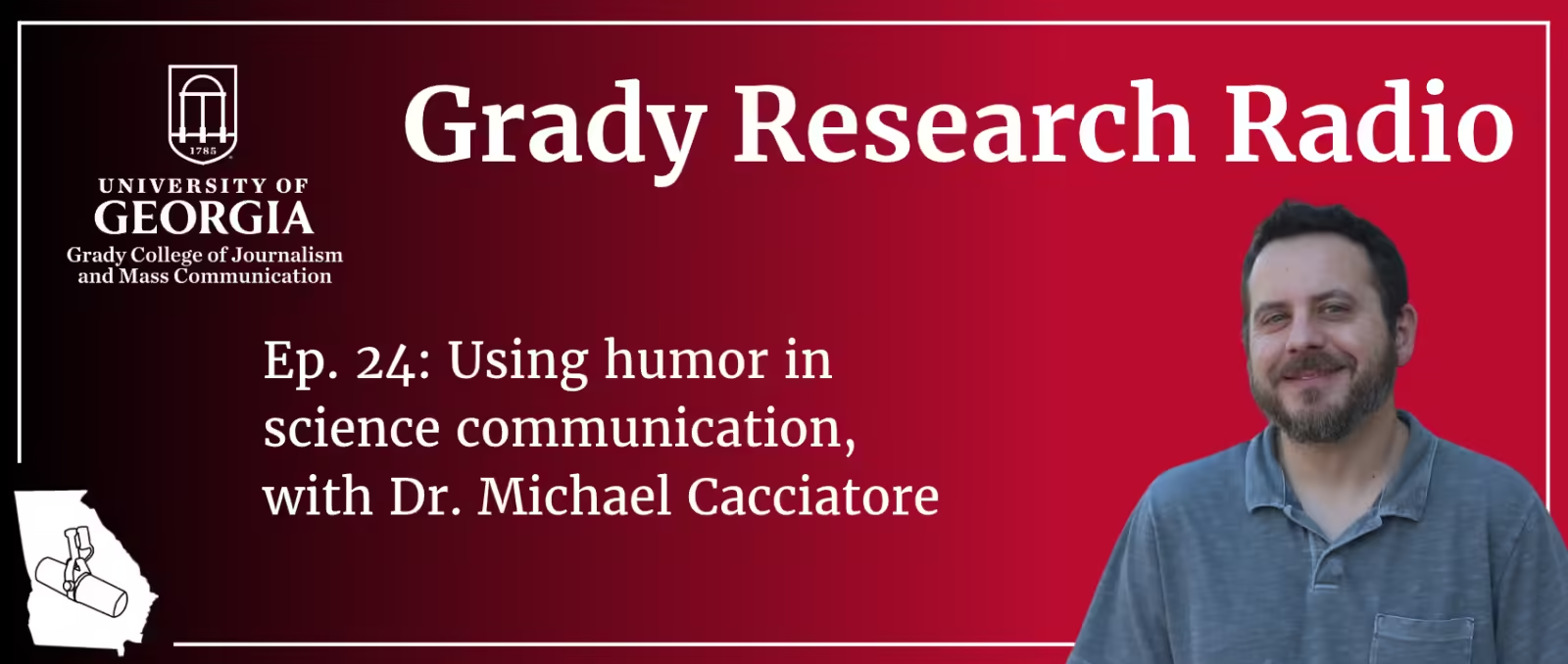

Michael Cacciatorea professor, assistant department head of Advertising and Public relations at Grady College and the co-director of the Center for Health and Risk Communicationdescribed his academic journey and his current research focus on implementing humor in science communication during an interview with Grady Research Radio.
Cacciatore’s academic career began at the University of Manitoba graduating with an English degree. From there, he decided to move away from home and “see the world a little bit,” he said. Cacciatore then began his graduate studies at the University of Wisconsin-Madison. He wanted to be a writer, originally deciding on a traditional journalism route, writing about environmental issues and topics he grew up around.
“While I was there, you take a stats class, a methods class and a theory class, and it kind of opened up my world to academia and research,” he said. “Before you know it, I was in the Ph.D. program, working with people, research groups, starting to publish papers, and here I am today at the University of Georgia.”
Cacciatore’s research focuses on implementing humor into science communication, striking a balance between framing information in an entertaining way without sacrificing credibility.
“Sometimes, scientists get a bad rap of being pretty rigid, and maybe not the most playful people on the planet,” Cacciatore said. “But on the other hand… does it make others think that maybe this isn’t the authority on this topic? Can you really be this light-hearted person and really do serious research? So, we decided to jump into that space.”
While the humor research space is nothing new to Grady College, with faculty like Jim Kennedy New Media Professor Hye Jin Yoon publishing work in the advertising space for years, Cacciatore enjoys working in the area now because of its lighthearted, fun nature.
“It’s something that doesn’t feel like work a lot of the time,” he said. “There’s that practical element to it as well, not just theory building. It’s a fun space working with fun people, so that’s always a recipe for success.”
Cacciatore’s humor research has caught the attention of other researchers and science organizations alike. In 2021, Cacciatore was awarded a $2.5 million grant from the U.S. National Science Foundation’s Advancing Informal STEM Learning Program. He has partnered with actual comedians as part of this research, helping Cacciatore and his team write jokes and scripts for studies and videos.
“They’re incredibly gifted at what they do,” Cacciatore said. “We’ve tried to take stuff from the online world and adapt it and make it more user friendly, or, you know, something that would go through IRB properly. We’re not joke writers… we’re not comedians. Whereas they bring this touch, this natural ability. They’re exceptionally strong at writing jokes and punchlines and just kind of putting the whole thing together.”
Some of the areas of humor Cacciatore and his team have explored include anthropomorphic humor, satirical comedy with varying degrees of aggressiveness and even the joke teller’s demographics. These include the speaker’s race, gender, title and whether they are described as a scientist or comedian first.
Cacciatore and his team are also measuring for curiosity in science information. Some of these tests are as simple as adding the phrase “curious why?” to the end of scientific facts or strange phenomena. However, in its current state, the experiment was a bit too successful in priming curiosity.
“People are naturally curious about this stuff, or at least, they report being naturally curious in our experimental settings,” Cacciatore said. “We had stuff about just basic plant life and how plants operate and grow, and that made people very curious. People reported incredibly high levels of curiosity.”
Cacciatore hopes that readers and experts learn from the humor research that it can work in scientific fields if it is done well and naturally.
“I don’t think we’re suggesting that everyone should use humor,” he said. “What I really want is people that are comfortable doing it to know that there’s some data out there… that suggests this can be a positive thing. If you’re presenting at a conference, if you’re doing a talk in front of everyday audiences… you can have elements of humor in it if that’s in your natural personality.”
When he is not conducting research or teaching methodology, Cacciatore instructs a First-Year Odyssey course focused on representations and discussions of science in media. The students are asked to work in presentation groups, bringing in clips from different movies, TV shows, anime and other entertainment mediums to examine the depictions of science or scientists.
“It’s kind of like a film class, or, at least, what I envision a film class to be,” Cacciatore said. “A number of people brought in a lot of kind of supernatural stuff. Backrooms… even Obsession was another one. They’re bringing that in, talking about the science of attraction and parallel universes. It’s been a fun situation.”
Editor’s Note: This feature was written with the assistance of AI and edited by a human.
Grady Research Radio Interview and Feature Editor: Sam Tupper, [email protected]
Source: grady.uga.edu