

Nationwide FAA flight restrictions have disrupted Tennessee’s travel to Texas A&M. Past SEC postponements, federal aviation updates and conference rules provide context for Saturday’s game.
The Tennessee Volunteers had a big SEC road game circled for Saturday in College Station, Texas. Then the sky closed for over four hours Friday evening.
The FAA stopped departures nationwide Friday afternoonaccording to Reuters, citing “extraordinary circumstances and for reasons of safety.” The Associated Press reported that Tennessee, Texas, Utah, Ole Miss, and several other college football teams were dealing with travel disruptions ahead of Saturday road games.
So the obvious question is whether Tennessee-Texas A&M gets played as scheduled. As of this writing, the SEC has not announced a postponement. This is a developing situation, and we’ll update it as the conference, UT, and Texas A&M say more.
Update: FAA ground stop live updates: Nationwide ground stop lifted, Vols to fly out Friday night
The FAA has lifted the ground stop, as reported by ABC News:
The Federal Aviation Administration ordered a rare nationwide ground stop Friday for all airports that lasted more than four hours.
Department of Homeland Security Secretary Markwayne Mullin told reporters it was due to a “telecommunications outage” and that there was no indication the incident was a “nefarious attack.”
Nearly 5,000 flights were canceled amid the issue.
Without wasting any time, ESPN’s Pete Thamel and On3’s Chris Low both report that Tennessee plans to fly out of Knoxville’s McGhee Tyson Airport to get to College Station Friday night for the regularly scheduled Saturday 2pm local time kickoff.
Why the FAA grounded departures nationwide
Per Reuters, aircraft already in the air could continue to land, departing flights were held, and international departures were handled case by case. The move followed serious communications problems affecting air traffic control.
Transportation Secretary Sean Duffy said the disruption hit all 22 Air Route Traffic Control Centersthe regional facilities that coordinate aircraft in flight. FAA technicians were investigating.
Homeland Security Secretary Markwayne Mullin described it as a telecommunications outage and said officials had no indication at that time of a malicious attack, per CBS News. That is not a final ruling on the cause. The communications failure is established. What broke, and why, is not. Officials also had not given a firm timetable for restoring service in the reports I reviewed.
The AP called this the first nationwide ground stop since the NOTAM-system outage in January 2023. Before that, the notable nationwide shutdown came after the Sept. 11, 2001, attacks. Those are three very different events, and nobody should treat them as the same thing.
Why Tennessee’s trip to College Station is complicated
Tennessee was scheduled to depart Knoxville at approximately 4 p.m. ET for College Station, according to Bill Martin with the university. Kickoff is set for 3 p.m. ET Saturday in College Station (2 p.m. local time).
My first instinct was simple math. Can the Vols just bus it? No way. A nonstop drive runs roughly 14 hours, and that’s before stops, loading, meals, or rest.
But getting a team to College Station before kickoff is not the same as having a workable football itinerary. Lodging, equipment, meals, sleep, medical prep, and pregame access all matter. And the AP raised a separate problem: whether game officials can even reach their assignments. A disruption hitting multiple teams, charter operators, officiating crews, and airports at once is a lot messier than one delayed flight.
The closest thing to a blueprint comes from 2001, and Tennessee was right in the middle of it.
The SEC postponed every football game scheduled for Sept. 15, 2001in the aftermath of the terrorist attacks. That was a conference-wide call made during a national tragedy and transportation restrictions. In fact, Tennessee athletics director Doug Dickey said UT had made provisions to comply with the original plan to play before the SEC changed course.
Tennessee at Florida, Vanderbilt at Ole Miss, and Auburn at LSU all moved to Dec. 1. The Vols won that rescheduled game in Gainesville 34-32, and the SEC Championship Game slid to Dec. 8.
The most direct travel precedent came from outside the conference. Missouri at Michigan State, a Big 12-Big Ten nonconference game, also moved from Sept. 15 to Dec. 1. Michigan State said Missouri could not verify charter availability and timing, and suitable hotel arrangements for a bus trip weren’t available. Charter questions and bus logistics.
Colorado State at UNLV was also pushed from Sept. 14 to Oct. 20. Mountain West commissioner Craig Thompson pointed to the difficulty of asking Colorado State to take a 12-hour bus trip, along with other logistical and national circumstances. That’s useful context, but it isn’t SEC policy.
What LSU-Florida in 2016 shows about SEC discretion
The SEC has made this kind of call without a national emergency, too. Hurricane Matthew led the conference to postpone LSU at Florida from Oct. 8, 2016. Commissioner Greg Sankey said Florida could neither host nor travel under the circumstances, and the SEC cited uncertainty around the storm’s impact on emergency personnel, facilities, and travel.
The game eventually landed on Nov. 19 in Baton Rouge instead of Gainesville.
It’s a relevant case because travel feasibility and safety drove the decision. It’s not a perfect match. A hurricane threatened the host region itself. This is a national aviation problem, and College Station is presumably ready to go.
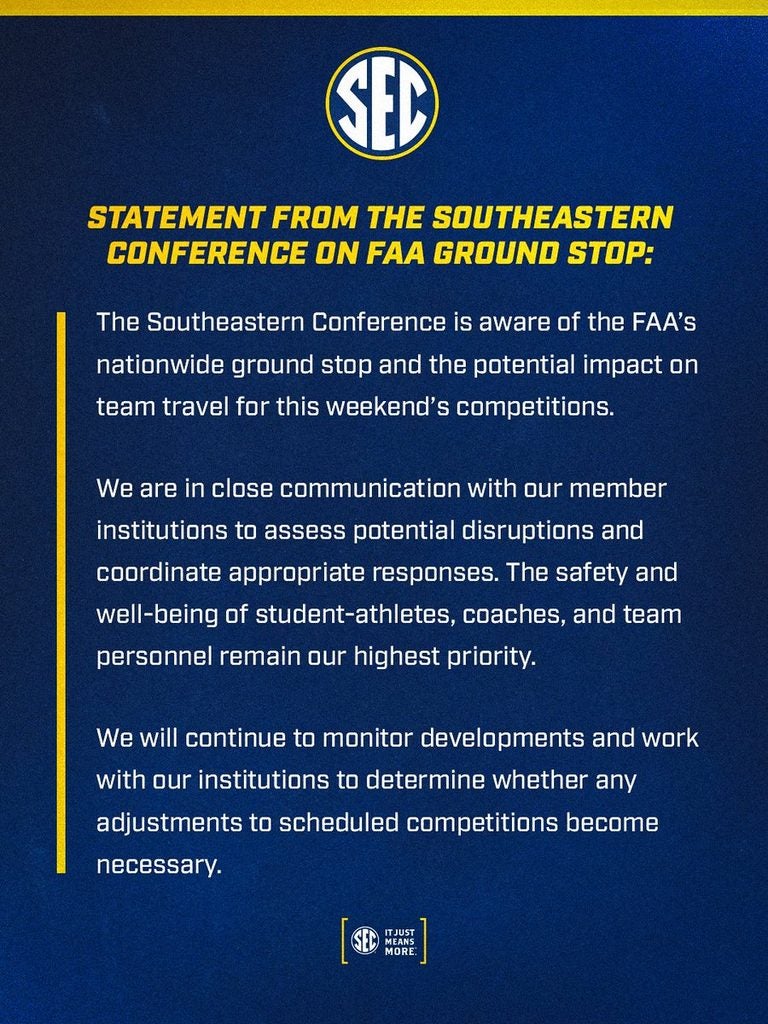
Can the SEC move Tennessee-Texas A&M?
Published SEC football regulations give the commissioner procedures for postponing and rescheduling games, including authority over dates beyond a same-day adjustment. How the current 2026-27 wording applies to a nationwide FAA outage is something only the conference can answer.
So let’s be clear about what we don’t know. Nobody has said Sunday is mandatory. Nobody has said a bus trip is required. Nobody has said a forfeit is on the table.
The questions I’d want answered: Does an FAA ground stop count as an extraordinary circumstance under the rules? Who decides between a Saturday delay and a Sunday postponement? What’s the deadline? And what happens if the officials can’t get there either?
History says the SEC has options . . . and has used them before. Whether it needs them this time depends on how fast the FAA gets the planes moving again.

Source: atozsports.com