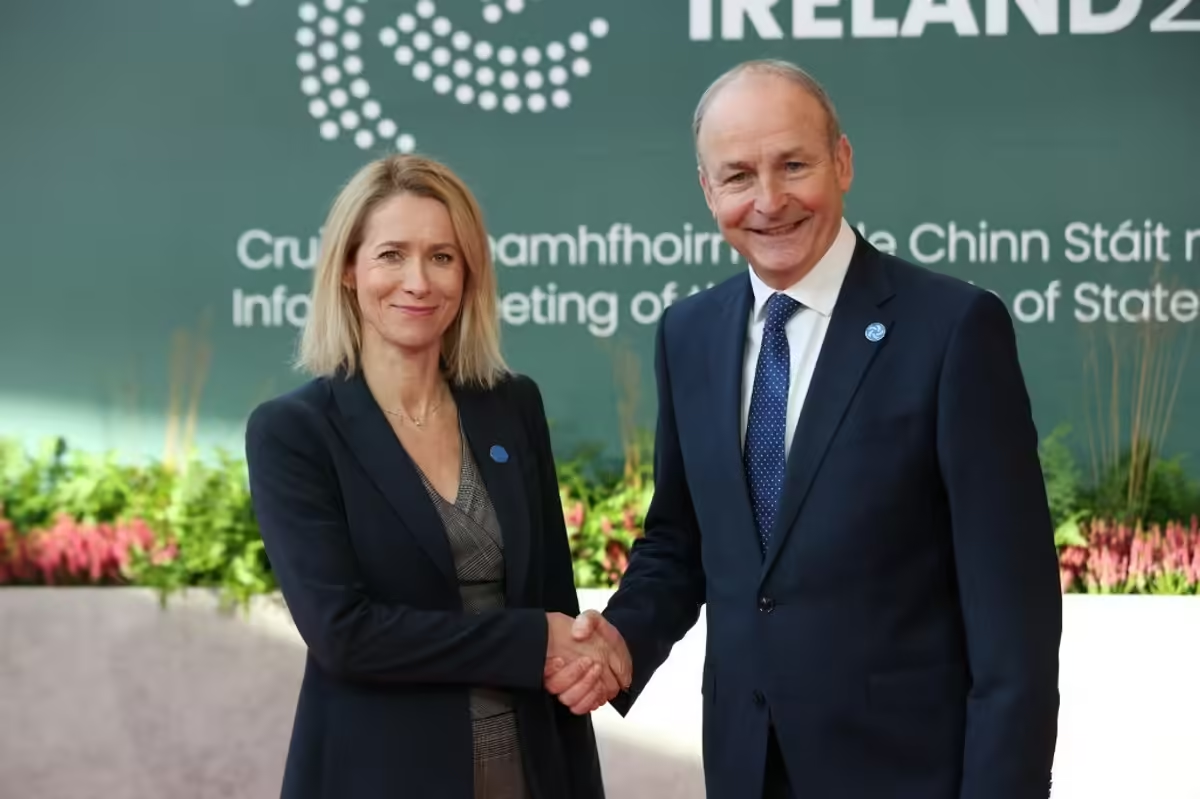

EU foreign policy chief Kaja Kallas warned Friday, Nov. 13, that Russia is attempting to draw Europe into negotiations over the continent’s security architecture while sidestepping the urgent need for a ceasefire in Ukraine.
“We have one aggressor and one victim, and the aggressor does not have security concerns. Nobody has ever attacked them. They have attacked others,” Kallas told reporters ahead of an informal EU leaders’ meeting in Dublin.
JOIN US ON TELEGRAM
Follow our coverage of the war on the @Kyivpost_official.
“I mean, keep the focus, people,” she added.
Kallas warned that allowing Moscow to shift the negotiating agenda toward Europe’s wider security arrangements would play directly into the Kremlin’s hands, distracting from Russia’s continued war against Ukraine.
“If we start to talk about what Russia is asking regarding the security architecture, we actually walk into the traps that Russia is setting us,” she said.
Kallas stressed that Europe must stick to the agreed sequence: first a ceasefire, then a peace agreement, and only afterward broader talks on Europe’s security architecture.
“First there has to be a ceasefire,” she said, arguing that halting the fighting would be the first test of whether Moscow has any genuine willingness to make peace.
‘We are actually in a worse place’
Kallas’s warning came as Russia sought to revive sweeping security demands dating back to 2021, when Moscow called for restrictions on NATO’s military presence and activities in Eastern Europe.
Other Topics of Interest
Health Minister Viktor Liashko said on Friday, Nov. 13 that the bill will classify medical AI systems by risk level and will soon be presented for public discussion.
As Kyiv Post reported, Russian President Vladimir Putin renewed those demands during talks with US envoys Jared Kushner and Steve Witkoff in Moscow on Thursday.
Putin also warned against the deployment of European troops to Ukraine as part of any post-war security arrangement.
Kallas cautioned that engaging with Moscow’s broader demands before securing a ceasefire would weaken Europe’s negotiating position.
“We are in a good position if we keep to the agreement that we push for the ceasefire,” she said.
“If we walk into the trap that we start to discuss regarding the European security architecture, then I don’t think we are in a better place. We are actually in a worse place.”
She argued that Russia’s demands should not be accepted as the starting point without Europe presenting its own equally firm negotiating position.
“Russia is presenting their maximum demands, and that’s why I’ve put together with the European foreign ministers also European maximum demands,” Kallas said.
“If they start from maximum, we should start from maximum as well, so that it would be a real negotiation.”
She added: “If one starts from maximum and the other does not ask anything, you can guess where this negotiation is ending.”
‘I know that the Russians don’t want me’
Kallas also confronted questions about who should represent Europe in future negotiations with Moscow, pushing back against suggestions that Russian opposition could prevent her from taking part.
“I know that the Russians don’t want me, but, you know, do we have a say who is representing Russia? No, we don’t,” she said.
Asked why Moscow opposed her participation, including whether her Eastern European background was a factor, Kallas accused Russia of seeking the weakest possible negotiating partner.
“They don’t want anybody strong on the other side because they want to push through their maximum demands, like they have always done,” she said.
She described a familiar Russian negotiating tactic: issue threats and ultimatums, use force, and wait for Western governments to offer concessions.
Kallas argued that allowing the Kremlin to influence Europe’s choice of negotiator would surrender leverage to Moscow before talks even began.
“It’s not up to them to say,” she insisted.
“Otherwise, if we give them the right about this, we are actually really giving them the leverage that they shouldn’t have.”
The dispute over Europe’s representation has intensified as Washington prepares to bring European officials into the next round of negotiations.
Estonian Prime Minister Kristen Michal previously defended Kallas, insisting that Putin should have no say in who speaks for Europe.
Kallas asserts her mandate to represent 27 EU nations
Kallas maintained that EU leaders had already agreed in 2024 on the bloc’s foreign and security policy representation, providing an institutional basis for her role.
“All the member states actually agreed that I’m the one who is representing Europe in the foreign and security policy,” she said.
She acknowledged that EU leaders could change those arrangements but argued that debating personalities risked distracting from the substance of negotiations.
“Any divisions between us is really playing to the other side,” Kallas warned.
The EU foreign policy chief said she was prepared to work with the bloc’s foreign ministers to establish negotiating demands, identify possible compromises, and prepare a common European position.
“I’m not representing myself. I’m representing 27,” she said.
Kallas also drew a pointed distinction between Europe’s institutional approach and Washington’s use of envoys.
“We have institutions in place, so we can’t just send any person that has no institutional role, like the Americans are sending,” she said.
“We should not copy the same patterns.”
Kushner ‘finally admitting’ Europe must be at the table
Kallas welcomed the acknowledgment by US envoy Jared Kushner that European governments must participate in implementing any Russia-Ukraine peace agreement.
“What we saw was Jared Kushner finally admitting what I said already one and a half years ago, that for any deal between Russia and Ukraine, for this implementation, you also need the Europeans,” she said.
But she stressed that Europe must have more than a symbolic seat.
“I hope that we are not just at the table, but we are actually also really influencing the outcome of these negotiations.”
As Kyiv Post reported, Kushner and Witkoff said Thursday that European representatives would participate in the next round of US-mediated talks following their meeting with Putin.
Source: www.kyivpost.com