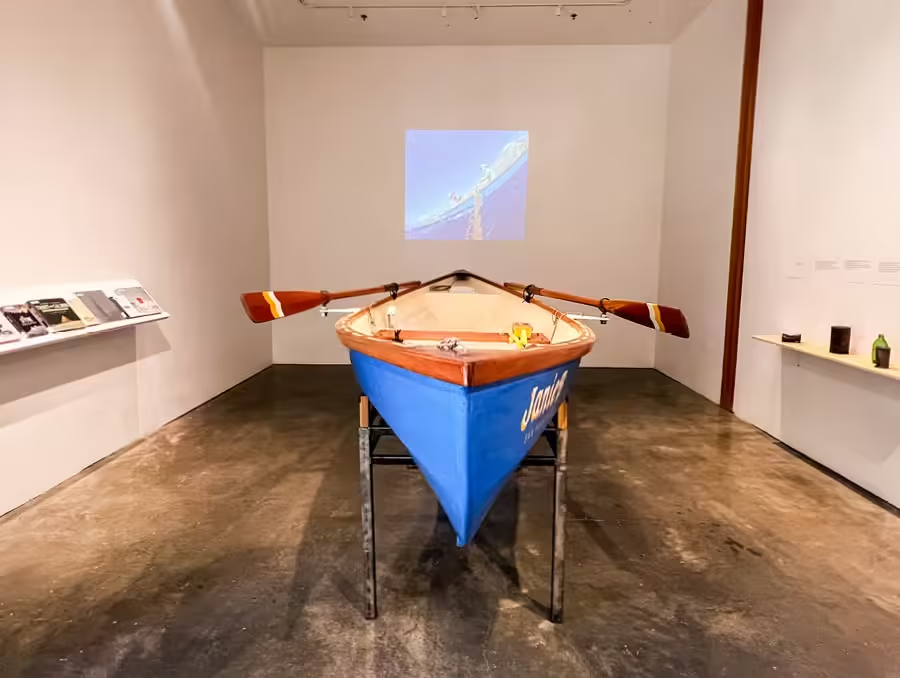

On the R/V Liberty, the University’s research vessel, an artist and scientist collect data side by side to collaborate on an experimental exhibition at the University of Nevada at Lake Tahoe. The exhibit, which makes up only a piece of the annual Tahoe Art-Science Co-Labis part of an effort to bridge science and art and push the boundaries of what sustainability research and discovery can look like. This fall, artist Lawrence LaBianca from California College of the Arts and scientist Rene Henery, California science director at Trout Unlimited, are working through the Tahoe Co-Lab to collaboratively explore themes of place and space at Lake Tahoe.
There are two iterations of this collaboration. First, the collaborators visited the Lake Tahoe campus to collectively research and brainstorm for their shared exhibition. The Tahoe Gallery in Prim Library was then activated as a studio, lab and research space. In the second iteration of the collaboration, the final exhibition is installed in the gallery and there is a collaborative lecture.
The art-science connection
The Tahoe Co-Lab is a semester-long, experimental, collaborative research residency situated within the Lake Tahoe Basin and hosted by the University of Nevada at Lake Tahoe. The Co-Lab positions the Tahoe Gallery as an active site of interdisciplinary inquiry, where artistic and scientific practices intersect: for scientists, collaboration with artists provides alternative modes of inquiry and communication, expanding how research is visualized, interpreted and shared with broader publics, and for artists, access to scientific data, methodologies and fieldwork enables deeper engagement with environmental systems and expands the conceptual and material scope of their practice.
Most importantly, for the broader community, the Co-Lab increases access to complex environmental research through experiential and interdisciplinary presentations. By translating scientific knowledge into accessible and affective forms, the program fosters public awareness, dialogue, and connection to the Tahoe Basin.
A day on the lake
To gather inspiration and data, LaBianca and Henery spent a day with Tahoe Institute for Global Sustainability faculty members Sudeep Chandra, Katie Senft, and Eli Everest who were collecting data around Tahoe for the Tahoe Environmental Observatory Network (TEON). Everest, in scuba gear, cleaned the sensors and retrieved data for TEON while LaBianca and Henery collected their own data using an invented tool called a “fishing guitar,” and an acrylic lens designed to gather water from the middle of the lake.
In an interview with Chris Lanierteaching assistant professor in Interdisciplinary Art at the University of Nevada at Lake Tahoe, LaBianca and Henery discussed the nature of water, the ways artists and scientists use and modify tools, and the ways tools of investigation offer, in their use, portals to heightened experiences.
Lanier: Let’s start with what you did today – going out on the boat, what you collected, the types of equipment that you used to collect it, and unpack what we did this morning.
LaBianca: We had a couple conversations before meeting each other. I drafted some sketches and journal entries about my thoughts, and where it could go – maybe some book recommendations. And Rene looked at those and then responded. One of his responses, one of the conversations we had, drew me to this one sketch of looking through the lake at each other – a duality theme. So, one of the things we brought out there was this acrylic lens that we filled with the lake water today. That’s something we’ll start working with. It’s an opportunity for us to look at something together, and see where a scientist and an artist might go.
Henery: Lawrence made this really simple but really cool instrument that he graciously invited my daughter to name – and she named it the fishing guitar. It’s a tool for capturing resonance in a medium. And in a very core sense, that’s what we’ve been up to – moving between these different mediums, the mediums of water and air and landscape, and also the mediums of different people, different perspectives on the world, different interests, different desires to engage with us and be part of what’s going on. We’re just keeping that rolling. I’ve been appreciating how little difference there is between this thing we’ve been doing together and any sort of field work I’ve done. There’s a part of it that’s just an excuse to get out there and observe things deeply together.
Source: www.unr.edu