
China has ambitious plans to become the leader in the global race for artificial intelligence (AI). Beijing is aware that the country needs cutting-edge chips to achieve this goal.
Vice Premier Ding Xuexiang, who chairs the Communist Party’s Commission on Science and Technology, has been tasked with strengthening China’s capacity for technological innovation, which would enhance its strategic competitiveness against the United States.
The party is currently using AI to monitor citizens, develop advanced unmanned weapons systems, and transform economic sectors through robotics and industrial automation, among other things.
But the US has so far been leading the way in manufacturing technology and chip design. And Washington has taken a slew of measures to retain its dominance in this strategic sector.
US moves to restrict China’s access to chips
As early as 2023, the then Biden administration decided to restrict the export of advanced semiconductors and chip manufacturing equipment to China, citing national security reasons.
Beijing slammed the US restrictions, calling them “unilateral and arbitrary.”
US chipmakers, however, have been drawn to China’s vast and rapidly growing market.
Jensen Huang, who resigned as CEO of the American AI chip manufacturer Nvidia last weekenjoyed something of a rock star status in China. The 63-year-old, who was born in Taiwan, is viewed in China as a successful entrepreneur.
Huang, who has emerged as a key adviser on AI to US President Donald Trumpduring his second term, has pushed for looser regulations and fewer restrictions on selling AI chips to China.
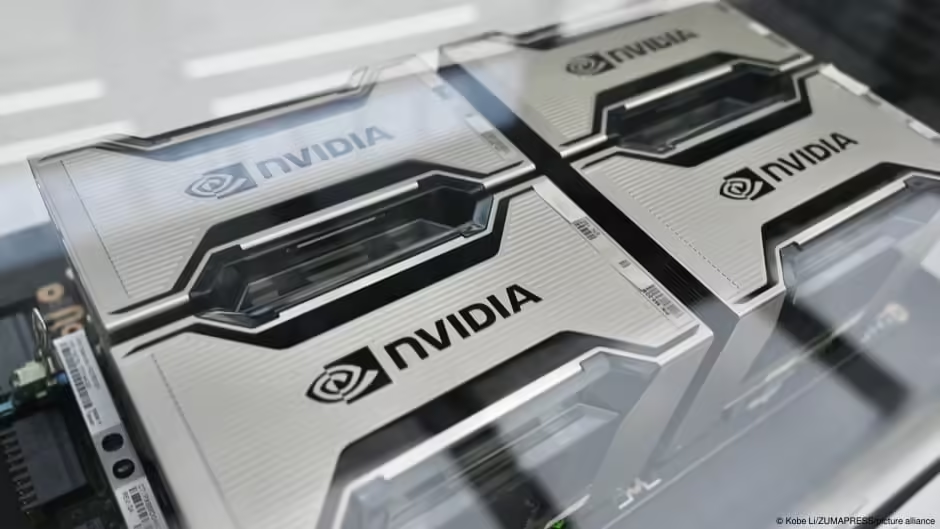
In December, the Trump administration granted Nvidia permission to ship its H200 chips to China, provided the US got a 25% cut of sales.
Although the H200 is not part of Nvidia’s highest-performance seriesit is significantly more efficient than competing Chinese products.
Each of these chips carries a hefty $27,000 (€24,000) price tag, and Nvidia estimates demand in China at 2 million units, which corresponds to sales of approximately $5.4 billion from this product alone.
Nvidia affair and espionage allegations
But Huang resigned last week following revelations of extramarital relationshipsincluding one involving a businesswoman suspected by the US of spying for Beijing.
The scandal not only sent shockwaves through the global AI and semiconductor industries, but also fueled highly contentious political debates in China and the US.
Washington, which sees its national security threatened, is said to be planning further restrictions against China to close loopholes that allow Chinese firms to acquire advanced American semiconductors.
China, on the other hand, denied it engaged in an attempt to ensnare Huang, saying the spying allegations were unsubstantiated and a smear campaign against Beijing.
Beijing also stepped up its rhetoric ahead of the meeting between President Xi Jinping and Trump at this week’s Asia-Pacific Economic Cooperation (APEC) summit in the southern Chinese city of Shenzhen.
“China has consistently opposed the misuse of export control measures that jeopardize the stability of global industrial and supply chains, as this is not in the interest of either party,” Chinese Foreign Ministry spokesperson Mao Ning said on November 13.
Some Chinese media outlets have also criticized the reporting on the issue.
“Jensen Huang cheated on his wife. What does that have to do with China?” asked China’s state-run Global Times newspaper in an editorial.
It accused the US media of turning the affair into a “Hollywood thriller” but without providing the “hard evidence to back up the central allegations.”
Many Chinese have also taken to the microblogging and social media platform Weibo to comment on the controversy.
A user wrote that Huang’s downfall was, in essence, “the result of political maneuvering within the United States,” while another user asked: “Could a love affair really cause Mr. Huang to resign? Isn’t this plot a little too melodramatic?”
Behind the verbal sparring lies an economic calculation.
Is China buying more US chips?
Ding, the Chinese vice premier, has to decide whether China should continue to rely on US chips or back its domestic industry in the hope that it can achieve the breakthrough needed to surpass American competitors.
Around 600,000 Nvidia H200 chips, for instance, are currently sitting in Hong Kong, awaiting Chinese import approval.
The White House has already given the green light, but Beijing has yet to approve the imports.
For Karson Elmgren, research manager at the Institute for AI Policy and Strategy in Washington, that is puzzling. “To me, this suggests that China does not view short-term advantages as decisive and is confident in its ability to replace US chips over the medium term.”
Chinese AI products are also increasingly using “Made in China” chips.
“This effectively mitigates the risks of cyberattacks by foreign actors,” wrote Tiantian Wang of the Harbin Institute of Technology in a recent study on China’s semiconductor strategy.
This is the case not only to civilian sectors. “Against the backdrop of the current complex geopolitical situation, strengthening autonomy and control over national defense and critical infrastructure has become a core element of the national security strategy,” Wang explained.
According to her, for example, the radar systems in China’s fifth-generation Chengdu J-20 fighter jet and in the Dongfeng-41 intercontinental ballistic missile are equipped exclusively with Chinese chips.
China is increasingly focused on autonomous AI chip platforms developed domestically, Wang underscored.
“This has created a closed ecosystem that encompasses data, algorithms, computing power, and chips, thereby reducing systemic dependence on foreign chips such as Nvidia,” she added.
China lacks advanced chip-making equipment
However, China still lacks production equipment for state-of-the-art chips.
Chip manufacturing requires lithography systems that expose raw silicon materials to ultraviolet light.
Bowing to pressure from Washington, the Dutch maker of lithography machines, ASML, has stopped exporting its most advanced machines to China.
The ban helps secure the US’s technological lead in AI chips, said the Center for Technology & Statecraft, a Washington-based think tank. If China were to import additional ASML systems like it did in 2024 and 2025, “its annual production could be sufficient to wipe out much of the US lead and, under certain scenarios, even surpass it.”
According to the international consulting firm Deloitte, China is planning further extensive investments. “The focus is on supporting companies through long-term capital provision and research-oriented incentives to build sustainable innovation in key technologies.”
Policymakers aim to stabilize the entire supply chain, expand self-sufficiency, and actively manage risks, the study noted. “The focus is shifting from supporting individual companies to fostering synergies within the supply chain, establishing quality systems, and ensuring the secure management of critical resources in order to promote the development of a more resilient industrial organizational structure.”
This article was originally published in German.
Source: www.dw.com