

Foreword
We have reached a moment where decisive, system-wide action is needed to close the evidence gap for women across the healthcare system. Small scale isolated efforts will not be sufficient.
Women make up 51% of the population, yet the evidence base that underpins medicines, medical devices and healthcare technologies too often does not reflect women’s lives, bodies or needs. Fewer than 1% of UK clinical trials include pregnant women, only 33% of trials approved from 2019 to 2023 included women of childbearing potential, and women continue to experience differential outcomes in safety, effectiveness and adverse events. These are system-level evidence gaps that shape access, confidence and outcomes across a woman’s life course.
The MHRA’s Women’s Health Programme is our commitment to help change this unacceptable position in the name of equality. As the UK regulator of medicines and medical devices, we have a powerful opportunity to shape the evidence that is generated, the standards that are expected, the innovations that reach patients, and the information that supports decisions in clinical practice. Our ambition is not simply to identify sex-based differences after they have emerged, but to embed women’s health into the way healthcare products are developed, assessed, monitored and communicated from the outset.
This is also a major opportunity for the UK as a whole. Closing the women’s health gap could add at least £36 billion annually to the UK economy by 2040, while the UK FemTech sector is rapidly growing, with an annual turnover of nearly £300 million, and £544 million of investment.
By supporting proportionate innovation, strengthening sex-specific evidence and enabling clearer information for women and healthcare professionals, the MHRA can play its part in unlocking this potential while maintaining the highest standards of safety, quality and effectiveness.
Our vision is for a regulatory system that supports equality, actively reduces avoidable evidence gaps, supports innovation where women’s needs remain unmet, and gives women the confidence that healthcare products have been developed and monitored with them in mind. Through this programme, we will work across the UK health system and with international partners to drive lasting improvements in women’s health, reduce inequalities and help set a new benchmark for regulatory leadership in this field.
Lawrence Tallon, Chief Executive, MHRA
Executive summary
Women do not always experience the same health outcomes as men, and in some areas their health needs have been overlooked. Addressing these inequalities requires action across the healthcare system, and the MHRA has an important role to play in addressing health inequalities between men and women. This includes ensuring that women have access to safe and effective healthcare products that meet their needs throughout their lifetime. It is also important that any differences in outcomes between men and women are identified and communicated to improve treatment decision making and increase health equity.
The MHRA is launching this Women’s Health Programme to:
support innovation in women’s health technology and medicines, so women’s health needs are met
improve the information women have on the healthcare products they use throughout their lives
strengthen evidence generation and monitoring of healthcare products so any differences in safety and effectiveness between men and women can be identified and addressed
continually engage and listen to women so their needs and experiences can inform our regulatory decisions and activity
Through this programme, the MHRA will use its regulatory remit to help improve health outcomes for women and support informed treatment decisions, enabling women to have confidence in the healthcare products they use throughout their lives.
Introduction
The MHRA operates at the intersection of science, regulation and patient impact. We enable the health system across all four UK nations to translate innovation into better outcomes.
Our role is to protect and improve public health by ensuring that people across the UK can rely on and trust in the safety, quality and effectiveness of the medicines and healthcare products they use. The MHRA has long been recognised internationally for its scientific excellence, pragmatism and leadership of global regulatory policy.
Our Strategy to 2030 sets out how to deliver health and prosperity for all, through scientific excellence. One of our strategic priorities within this strategy is to deliver proactive regulation to address evidence gaps and reduce inequalities.
The MHRA is an integral part of a wider healthcare system that is committed to reducing health inequalities, including the Department of Health and Social Care’s Women’s Health Strategy which has recently been renewed and the Women’s Health Plan: Phase Two from the Scottish Government. As a sovereign regulator, we are in a position to drive widespread change globally.
It is widely recognised that there are sex-based health inequalities and areas of unmet clinical need in women’s health that impact a significant proportion of the population. We also recognise there are a range of health inequalities in the UK that need addressing. This Women’s Health Programme sits in a wider framework within the MHRA which is considering where the regulator can tackle the spectrum of health inequalities.
The MHRA is committed to reducing health inequalities within our regulatory remit across the UK and this programme identifies a range of regulatory levers to deliver change for women across the healthcare product lifecycle.
The programme aims to increase women’s trust and confidence in the medical products they use throughout their lives. It considers diverse needs and ensures that women have appropriate access to tailored information for informed treatment decision making.
The programme encourages innovation in women’s health and addresses differential outcomes between men and women when using healthcare products, without unduly increasing regulatory burden or hampering access.
We have actively engaged with patients, the public, and wider stakeholders to shape the Women’s Health Programme. The programme’s iterative production with stakeholders, including co-designing the key themes with patients, is to ensure that the programme outcomes are aligned with their needs. We recognise that ongoing patient involvement in the implementation of the programme, alongside robust evaluation of the activities, is essential to ensure impacts are realised and to help inform future activities to address health inequalities.
Blending enhanced data methodologies, regulatory innovation and cross system working will enable us to take an ambitious approach to tackling sex-based health inequalities.
The problem statement
Women’s health is a wide-ranging topic, however, it has historically focused on reproductive concerns such as pregnancy, menstrual issues and menopause. While these are important factors in women’s health, a broader focus is required on improving women’s health throughout their life course and addressing areas of significant unmet medical need.
Despite women making up 51% of the population, there remain common conditions for women that lack adequate treatment options and are under researched. Women also need a clear understanding of the performance and safety of medical products to support informed treatment decisions, particularly where medical product development has previously focused on the male body.
Our published data within the UK clinical trials ecosystem indicates less than 1% of clinical trials include pregnant women, while only 33% of all clinical trials approved in the 2019 to 2023 period included women of childbearing potential, with limited inclusion of women in early phase studies where dose is often determined. In the post-market phase, adverse events disproportionately affect women, and it remains unclear whether this reflects a genuine susceptibility. However, there is a wealth of published data demonstrating worsening outcomes for women when compared to men on tolerance, effectiveness and adverse events. This is potentially related to a lack of consideration of the biological differences between men and women, not just in medicine development, but also for medical devices, including software and AI as a medical device., , ,
These data and care gaps represent untapped potential in the market for improving women’s health, where meaningful benefits could be realised for both industry and women themselves. A recent report identified that closing the gap in health outcomes between women and men in the UK could add at least £36 billion annually to the UK economy by 2040. This demonstrates that women’s health is currently one of the largest health-related economic opportunities for the UK. Further to this, a 2026 industry report identified that in the UK the FemTech industry has an annual turnover of nearly £300 million and has received £544m of investment, with the sector growing by 2.7% per year.
The MHRA has an important role to play in enabling this growth and supporting access to safe and effective healthcare products for women.
We have proposed an ambitious plan to tackle these problems, supporting a cross-government drive to tackle health inequalities and enable innovation to meet unmet needs for women. We are committed to delivering regulatory leadership in this area and driving forward scientific and regulatory innovation to enact change. This programme is designed to accelerate progress towards better health outcomes for women at every stage in their lives.
Context
Our definition of women’s health
Women’s health has typically been viewed as reproductive health. However, women’s health needs are much wider than this and inequalities exist in health outcomes between men and women across a wide range of conditions and due to a range of factors, with women spending more years of their lives in poor health than men.
The Women’s Health Programme takes a comprehensive view of women’s health that encompasses conditions that affect women exclusively, including reproductive conditions, conditions that affect women disproportionately (occur at a higher rate in women compared to men) such as myalgic encephalomyelitis or chronic fatigue syndrome (ME/CFS), and conditions that affect women differently, such as cardiovascular disease.
We are embedding a life course approach to women’s health. The programme will address the full range of women’s health needs throughout their lives and the medical products they may use along the way. It will deliver an inclusive programme that reflects and responds to the needs of all women.
Intersectionality in women’s health outcomes
It is acknowledged that drivers for health inequalities can be overlapping, including sex, gender, race, class and disability, and this can lead to different outcomes for groups with specific combinations of factors impacting health. It is also known that women often experience intersecting disparities.
While this programme is focused on women’s health, it sits within a broader approach being developed within the MHRA to address health inequalities, which will consider the intersectional nature of a range of characteristics that can impact health outcomes and health inequalities. The Women’s Health Programme feeds into this wider context and will help inform and develop approaches that may be utilised for addressing other issues related to health inequalities.
The programme identifies regulatory levers to address sex-based health inequalities throughout the healthcare product life cycle. This means we are looking right across our regulatory remit, including initial product development and clinical trials, authorisation and market access, and post-market usage in the “real world” and ongoing monitoring of differences in outcomes. Our regulatory processes affect many areas where we can have a positive impact in addressing these inequalities between men and women where they arise.
Considerations of sex and gender
The Women’s Health Programme focuses largely on sex-based differences in outcomes to medical products, due to the nature of the data the MHRA typically utilises in our regulatory functions. However, we acknowledge that gender also plays an important role in health outcomes, and men and women may receive different treatment which impacts their outcomes.
This programme does not preclude considering the impact of gender and will address this wherever this is possible within the data available and our remit as the UK regulator of medicines and healthcare products. Gender is also part of our broader consideration of addressing health inequalities.
We acknowledge that the terms “sex” and “gender” can be used in different ways in different contexts. With respect to the Women’s Health Programme, sex refers to biological characteristics, and gender relates to aspects of a person’s identity. The programme focuses on inequalities affecting women, while recognising that some of these inequalities may affect others and that its benefits may extend beyond women.
Strategic themes for delivering our ambitions
The programme has four strategic themes to address our overall objective of improving health outcomes for women through our regulatory remit and as part of the wider health ecosystem.
Theme 1: utilising data to improve health outcomes for women
A core ambition of the Women’s Health Programme is to transform how the MHRA utilises data to generate sex-specific evidence across the entire healthcare product lifecycle.
Central to this is a stratified approach to real-world data (RWD) and the adoption of advanced analytical methods that enable identification of differences in outcomes to healthcare products between women and men from a range of data sources. This is particularly important given the historic underrepresentation of women in early-phase studies and the evidence demonstrating disproportionate adverse events among women in the post-market environment.
The MHRA intends to expand the analytical toolkit available for characterising differential outcomes, including patient-reported outcome measures (PROMs) and patient-reported experience measures (PREMs). Emerging modelling techniques and use of synthetic data provide new opportunities to identify where differential outcomes exist for women, particularly in exploratory or data-poor contexts, with careful consideration of the risk of potential bias propagation. These developments, supported by artificial intelligence (AI), will strengthen and scale advanced analytical approaches in routine regulatory practice, subject to appropriate validation and governance frameworks. Our approach will position the UK as one of the global leaders in tackling sex-based health inequalities.
Improving outcomes for women also requires systematic consideration of sex-disaggregated evidence at every stage in the regulation of medical products, and for the development programmes of medical products to reflect the intended target populations. A key objective of the programme is to meaningfully incorporate data disaggregated by sex into regulatory assessments across the product lifecycle. Where applicable, this will enable greater sex-based information to be included in the product information for healthcare products and help inform treatment decisions.
Together, these approaches will create a regulatory framework where the evaluation of sex specific data is embedded across the product lifecycle. This will enable the early and ongoing identification of differential outcomes in women driving a more stratified approach to healthcare.
To deliver theme 1 we will identify specific products where there is a lack of evidence for women regarding efficacy and safety at the point of market access by:
- identifying gaps across key therapeutic areas and within specific populations that are often underrepresented or excluded, including pregnant and breastfeeding women, women of reproductive potential, and older women
- identifying, characterising and utilising sources of real-world data for medicines and medical devices, including PROMs, to fill these evidence gaps on safety and effectiveness
- defining how data sources and novel analytical approaches can be used to support regulatory decision-making in products used throughout the course of women’s lives, in conjunction with broader MHRA data strategies and aligned with international frameworks
We will also:
- support collaborative and improved evidence generation in women’s health through partnership with NHS organisations, academia, and data custodians
- seek the accurate reflection of target populations in development programmes, from pre-clinical through to clinical studies
We will also ensure the consideration and evaluation of sex differences in safety and efficacy throughout the product lifecycles of medical products by:
- establishing a consistent process for the submission of sex-disaggregated data across the product lifecycle
- introducing appropriate systems, guidance and training to evaluate and monitor sex-based differences across pre- and post-authorisation phases
- applying sex-disaggregated and real-world data-based approaches consistently across regulatory activities, developing internal capability in epidemiology, data science and advanced analytics, supported by training, guidance and tools
Theme 2: innovation and quality for healthcare products for women
We have an important role to play in ensuring that innovation is supported to address the currently unmet clinical needs of women. The Women’s Health Programme aims to support effective, proportionate regulation of medical devices in the “FemTech” sector, which relates to technologies targeting the health and wellbeing of women. This will seek to ensure that innovation thrives whilst maintaining appropriate standards of quality, safety, and compliance.
We will take an ambitious approach to addressing unmet clinical needs by using existing regulatory pathways to close gaps in women’s health. This includes defining how frameworks for priority areas of regulatory interest can stimulate product development and generate evidence that directly addresses gaps in women’s health.
These activities will create a supportive regulatory environment that actively guides innovation, strengthens evidence generation and focuses development on improving outcomes for women throughout life.
To deliver theme 2 we will support effective development, access and compliance for FemTech and related women’s health technologies by developing clear regulatory frameworks, underpinned by internal and external guidance.
We will also address unmet clinical need in women’s health and enable greater use of regulatory pathways by:
- establishing use cases for existing regulatory pathways
- identifying remaining barriers to access and how these can be overcome
We will also stimulate innovation in priority areas of unmet need for women by:
- defining clear strategic priorities through publishing topics of regulatory interest to encourage early engagement
- identifying where regulatory advice and support can enable cross-system collaboration
Theme 3: enabling informed treatment decision making for pregnant and breastfeeding women
It is well recognised that pregnant and breastfeeding women remain routinely excluded from clinical development, with fewer than 1% of trials approved in the UK including pregnant and breastfeeding women. This results in significant evidence gaps and potential barriers to safe and effective treatment with medical products.
These data gaps subsequently impact the confidence pregnant and breastfeeding women have in treatment decision making during these important phases of their lives. This can lead to unnecessary rejection or discontinuation of potentially important treatments, significantly impacting both mother and child.
A key objective of the Women’s Health Programme is to enhance evidence generation across preclinical research, clinical trials and investigations, and post-marketing surveillance, to support more informed regulatory and clinical decision making on the use of medical products in these populations. This includes introducing further guidance for industry and researchers, developing innovative regulatory pathways to encourage further characterisation of the safety profiles of healthcare products in pregnancy and breastfeeding, and improving the use of existing regulatory tools to better characterise outcomes in pregnant and breastfeeding women where evidence is limited. We will also work with stakeholders across the healthcare system to support research and innovation to address evidence gaps and unmet clinical need.
The programme aims to ensure that product information better reflects available evidence to remove barriers to appropriate use and ensure available evidence is reflected in product information leaflets, thus reducing long-standing inequities in information and access for pregnant and breastfeeding women. The MHRA will explore methods of increasing patient and healthcare professional awareness of this important information to help inform treatment decisions.
To deliver theme 3 we will:
- pilot innovative approaches to evidence generation in pregnancy and breastfeeding using priority products, applying a totality-of-evidence framework, including real-world data, to identify scalable solutions to fill evidence gaps
- develop and promote clear regulatory guidance to support the consideration and inclusion of pregnant and breastfeeding women in pre-clinical and clinical development, aligned with international frameworks and embedded across regulatory processes
- characterise and test new regulatory approaches to incentivise evidence generation where this is lacking in pregnancy and breastfeeding exposure at the time of approval
- strengthen the use of existing regulatory tools to address evidence gaps which remain following authorisation, including enhanced use of risk management plans and vigilance activities
- strengthen the communication of risks and benefits for medical products used in pregnancy and breastfeeding including clearer incorporation of data into product information to support informed decision-making.
Theme 4: increasing agency reach and impact in women’s health
To maximise its impact, the MHRA must not only identify sex-based differences but also communicate them effectively and work collaboratively across the health system to effect change.
The Women’s Health Programme will establish clear, robust guidance to support communication of sex-specific outcomes, so that these findings can be translated into meaningful improvements in treatment decision making, public awareness, and safe and effective product use.
These communications will be accessible and inclusive to ensure appropriate messaging is delivered and able to have impact. Wherever possible, this information will be developed with relevant patient and public representatives from diverse backgrounds including those from underrepresented and underserved communities. Improved communication of any identified sex-based differences in outcomes will allow for more informed consultations with healthcare providers and increase public confidence in treatment decisions.
In parallel, we aim to strengthen our position in addressing sex-based health inequalities and play a visible role nationally and internationally in improving women’s health. This includes cross-sector engagement within the UK health system and working with global regulatory partners, to support a coherent and influential approach to women’s health.
To deliver theme 4 we will:
- develop and publish clear and consistent guidance internally and externally for communicating sex-based differences in outcomes for medical products, to support understanding and uptake of the information by patients and healthcare professionals
- design and establish frameworks for cross-sector collaboration to address sex-based health inequalities, strengthening our role within the national health system and with key partners
- position the MHRA to drive best practice in women’s health across the medicine and healthcare product regulatory landscape, and enhance the visibility and impact of our work on sex-based differences in health outcomes
Patient and public engagement
We actively engaged with patients and the public to shape the Women’s Health Programme, focusing on the core themes of the programme to ensure they are relevant to women and informed by their lived experiences. These engagement activities sought the views of women from across all four nations of the UK and from people with a range of demographic backgrounds.
The feedback highlighted the diversity of women in the UK and the range of factors that can impact how healthcare products work. This has been incorporated further as part of the agency’s health equity initiatives.
Patients welcomed the programme’s focus on addressing unmet clinical needs, improving evidence generation for women and having appropriate evidence and information on how products might work differently for women. This will enable supported informed treatment decision making, including in products used during pregnancy and breastfeeding. Patients felt that the actions of the programme would improve health outcomes for women and reduce health inequalities.
Table 1. Key insights from public and patient engagement on the Women’s Health Programme and how the MHRA responded to them
| Theme | What we heard | How we responded |
|---|---|---|
| Diversity and intersectionality in the Women’s Health Programme | Patient feedback highlighted the diversity of women in the UK, and the wide range of factors that can affect how healthcare products work, and that this should be reflected in the programme, including consideration of intersectionality | We have emphasised how the programme sits within broader MHRA health equity initiatives and committed to further exploring how intersectionality can be addressed as this work develops |
| Sex-based differences in outcomes for product information | Patients felt that the product information for healthcare products in the UK should have information on sex-based differences in outcomes, where evidence is available | This has been incorporated into Theme 1 to produce guidance and workflows that strengthen how sex-based data are considered within regulatory assessments and, where appropriate, reflected in product information |
| Equality of access to clinical trials for women | Patients wanted the programme to advocate for equality of access to clinical trials for women, including those from marginalised and underserved communities | We have highlighted existing MHRA work to improve inclusion in clinical trials and reinforced our commitment to go further in supporting equality of access for women, including those from underserved groups |
| Prioritising underserved groups, including pregnant and breastfeeding women | Patients wanted to ensure that the needs of underserved groups who often have limited treatment options, including pregnant and breastfeeding women, were given greater priority, with stronger collaboration across the healthcare system | We revised two themes – “Innovation and quality for healthcare products for women” and “Enabling informed treatment decision making for pregnant and breastfeeding women” – to place greater emphasis on unmet need, evidence generation, innovation and collaboration across stakeholders, and to incorporate the need to increase awareness of this information when published by the MHRA |
| Ongoing, inclusive engagement with women | Patients highlighted how important it was for the MHRA to continue to work with a wide range of women throughout the implementation of the programme | We have included a clear commitment within the programme to ongoing engagement, ensuring continued involvement of women from diverse, underserved and underrepresented backgrounds, and enabling a variety of ways for people to take part |
Ongoing engagement with patients and the public will be essential for delivery of the themes of the programme. We will continue to work with relevant groups on the implementation of the programme objectives as well as part of the evaluation of the outputs and outcomes from the programme. This engagement will be conducted through a variety of methods to allow a range of opportunities for patients and the public to participate and to ensure accessibility of input to all.
UK health system alignment
Through our role in ensuring safe access to medical products in the UK, we are uniquely placed to contribute to the delivery of the priorities in women’s health across the country and help drive towards equitable health outcomes for women.
The Department of Health and Social Care published a 10-year Women’s Health Strategy for England (WHS) in 2022, and a renewal of this strategy was published in April 2026.1 We are working alongside the Department to support and align work within our programme with the renewed Women’s Health Strategy for England.
Further to this, Phase Two of the Scottish Government’s Women’s Health Plan has been launched, and the Women’s Health Plan for Wales is currently under implementation, with the Women’s Health Action Plan in Northern Ireland currently under development.
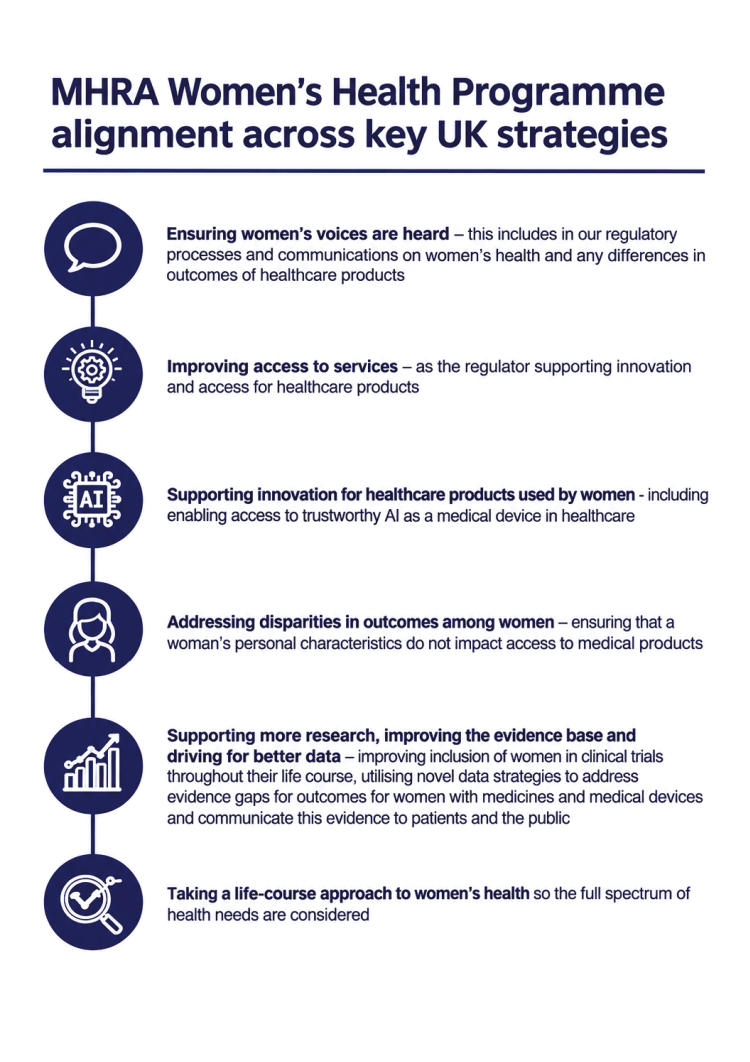
The MHRA’s Women’s Health Programme has been developed to ensure women’s unmet clinical needs are addressed. This includes priority areas identified in corresponding government strategies, spanning reproductive health needs, such as menopause, endometriosis, fertility and menstrual health, in addition to conditions across the life course, including cancer and healthy ageing.
We are positioned to support personalised care and shared informed decision making, enabling this to be at the heart of women’s experiences in the healthcare system.
We have strong alignment across the UK health system in taking a life course approach to addressing women’s health and considering the wide range of health needs for women. We already have projects underway in the UK with healthcare system partners, such as the joint pilot with the Health Research Authority, which aims to ensure appropriate diversity and inclusion in research so that those previously underserved and overlooked in research, including women, are involved in studies.
The MHRA’s programme is well aligned with broader health strategies in the UK, including the 10-Year Health Plan for England, which sets out a data-driven approach to enabling effective use of digital health and AI, improving personalised medicine, focusing on prevention and refining clinical trials regulation.
Alignment with global objectives to address health inequalities
Global efforts to reduce health inequalities for women are accelerating, and the MHRA is well placed to shape this agenda through its regulatory expertise and international leadership.
The MHRA is actively contributing to a number of international approaches to increase representation and inclusion of women and other underrepresented groups in clinical trials and in the development of medical devices. This includes being part of the international organisation revising guidelines on inclusion of pregnant and breastfeeding women in clinical trials. The MHRA conducted a UK consultation on these revisions, and we are currently analysing the outcomes of this.
We are well positioned to support broader global activities to address health inequalities, working with a range of international partners across industry, regulatory peers, academia and global health initiatives. For example, the MHRA is part of the Research in Europe and Diversity Inclusion (READI) project, which aims to create a more inclusive ecosystem for clinical studies.
We have worked with global partners on projects to evaluate existing mathematical physiologically based pharmacokinetic (PBPK) models for their potential to support dosing in pregnant women and development of a policy paper by the World Economic Forum to set out policy recommendations for increasing research and evidence generation in women’s health. Initiatives such as these should lead to more informed use of medicines that meet the needs of women and the development of medicines that are safer for use in pregnancy.
Taking a data-driven approach to identifying differences in outcomes to medicines and medical devices between men and women is also aligned with approaches of other international regulators. These data driven approaches can be leveraged in the international sphere to improve the understanding of how these medical products work in women and how any differences can be best communicated to patients.
We will actively align with international approaches and our peer organisations globally throughout the implementation of the Women’s Health Programme and continually evaluate where we can drive global efforts to improve women’s health.
Delivery model for the Women’s Health Programme
The Women’s Health Programme has been produced following an extensive review of the women’s health landscape in the UK and internationally, and developed iteratively through a range of workshops, focus groups with patients and the public, and engagement with broader healthcare system partners.
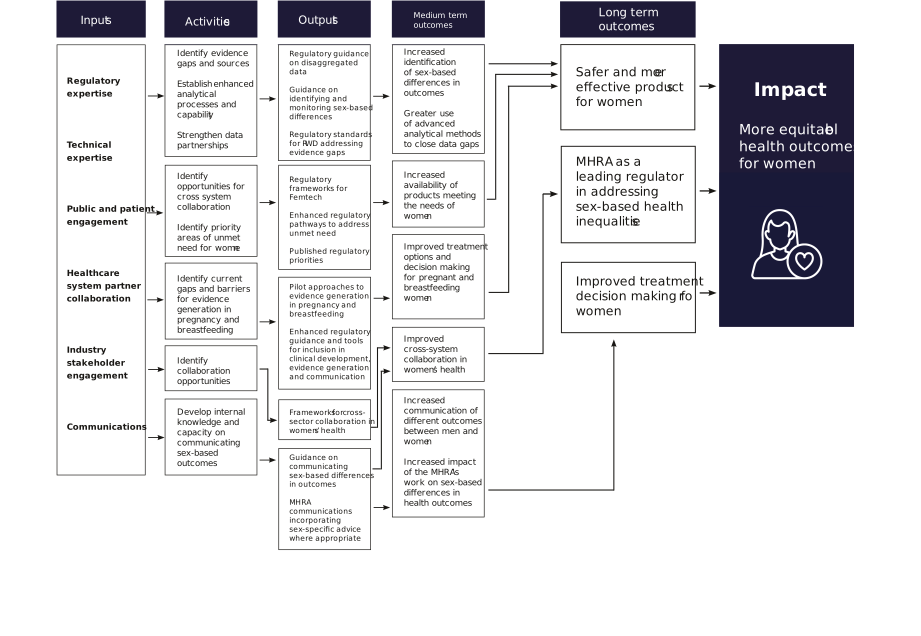
These outputs have been brought together into a logic model, applying theory of change concepts and co-designed with input across our regulatory functions. This logic model will inform the implementation and ongoing evaluation of the programme. This model maps the programme’s intended outcomes and impacts, as well as what activities and outputs required to achieve this.
Figure 1. Logic model for implementation of the Women’s Health Programme
Summary
Through the Women’s Health Programme, the MHRA is taking an ambitious regulatory approach to women’s health, ensuring that medical products are developed, assessed, and monitored in ways that recognise women’s diverse health needs across their life course. We will promote sex specific evidence being systematically considered, from product development and clinical trials through to post-market surveillance.
Through strengthened data use and application of novel methodologies, support for innovation in women’s health and engagement with patients and health system partners, the MHRA aims to address longstanding sex-based health inequalities without increasing regulatory burden or compromising scientific integrity. This will improve health outcomes for women across the UK and globally.
Source: www.gov.uk