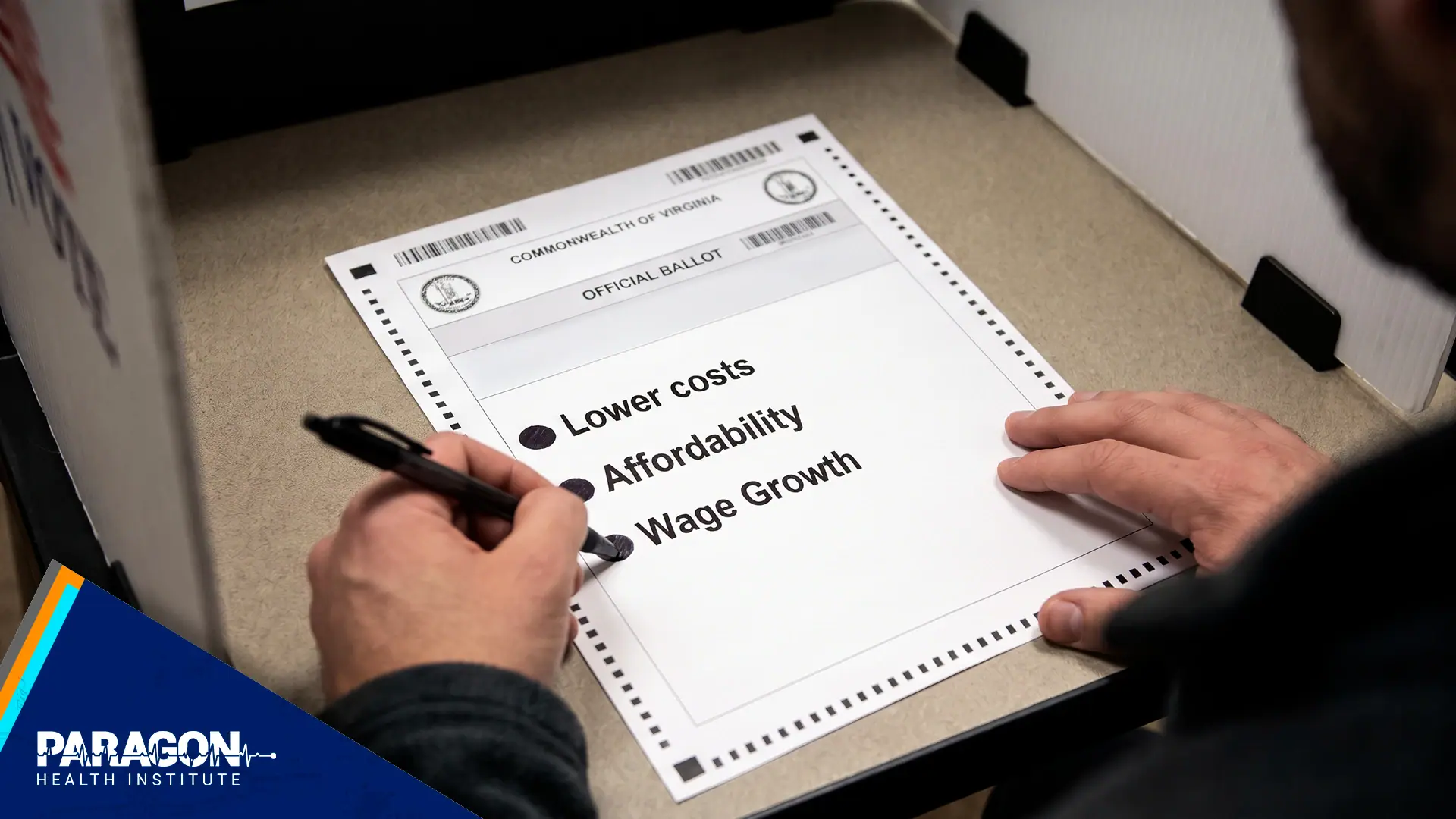

Last week’s election reinforced a message policymakers cannot ignore: Americans are deeply frustrated by the cost of living and a political system they believe too often serves powerful interests. Although only 8 percent of voters identified health care as their top issue, rising health care expenses strain household budgets and eat away at wage growth. Too often, government policies reward politically powerful health care institutions at the expense of hardworking American families.
Government policy is a major contributor to rising health care costs. Too many policies restrict consumer choice and competition, subsidize inefficient providers and insurers, and prop up an expensive status quo. Washington too often responds to rising costs by increasing subsidies without addressing the underlying incentives that drive prices higher. The better approach is to expand competition and choice, remove barriers to more affordable coverage and care, and ensure that public resources support patients rather than entrenched interests. As we head into 2027, Paragon will make health care affordability a major focus of our research and policy agenda.
This week’s newsletter examines several fronts in that fight: protecting taxpayers from phantom Obamacare enrollment, falling prescription drug prices, growing bipartisan momentum for price transparency, and the tax privileges enjoyed by hospitals.
The Fight Over Obamacare’s Phantom Enrollees
In a new National Review piece, I analyze the claims of more than a dozen Democratic senators who sent a letter to insurers accusing them of “colluding” with the Trump administration to terminate coverage for more than 760,000 Obamacare enrollees. As I explain, their criticism “gets insurers’ financial incentives backward and overlooks the extensive safeguards the Centers for Medicare and Medicaid Services (CMS) employed before terminating these highly suspicious enrollments.
“Insurers have little incentive to drop phantom enrollees. For years, insurers have been the biggest beneficiaries of the expanded Obamacare subsidies—reaping tens of billions of dollars in higher subsidies. By making millions of plans free to consumers, Democrats created powerful incentives for improper and phantom enrollment.”
CMS did not simply remove people because they had free coverage or had not used medical services. An enrollment was considered for cancellation only if it met all five criteria: 1) an agent or broker, rather than the consumer, submitted the application; 2) the application lacked a Social Security number or verifiable immigration identification number; 3) the federal subsidy covered the entire premium; 4) the enrollee had filed no medical claims; and 5) the insurer had no record of contact with the enrollee.
“Even then, insurers were required to attempt contact through two methods and provide 30 days to respond. Only after all these conditions were satisfied did CMS take action.”
Anyone removed in error can verify their identity and have coverage reinstated. According to CMS Administrator Dr. Mehmet Oz, fewer than 1 in 10,000 of the canceled enrollments have led to a phone call or outreach from a potentially real person.
The scale of improper and phantom enrollment was substantial. Paragon estimated 5.0 million improper enrollees in 2024 and 6.5 million in 2025. CMS later reported that 40 percent of enrollees in fully subsidized plans had no medical claims in 2024, and the Government Accountability Office enrolled 23 of 24 fictitious applicants in fully subsidized plans. Although the enhanced COVID-era subsidies expired after 2025, there were still more than six million sign-ups for zero-premium plans in 2026.
Following their election victories, Democrats have signaled plans to once again expand Obamacare subsidies. As I conclude:
“This is a very bad idea that will cost Americans tens of billions of dollars each year and lead to more improper and phantom enrollment. Congress should learn from the widespread fraud and improper enrollment that accompanied the subsidy expansion rather than repeat past mistakes.”
Prescription Drug Prices Are Falling
In a new City Journal article, “Drug Prices Are Finally Falling,” Dr. Joel Zinberg highlights encouraging developments in prescription drug affordability. According to the Consumer Price Index, prescription drug prices fell 4.5 percent over the past year—the largest year-over-year decline since 1963. Joel emphasizes the importance of competition and transparent pricing, citing research showing that prices decline by approximately one-third in the year the first generic competitor enters the market.
Bipartisan Momentum for Price Transparency
Price transparency is an area for bipartisan policymaking. In October, the Trump administration finalized changes to Transparency in Coverage requirements designed to make disclosed prices more standardized, accurate, and accessible while reducing unnecessary reporting burdens. Congress is also considering legislation to make price information more usable. Senators Roger Marshall and John Hickenlooper introduced the Patients Deserve Price Tags Act; House lawmakers have advanced the Lower Costs, More Transparency Act; and Representative Mariannette Miller-Meeks introduced the Prices on the Wall Act.
As I discussed in a 2019 Galen Institute report, price transparency is an important step toward a more competitive health care market. Usable pricing information can help patients shop for better value and enable employers to adopt cost-saving benefit designs. More consumers and employers using price information to shop for the best value will foster greater competition and force providers and insurers to become more efficient.
Questioning Hospitals’ Tax Privileges
Earlier this year, Paragon published a major research paper examining how government policies drive consolidation, undermine competition, and fuel soaring hospital prices. Most hospitals operate as tax-exempt nonprofits, yet many behave like aggressive commercial enterprises rather than the charitable institutions their tax exemptions are intended to support.
A new research paper from the Tax Foundation proposes options for reducing this privilege. Applying the 21 percent corporate income tax to the profits of the 287 health systems with over $1 billion in total revenue over the last three years would raise $147.6 billion over ten years. More targeted reforms—applying an excise tax on net investment income (modeled after the tax currently applied to universities’ investment income), ending tax-exempt bond financing, denying the charitable deduction for giving to hospitals, or recapturing tax benefits that exceed the “community benefits” defined by the IRS—would raise less revenue.
Paragon Visiting Fellow John R. Graham joined Andrew Lautz, who coauthored the Tax Foundation’s report, and several other experts for a briefing on Capitol Hill to discuss whether taxpayers are getting their money’s worth from this massive giveaway to hospitals.
Although Congress has not yet considered removing or reducing this privilege, the Ways and Means Committee did pass a bill to impose more stringent reporting requirements on hospitals that wish to remain exempt from federal corporate income taxes.
Source: paragoninstitute.org