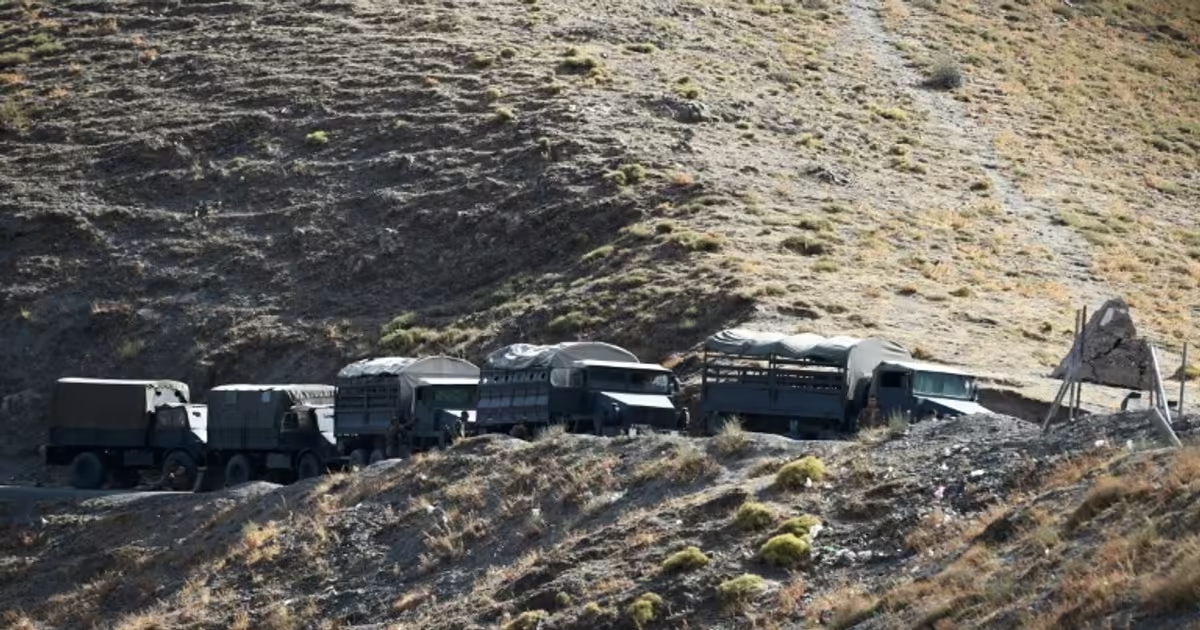

Currently, the first batch of the 50-man unit has arrived in Niger with a brief to help the country ward off terrorist attacks.
It is widely believed that terrorist threats, migration pressures originating from Mali, Russian military influence, and strategic competition over natural resources and energy routes all contribute to the complex regional landscape.
Algeria’s move to send its soldiers to Niger came on the 26th of October, when the North African country’s president, Abdelmadjid Tebboune, gave the go-ahead after parliament’s approval.
The measure got unanimous support from Algeria’s upper chamber, with all 148 senators voting in favor.
The approval came on October 30, when the first Algerian forces landed in Arlit, northern Niger, as seen on Defense24.
Algeria’s deployment is an uncommon military maneuver, with the last equivalent foreign troop commitment dating back to 1973, when its soldiers fought in the Arab-Israeli War.
This was not Algeria’s first military deployment to Niger this year.
In August, the North African country dispatched fighter planes to Niger in response to an attempt to destabilize the Niamey administration.
During the month, insurgent groups attacked Base 101 at Diori Hamani International Airport, one of the most strategically important military installations in the capital.
Gunfire and explosions were also reported around the presidential palace and Niger’s state broadcaster.
The attackers briefly gained control of parts of the airbase and attempted to expand the rebellion, but loyalist forces eventually pushed them back and restored control after nearly 24 hours of fighting.
Russian troops in the region helped Naimey gain control of the situation.
Algeria’s Ministry of National Defence said some weeks back that it had delivered four military helicopters to Niger, together with ammunition, spare parts, maintenance equipment and other logistical supplies to support the country’s armed forces.
The delivery consists of two Mi-24 SuperHinds attack helicopters and two Mi-171 transport helicopters, providing Niger with additional air support and transport capacity as its military continues to battle armed groups operating across the central Sahel.
Algeria has one of Africa’s largest stockpiles of Russian-made military equipment, and servicemen from Russia’s Africa Corps are stationed in the nation.
Although there is no evidence that Algerian and Russian soldiers are collaborating on a combined operation, their presence in the same nation underscores the growing overlap of their security objectives in the Sahel.
The new move underscores both countries’ resilient relationship, given that they both had a falling out last year, only reconciling at the start of the current year.
Algeria and Niger reconcile
The declaration came as Niger’s President, Abdourahamane Tchiani, arrived in Algiers for high-level discussions, generally viewed as the clearest indication that the two nations’ diplomatic tensions had subsided after an intense standoff.
Relations between Algeria and Mali deteriorated sharply in April 2025 after the two countries became embroiled in a dispute over the destruction of a Malian military drone.
Mali, which maintains close ties with Niger and Burkina Faso, accused Algeria of shooting down the drone.
Algiers, however, maintained that the drone had entered its airspace while flying on what it described as an aggressive trajectory. It said the incident was the third such airspace violation.
Mali rejected Algeria’s account, arguing that the drone wreckage was found about 9.5 kilometres south of the Algerian border.
According to Bamako, the aircraft was brought down sometime between March 31 and the first of April.
The disagreement quickly developed into a wider diplomatic dispute involving the three members of the Alliance of Sahel States, Mali, Niger and Burkina Faso.
All three countries withdrew their ambassadors from Algeria following the incident.
Source: africa.businessinsider.com