
Listen to this article
Estimated 5 minutes
The audio version of this article is generated by AI-based technology. Mispronunciations can occur. We are working with our partners to continually review and improve the results.
Delays at Toronto Pearson International Airport may continue Friday night despite an order that grounded all planes in the U.S. was lifted, NAV Canada says.
In a social media post on X on Friday night, NAV Canada, the non-profit overseeing the country’s air traffic controllers, said it will continue to keep “air traffic moving safely and efficiently” in Canadian airspace.
“Some delays may continue while operations return to normal and backlogs are cleared. Passengers are encouraged to check the status of their flight with their airline,” the non-profit said.
The U.S. Federal Aviation Administration (FAA) issued a ground stop on Friday afternoon due to communications problems at regional air traffic control centres. The ground stop was lifted shortly before 9 p.m.
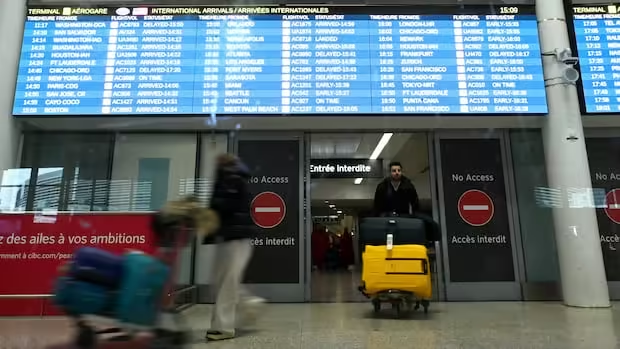
Toronto Pearson Airport said it suspended flights to and from the U.S. on Friday after the ground stop was issued. It caused confusion at Pearson, with at least one passenger saying the situation left her frightened.
Earlier, NAV Canada had said it had implemented traffic management measures at Toronto Pearson, Montréal Trudeau, Calgary and Vancouver airports to manage traffic safely and was closely monitoring the ground stop.
But shortly after 6 p.m., it posted that the traffic management measures put in place were lifted.
In a statement Friday afternoon, Pearson said scheduled U.S.-bound departures and arrivals were not proceeding. It advised passengers to check directly with their airlines for the latest flight information before heading to the airport.
Billy Bishop Toronto City Airport, meanwhile, also advised its passengers to contact their airlines directly for the latest information on flight status, delays and cancellations. It said it didn’t anticipate receiving any diverted flights from the U.S. Friday evening.

The U.S. Federal Aviation Administration has lifted a ground stop it issued Friday evening. (Ryan Mahle/CBC)
Federal Transport Minister Steven McKinnon had said in a social media post on X that the federal government was “monitoring the situation closely” and remained in contact with NAV Canada.
“While Canadian systems are operating normally, travel to the United States may be disrupted as a result of the ground stops,” McKinnon said. “We will continue to monitor developments as the situation evolves and remain in contact with the relevant authorities.”
In an email, John C. Munro Hamilton International Airport had said: “At this time, there are no impacts to operations at Hamilton International and flights are operating as scheduled.”
‘It’s a major, major disruption,’ aviation expert says
John Gradek, an operations and integrated aviation management professor at McGill University, told CBC Radio’s Here and Now on Friday that communications problems mean that airplanes have to land as soon as possible.
“If there is no communication between the air traffic controllers and the airlines, we have accidents that could possibly happen,” Gradek said.
Gradek said these kind of communications problems are not supposed to happen because there are backup systems in place.

The Federal Aviation Administration has grounded all flights across the United States, citing an air traffic control system issue creating critical safety concerns. CBC’s Here and Now speaks with a McGill University aviation management expert.
Gradek said he hadn’t seen something like this since the Sept. 11 terror attacks in the U.S., when there was total shutdown of air space worldwide and planes had to get on the ground quickly.
“It’s not as bad as 9/11, but it’s still a major, major disruption. You are going to have hundreds of thousands of people whose trips will be interrupted tonight,” he said.
Gradek said there were implications for domestic and international services from Canada that are flying over U.S. airspace as well as flights to and from the U.S.
“This is interrupting the whole of North American airspace.”
Airlines will have to reassemble schedules, expert says
Duncan Dee, an aviation analyst and the former chief operating officer for Air Canada, told CBC Radio’s Here and Now he thinks the ground stop will have a ripple effect on travellers and airlines.
Many travellers will have to find somewhere to stay if their flights were interrupted and will have to find a way home, while airplanes will have been grounded in places where they are not supposed to be, he said.

CBC Toronto spoke with a freelance journalist who was travelling from Miami to Toronto this afternoon, who says she might have been one of the last flights to land at Pearson as the U.S. Federal Aviation Administration issued a ground stop.
“So airlines are going to have to reassemble their schedules not knowing what’s going to happen over the next few hours.”
Until the situation becomes clearer, Dee said it’s unclear if there would be a major impact on Canada, “just because we rely so heavily on access to U.S. airspace in our air transportation system.”
Dee, who retired from the airline in 2012, added that he thinks the FAA made the right decision in grounding flights because there is no margin for error when it comes to tracking where a plane might be in the air.
“When the FAA issues a ground stop like this out of an abundance of caution for safety, it likely means both the main system and any backup systems that they had failed or were not reliable enough,” Dee said.
Source: www.cbc.ca