
This article is an on-site version of our Moral Money newsletter. Premium subscribers can sign up here to get the newsletter delivered twice a week. Standard subscribers can upgrade to Premium here, or explore all FT newsletters.
Visit our Moral Money hub for all the latest ESG news, opinion and analysis from around the FT
Welcome back. I’m Kana Inagaki, the FT’s industry editor, standing in for Simon who is on holiday.
This week I’ve been swamped with auto earnings and the landscape is grim as European carmakers struggle with intense competition from Chinese rivals that are offering more affordable electric vehicles and hybrids with advanced software technologies.
One bright spot has been the surge in EV sales across Europe but I’ll explain below why this is not necessarily good news in terms of profits for the western automotive industry, at least for now.
The battle to make money from electric vehicles
“At the beginning of the year, we were rather worried that our battery electric vehicle [BEV] share was not high enough and we would have to sell much more BEVs,” said Arno Antlitz, Volkswagen’s chief financial officer, yesterday.
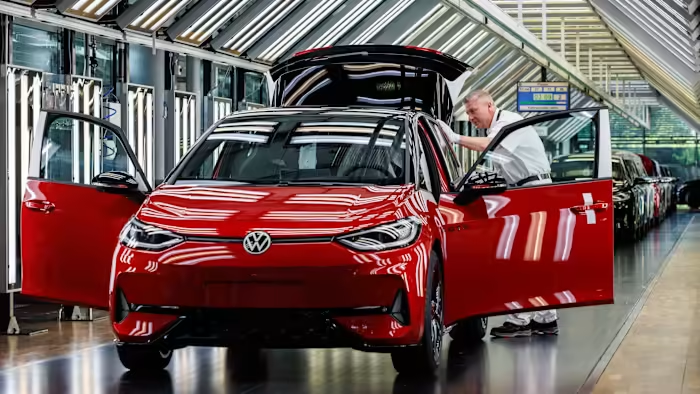
Nine months on, Europe’s largest carmaker is worried that it might be selling too many EVs without bringing down their cost of production fast enough.
Volkswagen’s sales of electric cars in Europe jumped 29 per cent year-on-year, boosted by government subsidies for EV purchases in Germany and a surge in fuel prices caused by the war in Iran. As a result, EVs account for about 40 per cent of its order book.
The boom in EV sales in Europe contrasts sharply with last year when carmakers from Honda to Porsche and Stellantis all watered down their electric car ambitions, incurring massive writedowns along the way.
While the rise in petrol and diesel prices has been the biggest catalyst, the product line-ups at the Paris Motor Show this month also showed that European carmakers had developed far more attractive and affordable EVs in response to the competition posed by the likes of BYD, Chery and Geely in China.
The issue for Volkswagen and other western carmakers is that electric cars still make less money than combustion engine models owing to the higher cost of batteries.
All three of Germany’s biggest carmakers, including Mercedes-Benz and BMW, are forecasting far smaller profits for 2026 following a series of profit warnings, while Volkswagen yesterday reported an operating loss of €5.9bn for the third quarter.
Much of the weakness in their earnings is due to a collapse in combustion engine models in China, but it does not help when the rise in EVs in their home market fails to lift their bottom line.
This is also why Germany and France recently reached a deal on European car policy that would allow carmakers to sell small volumes of petrol vehicles beyond 2035 if their proposal were more widely accepted across the bloc.
Such a change would be a big blow to Europe’s green ambitions and climate groups warned that it would threaten investments in critical infrastructure at a time when EV sales have finally started to take off.
For Volkswagen, Antlitz said the challenge was to forecast how much of the current EV demand would be sustainable when fuel prices eventually fall. Regardless of fuel prices, Volkswagen’s EVs still have to reach cost and margin parity with petrol counterparts by 2030 because there is no sign that Chinese rivals will slow their global EV charge.
Smart reads
The UK energy secretary Miatta Fahnbulleh should not fall for an illusion and block the Rosebank oilfield in the Atlantic, writes John Gapper.
The Trump administration has renewed its campaign against offshore wind, challenging three projects just weeks after signalling it would ease its attacks on renewable energy.
A UN-backed climate science body is left in limbo after countries failed to approve its budget.
Source: www.ft.com