AI and cloud infrastructure could boost Europe’s competitiveness and innovation, but growing dependence on a handful of foreign tech providers could also leave the bloc dangerously vulnerable. A new study maps out four future scenarios, raising a question: Which path will Europe take?
Those are the conclusions of a new report by 28DIGITAL, A Digital Resilient Europe: Agile to Adapt, Firm to Control. It examines how innovation, preparedness and government intervention could shape Europe’s ability to resist disruptions. The study calls for regular crisis exercises to test exactly that.
Its central argument is that digitalisation is a double-edged sword. While artificial intelligence can help businesses anticipate supply chain disruptions, detect cyber threats and maintain essential services, growing reliance on a small number of cloud and AI providers could also expose Europe’s economy and public institutions to new risks.
Four possible futures for Europe
Europe’s digital future could take four very different directions, depending on how quickly businesses adapt to new threats and how effectively governments keep technological risks under control.
You might be interested
Researchers named the most favourable scenario “Proactive Response”, where Europe gets both right. Businesses use AI to predict disruptions, governments protect critical infrastructure, and smaller companies receive support to keep up. The result is a Europe that can innovate without becoming overly dependent on foreign technology.
At the other extreme is what they call “Drift & Dependence”. Europe gets neither right. Businesses rely heavily on foreign cloud and AI providers, governments struggle to control the risks, and smaller companies fall further behind. A cyberattack, major outage, or geopolitical dispute could leave entire sectors exposed.
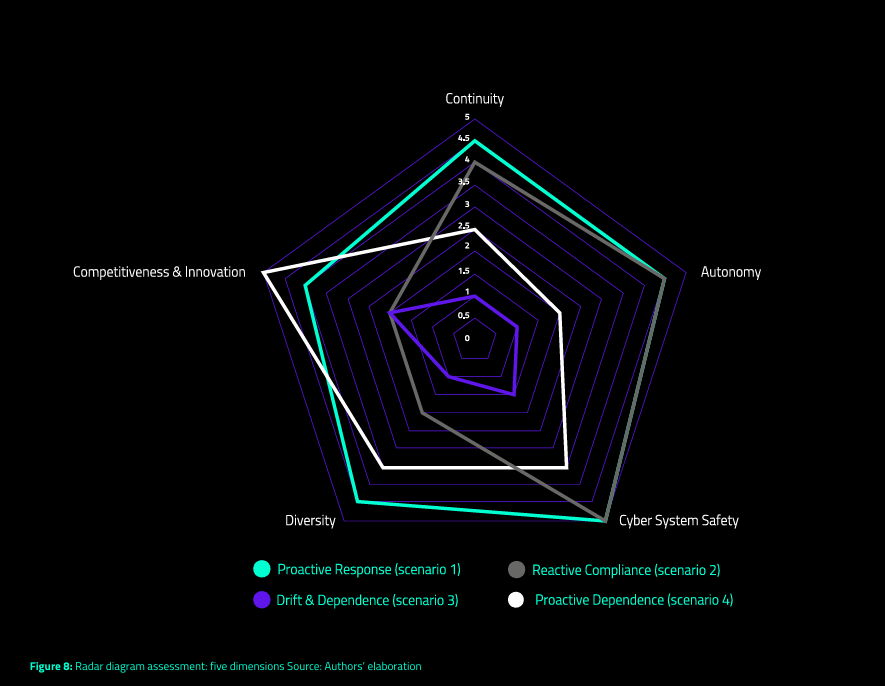
In between are two scenarios where Europe succeeds in one area but falls short in another. The bloc strengthens cybersecurity and tightens regulation, but businesses struggle to innovate under the weight of new rules. The continent becomes better protected, but less competitive.
Or the opposite happens. Businesses embrace AI and innovate rapidly, but rely heavily on foreign technology providers. Europe becomes more competitive, yet remains vulnerable to service outages, price increases and external restrictions.
Europe’s digital divide is widening
The study points to existing weaknesses that could determine which of these futures emerges.
One is the growing gap between large and small businesses. In 2025, 55 per cent of large European enterprises used artificial intelligence, compared with just 17 per cent of small businesses. The gap has widened by around eight percentage points since 2024. Smaller businesses often lack the funding, technical expertise and staff needed to adopt new technologies, leaving them at risk of falling behind.
Cybersecurity is another concern. Only 48 per cent of European organisations believe they can prevent a ransomware attack, while just 32 per cent have cybersecurity insurance, according to figures cited in the report.
The study also warns about Europe’s growing reliance on a handful of cloud and AI providers. Currently, Amazon, Microsoft and Google control around 70 per cent of the European cloud infrastructure. When several services depend on the same infrastructure, a single provider’s failure could disrupt multiple sectors at once.
EU regulation to the rescue
While Brussels has been looking to tackle some of these risks through legislation, including the Digital Operational Resilience Act, the Cyber Resilience Act and the AI Act, researchers recommend testing exercises simulating cloud outages, electricity failures or disruptions to critical communications.
The European Commission has taken steps to reduce dependence on foreign cloud providers. In April, it awarded contracts worth up to €180 million over six years to four European providers for sovereign cloud services for EU institutions.
In June, the Commission also proposed the Cloud and AI Development Act, aimed at strengthening Europe’s computing infrastructure and addressing dependence on non-European technology providers. The EU Data Act also seeks to make it easier for businesses to switch cloud providers, with switching charges set to be removed from January 2027.
But having rules on paper does not necessarily mean Europe is prepared. “Resilience depends on institutional capability to govern and support, not only to rule,” the report states.
Speed is another problem. According to the researchers, it can take three to four years between identifying a regulatory problem and applying a rule, longer than the technology cycles authorities are trying to regulate.
Source: euperspectives.eu