
Liz Carolan is a Tech Policy Press fellow.
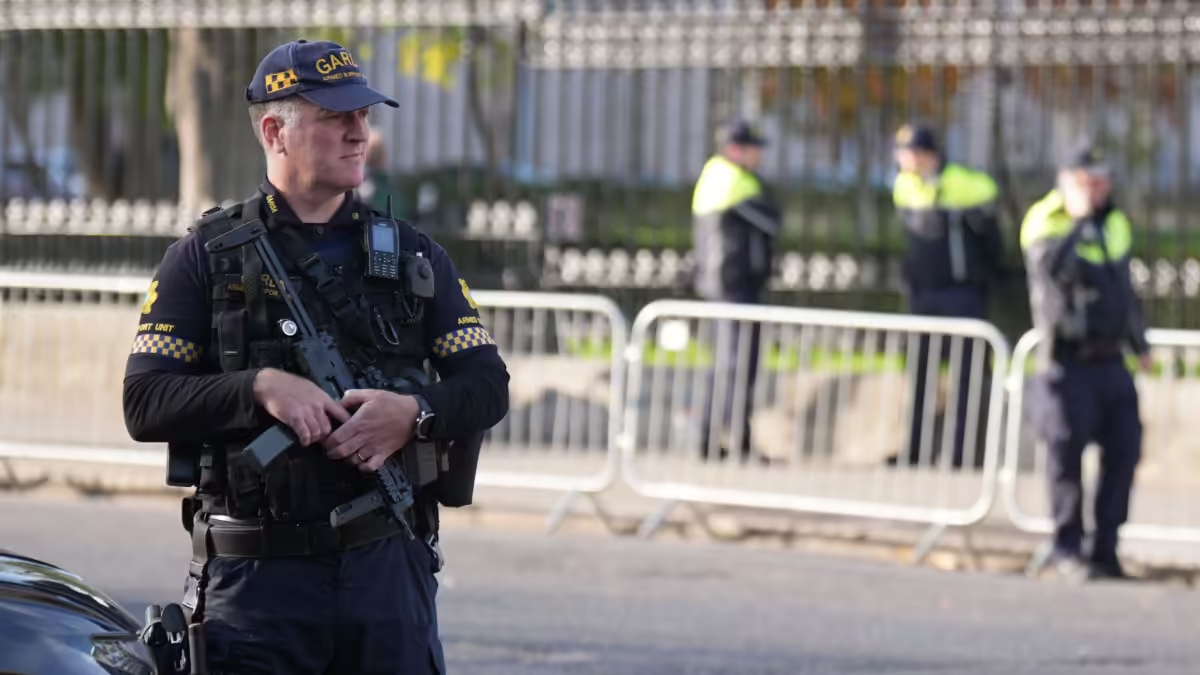
Members of the Garda Armed Support Unit outside the National Gallery in Dublin as more than 50 world leaders will visit Dublin for the European Political Community (EPC) summit on Thursday, followed by an informal meeting of the EU Council on Friday. The biggest security operation in the history of the Irish state is under way, as authorities in Dublin mount a ring of steel throughout the capital. Picture date: Wednesday November 11, 2026. PA Photo. Photo credit should read: Niall Carson/Press Association IRISH (Press Association via AP Images)
A pair of major political gatherings taking place in Dublin this week are likely to shape Europe’s approach to artificial intelligence and defense technology, amidst escalating cyber and hybrid security threats across the European Union.
Today, Ukraine’s Volodymyr Zelensky, Canada’s Mark Carney, NATO chief Mark Rutte and European Commission President Ursula von der Leyen are set to join presidents and prime ministers from EU member states, the United Kingdom and other European nations for the European Political Community (EPC) summit. The EPC is an informal forum for political and strategic dialogue set up in 2022 in the wake of Russia’s full-scale invasion of Ukraine. Canada is not a member of the EPC, but Carney has been invited as a guest for a second time, having attended the last meeting in Armenia in May, as ties grow between the EU and Canada.
Thursday’s summit will focus on security, with the official theme of the meeting “Europe – strong, secure and connected.” It is likely that discussions will include how to deal with the fallout from Ukraine’s drones being throttled by Elon Musk’s SpaceX last month, disruption that left civilians more exposed to Russian attack, according to Zelensky. This disruption to Ukraine’s war effort also left the country and its European allies looking for a replacement for Musk-controlled infrastructure, as technology and defense sovereignty continue to top the EU’s agenda. Alternatives are limited, however, with the BBC reporting that a planned European alternative to Starlink is not currently anticipated to be available until 2029.
On Friday, the Irish Government will host a long-planned informal meeting of the EU Heads of State or Government, and the 27 member state leaders have been issued an agenda focused on AI. In his invitation letter, European Council President António Costa stated that he believed this would be the first discussion “at Leaders’ level” at the Council — the representative body of member states within the EU — on “the opportunities presented by AI, as well as on its transformative effect on our economies and societies.”
The agenda includes presentations by the CEO of French firm Mistral AI, and the Nobel laureate and “Godfather of AI” Geoffrey Hinton. Hinton left his position at Google in 2023 to, he said, speak more freely about the risks of the technology. There will then be a two-part discussion, the first of which will cover European competitiveness and AI sovereignty, and specifically how the bloc can become a “leading and sovereign player” in the AI value chain. The second part turns to AI’s risks, safety and security, and to how Europe can contribute to international cooperation on the governance of advanced AI.
The two-part agenda reflects the tensions happening in EU tech policymaking. Anxiety about Europe’s failure to produce AI companies that can both compete with the market leaders and that are under European supervision is one of the major themes of this term of the European Commission. The Council has declared 2026 the EU’s “Year of Competitiveness,” and Ireland, which holds the six-month rotating Presidency of that body, chose it as one of their three themes for their tenure. Ireland’s Presidency program has regulatory simplification at its center, including the Digital Omnibus, which is amending parts of the GDPR and the AI Act in ways that, in the eyes of critics, favor business and weaken hard-won protections for human rights. Last month, Ireland’s own AI summit in Dublin was dominated by industry speakers, with no civil society organizations on the agenda.
At the same time, there is growing concern about AI safety within the bloc, which spent the decade before the current term passing regulations that try to bring technology and tech firms under regulatory governance. It is also facing increased cyber and hybrid attacks, and Irish officials fear that a recent escalation in incidents within the country is connected to the Council presidency and to this week’s meetings, and that there could be more.
The recent hacks of supermarket refrigeration systems, that sent temperatures in in-store coolers across Europe soaring to 50 degrees Celsius, affected 13 SuperValu outlets in Ireland. Ryanair, the country’s biggest airline, has faced an escalating wave of hoax bomb threats, disrupting dozens of flights across Europe in the days leading up to the summits. A number of Irish schools were evacuated after receiving bomb threats the day before the Dublin meetings.
And last Friday, the national broadcaster RTÉ was forced to pull all live radio broadcasts for over an hour and evacuate its Dublin campus while it dealt with an emailed bomb threat against the building. The government said it seemed likely that the attacks, which also targeted the commercial radio station and a national newspaper, were part of “a co-ordinated campaign of disruption.”
This has heightened long-standing anxiety within Irish government circles about managing security while hosting these meetings. Irish police are mounting the largest security operation in the history of the State, with 5,000 Gardai (officers) expected to be working the event, about a third of the total national force, and reinforcements have been drafted in from Northern Ireland, Portugal and Latvia. Major disruptions to the city are planned, with large areas cordoned off and a bridge closed for a large part of the week.
It also comes as Ireland faces fresh scrutiny over the independence of the institutions charged with enforcing digital rules. Just last week, two UN Special Rapporteurs, Ana Brian Nougrères on the right to privacy and Margaret Satterthwaite on the independence of judges and lawyers, raised concerns about the independence of Irish regulators as the de facto implementers of data protection rules within the EU. They warned of a “revolving door” between regulators and the industries they oversee, and called for impartial selection panels that identify conflicts of interest before appointments are made. They also highlighted challenges in taking legal action against tech companies.
Those questions are, however, unlikely to top the agenda this week. For the Irish government, the main priority will be getting the city and its high-profile guests through the next few days without incident.
Source: www.techpolicy.press