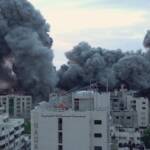
Oxfam in collaboration with the UK-based Conflict and Environment Observatory (CEOBS) has published a new report on how Israel’s military assault has turned Gaza into a toxic wasteland, threatening human survival.
Israel’s destruction of Gaza through the extensive use of explosive and incendiary weapons has made air, soil and water dangerous to Palestinians now and for decades to come, with indicators of toxic contamination across almost the entirety of the Strip. With international attention increasingly turning to Gaza’s reconstruction, environmental recovery must not be treated as an afterthought, but as a vital undertaking in parallel.
This paper presents a comprehensive picture of Gaza’s contamination landscape. Satellite-derived data, remote sensing analysis, and geolocated conflict incident databases are used to spatially map contamination risks across Gaza, drawing on scientific and legal literature to assess exposure pathways, potential health consequences, and the legal implications of environmental harm. It demonstrates that the evidence already available is sufficient to conclude that contamination is widespread, severe and consequential, and that the destruction and contamination of Gaza’s environmental resources and systems raise serious concerns under international humanitarian law (IHL), international human rights law (IHRL) and occupation law.
The research found that that the scale and intensity of the Israeli military’s onslaught has affected approximately 78 per cent of Gaza’s land area, with the report’s spatial analysis identifying indicators of potential contamination across more than 99 per cent of the territory; highlighting the scale and near-total geographical spread of pollution risks.
Oxfam calls for a full, independent, field-based Post-Conflict Environmental Assessment, which is needed to establish what contaminants are present, where they are found and at what concentrations; determine the risks they pose to people and the environment; and identify what needs to be done to address them. The absence of a full, independent, field-based post-conflict environmental assessment is a direct consequence of Israel’s continued refusal of independent access to Gaza.
Israel must end its genocide and siege of Gaza and to allow unrestricted access for aid, environmental assessment and essential equipment. Recovery and reconstruction of Gaza must be owned and led by Palestinians themselves. It must be rights-based, reparations-oriented, and rooted in accountability. International funding does not replace Israel’s obligation to make reparations for the harm caused by its unlawful acts.
Source: www.oxfam.org