
Earlier this year, dozens of alumni from Carnegie’s former departments of Global Ecology and Plant Biology gathered on the Stanford University campus to look back on eight decades of collaboration and discovery. The gathering represented current researchers, as well as past postdocs, grad students, and faculty members, who reported on their recent work and shared some of their favorite community-building memories.
From lab-made “lemondrops” to late-night jam sessions, attendees reminisced about the culture that made Carnegie’s presence at Stanford so special. And they uniformly celebrated Carnegie’s long-standing commitment to fostering an environment where intriguing scientific mysteries could be explored from new angles and novel career directions could be safely pursued. Many alumni talked about how they have replicated aspects of the Carnegie way of doing things in their current academic and industry labs.


Wang, the former- Acting Director of Plant Biology, presents his work on plant hormones.

Dukes gives quick remarks to kick off the day as attendees started to arrive on campus for the daylong Celebration of Science symposium.
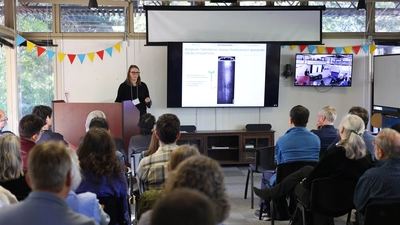
Alumna Renee Weizbauer presents her work on carbohydrate sensors.
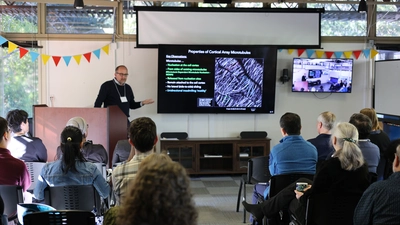
Alumnus Sidney Shaw of Indiana University presents recent work on microtubules.
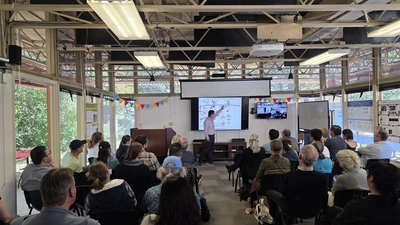
Staff Scientist Zhiyong Wang
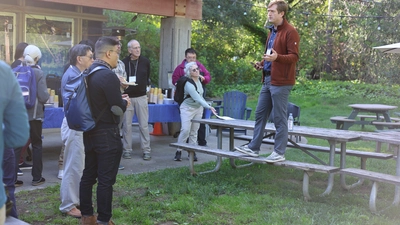
Senior Staff Scientist Jeffrey Dukes
“I was thinking about how rare it is to have a space for experimentation and failure, and dreaming and innovation, and thinking about what it is that contributes to that,” said Margaret Torn of Lawrence Berkeley National Laboratory during the gathering’s lunchtime memories session. She worked with founding Global Ecology Director Chris Field as a Stanford postdoc in the 1990s.
In the afternoon, Dominique Bergmann, a former Carnegie postdoc and, later, adjunct faculty member who is now a Stanford professor shared a scan of her first offer letter from Carnegie, as well as a job listing from another Carnegie department. Together, they are emblematic of the institution’s approach, she said, paraphrasing the ad to include everyone in the room: “We just have the insight, resources, and courage to investigate the margins of what is feasible and respectable. And so, I think that is what I aspire to.”
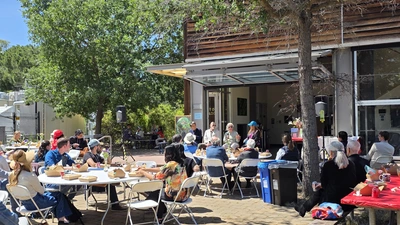
Panelists Margaret Torn, Dina Mandoli, Chris Field, and Meng Xu shared their Carnegie memories during a special lunchtime panel.
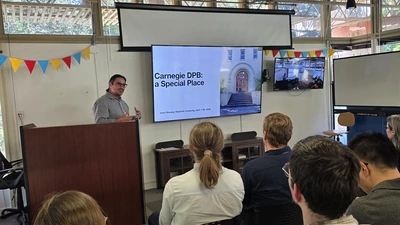
Former Carnegie Staff Scientist José Dinneny reminesces about Carnegie during an afternoon memory sharing session.
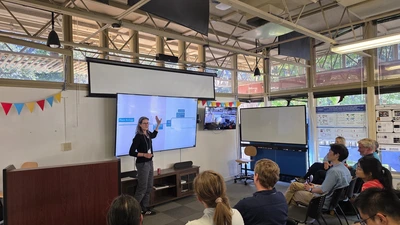
Stanford professor Dominique Bergmann, who joined Carnegie as postdoc and served as an adjunct faculty member until 2020 talks about how Carnegie shaped her career.
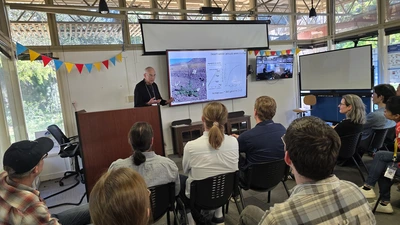
Joe Berry, who started at the Department of Plant Biology, helped found the Department of Global Ecology, and went on to lead it before retirement brought the house down with his remarks about the ways Carnegie and Stanford made each other better.
The day-long program also featured a display of historic artifacts, including a French pressure cell, invented by Carnegie plant biologist Stacy French, as well as a selection of archival photographs and guestbooks from the institution’s former Inverness retreat, which community members were able to reserve for spending time with friends and family away from work.
“What I think has been so wonderful and unique about the institution is that it had one foot in being a major high-powered scientific institution and another foot … in being a family,” said Field, who is now the Melvin and Joan Lane Professor of Interdisciplinary Environmental Studies at Stanford. “And that that duality has just been the secret of the institution’s success, of this site’s success.”
At the end of the day, a surprise was revealed by Staff Scientist Devaki Bhaya, who had worked with a local artist to create a painting about Carnegie’s legacy, not just at Stanford, but worldwide.
Special thanks to the Celebration of Science organizing committee—Liat Adler, Andrea Citrini, Jeffrey Dukes, Andrea Nebhut, Terri Tippets, and Renate Weizbauer—for all their work in making this program a success.
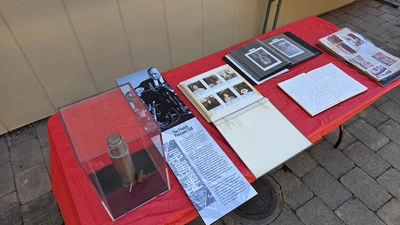
A display of historical items organized by Carnegie archivist Maggie Drain included a French pressure cell, old retreat guest books, and archival photos.
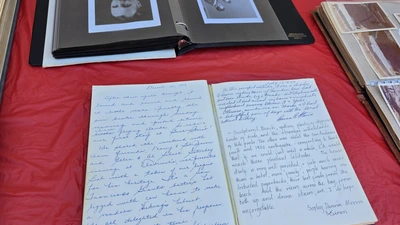
Symposium attendees enjoyed looking through old entries from the guestbook for the old Inverness retreat where Carnegie employees could take time away with friends and family.
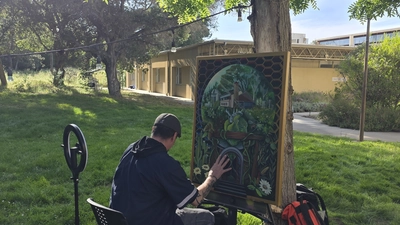
As a surprise, Senior Staff Scientist Devaki Bhaya commissioned a painting showcasing the history and impact of Carnegie research.
Symposium Presenters
Between attraction and defense – How roots pattern their associated microbiota
CarboSensors – illuminating wall carbohydrates in living organisms
Disentangling the roles of CO₂ and climate in the accelerating terrestrial carbon cycle
Molecular Sugar Recognition from Plant Physiology to Human Health
Allele Design for Crop Improvement: Gene Editing Tunable and Genetically Dominant Yield Component Improvement in Maize
2D and 3D image analysis applications for single cells and whole plants
Connecting the dots from steroids, auxin, gibberellin, sugar, light, clock, temperature to cell division, cell elongation, photosynthesis, and immunity
Cortical Microtubule Array Patterning in Hypocotyl Cells
Structural complexity biases vegetation greenness measures
Reconciling carbonyl sulfide budget estimates to advance understanding of the global carbon cycle
Aging, senescence, and stress in plants: what we have learned from Arabidopsis to horticultural crops
Establishing a genetic platform for studying photodevelopment in macrophytic brown algae
How curiosity-driven plant biology connects to human health
Poster Presenters
Feeding billions under water scarcity: global unsustainable irrigation and adaptation via Managed Aquifer Recharge
California poppy as a model system to study assisted gene flow and drought adaptation potential
RMT2 is required for efficient assembly of Photosystem I in Chlamydomonas reinhardtii
Synthetic activation of gibberellin signaling reveals spatial coordination of root growth
Balancing productivity, costs, and environmental trade-offs in global yield gap closure through irrigation and nutrient management
CDKB phosphorylation controls DNA replication stress response in plants
The Arabidopsis TIRome informs the design of artificial TIR (Toll/interleukin-1 receptor) domain immune receptor proteins
Amanda Shelton – Long read sequencing reveals dynamic phage defense systems in microbial communities of Yellowstone National Park
Quantifying weathering rates and carbon export efficiency of natural and synthetic enhanced weathering feedstocks in a controlled mesocosm trial
Synthetic activation of gibberellin signaling reveals spatial coordination of root growth
How Forest Carbon Change Shapes Future Global Land Use and Land Cover Change
Gene expression drives development: A research program using C. elegans nematodes
Atmospheric CO₂ Observations Reveal Seasonality Bias in Arctic–boreal Carbon Flux Estimates

Source: carnegiescience.edu