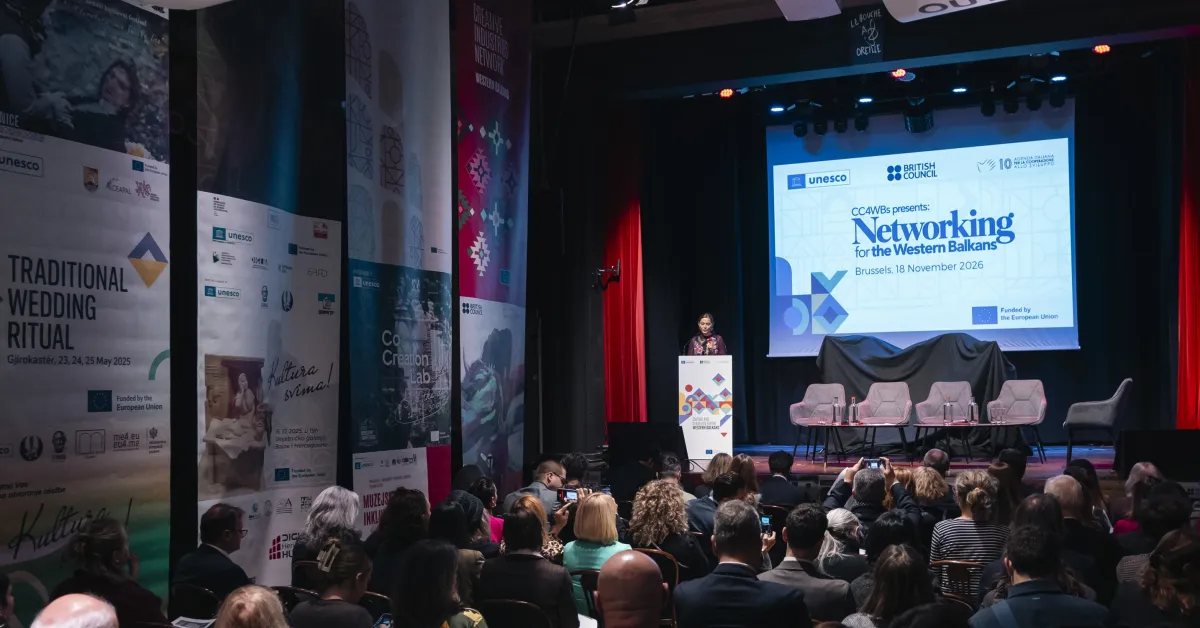

Beyond its contribution to cultural life, the project has helped lay the foundations for a stronger regional creative economy, opening up new opportunities for employment, entrepreneurship, and international cooperation. As the project approaches its official conclusion in March 2027, the focus is now on sustaining its achievements, maintaining the partnerships established, and creating the conditions for cultural organisations and creative professionals across the Western Balkans to continue growing and developing their work.
Eilidh Hamilton, British Council Director Western Balkans, emphasised the importance of investing in people and organisations as the foundation of a sustainable creative economy: “The true potential of the Western Balkans’ cultural and creative sectors lies in the talent, ambition and creativity of its people. Through the EU-funded Culture and Creativity for the Western Balkans programme, the British Council has focused on empowering creative professionals and strengthening the capacity of cultural organisations to innovate, adapt and thrive. By equipping people and organisations with the skills, knowledge, and confidence to shape their own future, we are helping to unlock the region’s creative potential and lay the foundations for a stronger, more dynamic, and sustainable creative economy.”
Grazia Sgarra, Director of the AICS Rome Office for Civil Society Organisations, Partnership and Finance for Development, highlighted culture’s contribution to sustainable development: “Culture is much more than the preservation of shared heritage. It is a resource for economic opportunity, social inclusion and dialogue between communities. Investing in people’s skills, creativity, and capacity to innovate is essential for sustainable development. CC4WBs demonstrates how international cooperation can help unlock this potential and create opportunities across the region.”
Source: www.unesco.org