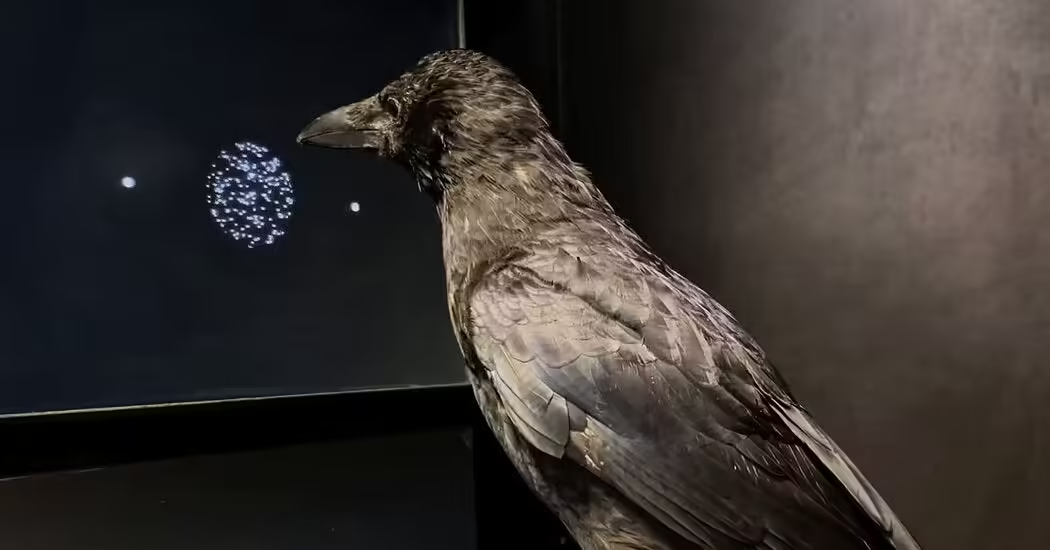

Lemmy and Iggy, two carrion crows, are no strangers to a psychology lab. As study participants, they have helped scientists prove that birds can use tools to forage, learn numbers and count objects, and provided other insights into the ways birds think.
Now, they’ve also revealed that birds can make staggeringly quick decisions, besting their human and nonhuman primate counterparts with ease. In new findings published in Sciencethe crows could process and respond to visual cues at twice the speed as humans and monkeys, quantifying the neural speed of avian decision-making for the first time.
The discovery might be the final blow for the use of “birdbrains” as a pejorative.
“We wouldn’t think of birds making these decisions faster than monkeys, or faster than us ‘awesome’ human beings,” said Mike Colombo, a neuroscientist and comparative psychologist at the University of Otago in New Zealand who was not involved in the research. “But they do. They’re just incredibly fast.”
Questions of bird intelligence have long been debated by researchers. Their small and superficially simple brains led scholars in the 19th and much of the 20th century to conclude they were not cognitively competent creatures. Even early research into birdsong, which demonstrated that some birds are capable of complex speech-like patterns and impressive vocal mimicry, was not enough to turn the tide. Their elaborate melodies were considered specialized adaptations that didn’t reflect their cognitive abilities.
Although passionate birders may find those conclusions obviously mistaken, the scientific community has been slower to catch on. “It’s taken the last 20 years to realize that actually their brain architecture is quite fascinating,” said Dr. Colombo.
Recent research, for example, has found that pigeons are capable of distinguishing between cancerous and noncancerous cells, numerical values, and words and non-words. Corvids (the group that includes crows, ravens, rooks and scrub jays) can even recognize themselves, solve abstract problems, plan for the future and show theory of mind — an ability to understand what other birds might be thinking and act accordingly.
Source: www.nytimes.com