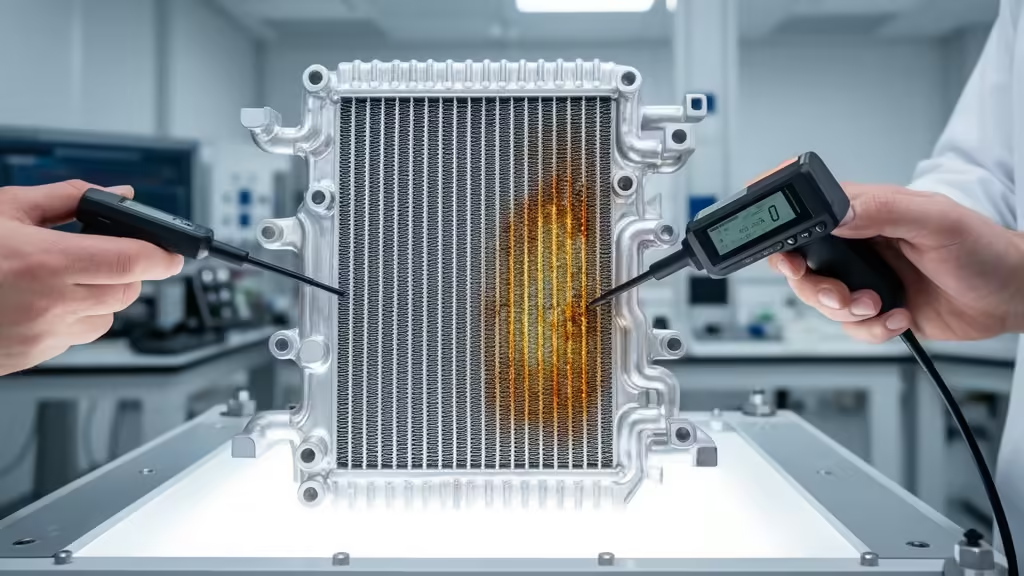

Automotive radiators serve as critical heat-rejection components whose ongoing corrosion compromises leak-tightness, heat-transfer efficiency, and long-term operational reliability, according to a systematic review published in Discover Materials. Modern automotive radiators feature a compact, aluminium-based, multi-interface architecture that inherently promotes coupled internal and external degradation processes. However, the physical signatures produced by this corrosion are frequently hidden, indirect, or confounded by operational fouling and surface residues, which severely limits the diagnostic effectiveness of conventional inspection techniques.
To establish a unified corrosion-diagnosis framework, the researchers executed a PRISMA-guided workflow that integrated radiator architecture, environmental exposure conditions, degradation mechanisms, observable signatures, diagnostic approaches, and industrial transferability. The systematic literature screening evaluated records from Scopus and Web of Science published between January 2016 and 15 April 2026, using rigorous eligibility screening and full-text assessment. This comprehensive synthesis systematically evaluated degradation mechanisms, specific diagnostic targets, diverse data modalities, existing validation evidence, and real-world deployment constraints.
Synthesized evidence from the review demonstrates a clear historical shift away from purely descriptive corrosion studies toward active monitoring, advanced sensing, artificial-intelligence-assisted assessment, and multimodal diagnosis. The researchers found that corrosion initiation and overall signature observability are governed principally by radiator geometry, brazed interfaces, protective sacrificial layers, coolant chemistry, wet-dry salt exposure cycles, and fluid flow heterogeneity across the component.
The manifestations of degradation depend heavily on location, as internal degradation produces coolant, pressure, or thermal disturbances, whereas external corrosion yields visual, thermal, or blockage-related signatures. Despite these diagnostic manifestations, critical failure-relevant signals remain exceedingly difficult to access within narrow tube interiors, fluid headers, and buried brazed joints, thereby restricting timely detection.
While conventional visual and physical inspection methods remain readily deployable in maintenance environments, they remain fundamentally surface-biased. More advanced techniques—including non-destructive testing, dedicated sensing, thermo-hydraulic analysis, and computer vision—substantially improve observability across components. Nevertheless, these newer diagnostic methods remain target-specific and frequently confounded by operating conditions. Furthermore, experimental validation across the sector is significantly constrained by scarce ground truth, non-representative datasets, domain shift, and practical deployment constraints.
To overcome these persistent barriers, the review emphasizes that reliable corrosion diagnosis requires systematically linking underlying mechanisms, observable signatures, empirical measurements, predictive models, and operational maintenance decisions. Achieving practical progress in the field will ultimately depend on adopting multimodal, physics-informed inference methods, conducting realistic field validation, establishing standardized data acquisition procedures, and implementing robust, uncertainty-aware deployment strategies.
Subject of Research: Diagnostic approaches and monitoring frameworks for automotive radiator corrosion
Article Title: Signature-driven multimodal and physics-informed diagnosis of corrosion in automotive radiators
Article References: Zarhyoun, H., Jeffali, F., Bouchnaif, J., & El Barkany, A. (2026). Signature-driven multimodal and physics-informed diagnosis of corrosion in automotive radiators. Discover Materials. https://doi.org/10.1007/s43939-026-01060-0
Image Credits: AI Generated
DOI: 10.1007/s43939-026-01060-0
Keywords: automotive radiators, corrosion diagnosis, heat-rejection components, multimodal diagnosis, physics-informed inference, aluminium architecture, brazed interfaces, sacrificial layers, coolant chemistry, wet-dry salt exposure, flow heterogeneity, non-destructive testing, thermo-hydraulic analysis, computer vision, domain shift, uncertainty-aware deployment
Source: bioengineer.org