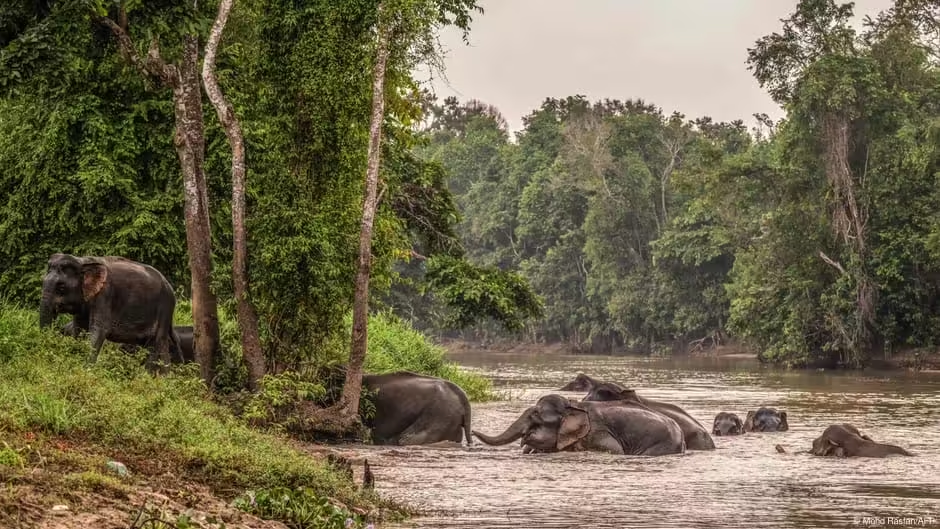

The world’s tropical forests play a vital role in slowing global heating and preserving biodiversity, storing climate-damaging carbon dioxide and providing a home for an extremely large number of species — when they’re intact.
More than 140 countries committed to halting global deforestation by the end of the decade at the 2021 UN climate change conference in Glasgow, but five years later logging continues.
In 2024, over 8 million hectares (19 million acres) of forest were lost. And since 1990, nearly 490 million hectares of forest have been wiped out.
More recently, the trend has shifted in the opposite direction. Deforestation in the Amazon region of Brazil decreased by 41% from August 2025 through 2026 to reach its lowest rate since records began.
To ensure lasting protection, the Tropical Forest Forever Facility was launched in 2025 at the COP30 climate conference in Belem, Brazil.
TFFF would protect forests with investment
Because rainforests are so important for the world, the idea behind the fund was to give money to the countries where they are located to help them preserve and protect these ecosystems.
So far, these countries have made more profit through deforestation — for example, by mining natural resources on rainforest land or farming the area.
Starting in 2027, the TFFF is expected to generate the funds needed for rainforest conservation, in part via contributions from various countries. By the end of this year, a total of $10 billion (€8.9 billion) in government capital is due to flow into the fund, mainly in the form of low-interest loans.
In addition, the TFFF is expected to issue bonds to private investors, such as banks and investment firms, to raise additional funds — initially totaling about $40 billion.
Going forward, the plan is for governments to contribute a total of $25 billion to the pot, and for private donors to contribute $100 billion. The fund will then invest this money in international financial markets with the aim of generating profits.
Private investors who purchase TFFF bonds can expect to earn about 5% interest per bond per year, said Felix Finkbeiner, the founder of the German environmental organization Plant-for-the-Planet, where he is responsible for forest conservation and advocacy.
“Private investors’ capital is very well protected,” Finkbeiner said, adding that any losses the TFFF might incur on the capital markets — for example, if the price of its bonds should fall — would be offset by government funds.
Millions in funding — for intact ecosytems
About 2.7% of the TFFF’s profits would be set aside for countries with tropical forests.
Countries would receive $4 per year for every hectare of forest that they preserve instead of chopping down. At least 20% of these funds must be allocated to Indigenous peoples and local communities.
According to calculations by the TFFF Watch websitean independent platform launched by Plant-for-the-Planet to track investments, the Democratic Republic of the Congo, for example, would receive about $333 million for its 2024 forest stock under this system.
Finkbeiner said the subsidies would be paid only for intact ecosystems and not for timber plantations, with forest areas and their condition mapped and assessed using satellite imagery. Though it can sometimes be difficult to identify plantations accurately on satellite photos, he said, the technology has improved significantly over the last decade.
That means any NGO or external party with access to the satellite data can check the condition of the region, providing further oversight. If forest areas are cleared or damaged, money is deducted from the total.
Another safeguard: If countries don’t use the TFFF funds for rainforest conservation, their payments could be frozen for the next few years.
The TFFF is supposed to invest, whenever possible, in government bonds issued by emerging and developing countries. Above all, the idea is not to invest in projects that harm the climate — such as those linked to oil, gas, or coal investments.
Conservation will continue as leaders change
The TFFF concept has received plenty of support from environmental organizations, in part because it gives countries in the Global South significantly more sovereignty than traditional forms of development financing.
“For example, if the government of Ghana wants to protect its rainforest today, it usually asks the World Bank for financial assistance — and then the World Bank in [Washington] DC decides whether Ghana is allowed to do so,” Finkbeiner said.
The TFFF fund is also designed to be immune to donor countries’ backing out in the event of a change in government, for example. Once a contribution is made, the money remains in the fund for 40 years before being paid back.
Continuing protection is also an incentive for countries receiving money from the fund. “When a new government comes into power that wants to cut back a little on climate protection, they will realize: We’ll get more money if we protect the rainforest,” said Finkbeiner.
TFFF still $2 billion short
For the rainforest fund to actually get off the ground, a total of $10 billion in seed capital must be raised by the end of 2026. So far, the confirmed pledges from countries, NGOs and foundations total only $7.9 billion.
Eight countries have expressed a willingness to contribute so far, including Brazil, Indonesia, France, the United Kingdom, the Netherlands and Luxembourg.
Norway, with a pledge of $3 billion, is the largest would-be donor. However, the government in Oslo is willing to honor its commitment only if the agreed-upon total amount is in place by the end of the year.
“This deadline isn’t set in stone, but otherwise the Norwegian government will have real trouble getting it through parliament,” Finkbeiner said.
Germany’s commitment must also still be approved by the parliament. The German government has pledged about €1 billion to the TFFF starting in 2027, to be paid out over 10 years.
Other countries are also considering investing in the TFFF, including Canada, China, South Korea and the United Arab Emirates.
Philanthropic organizations have pledged $88 million to the fund so far, including $73 million announced this week during the COP31 climate summit in Antalya, Turkey. Finkbeiner remains upbeat.
“Promises like that always come at the last minute,” he said. “I’m very optimistic that we’ll secure more commitments at the COP — and in the course of December — and that we’ll then reach that $10 billion.”
This article was originally written in German.
Source: www.dw.com