
Criminal expansion heightens the risk of violence around mining across the Legal Amazon
Over the past decade, increasing mineral development in Brazil has coincided with heightened levels of violence across several mineral-rich states, fueled by criminal organizations’ growing territorial reach and their incursion into illegal mining. The Legal Amazon, which lies at the heart of Brazil’s mining expansion, accounted for over 70% of the country’s mined surface in 2025 and faces the brunt of such risks.
Over the past decade, criminal organizations, including the First Capital Command (PCC) and Red Command (CV), have expanded their presence in the Legal Amazon to capitalize on shifts in drug trafficking routes that have raised Brazil’s relevance in the international drug trade. The expansion of their presence often manifests in the use of violence: Between 2019 and 2025, ACLED records a 110% increase in events involving these groups in the Legal Amazon (see graph below). These routes include the Solimões-Amazonas corridor, connecting the Amazonas state riverways with cocaine supply routes in Colombia and Peru; trafficking routes through Acre connecting to Bolivia and Peru; the northern borderland connecting Roraima to Venezuela and Guyana; the Bolivian border through the Mato Grosso and Rondônia states, which connect with the supply of cocaine; and Pará and Amapá, which have emerged as key transit states to connect inland trafficking with international and national markets.
Criminal groups have used this expansion to tap into pre-existing illicit economies in the Legal Amazon, particularly illegal gold mining, as soaring gold prices and the relative ease of laundering gold into legitimate supply chains have made it a lucrative enterprise for organized crime groups. Criminal penetration into the mineral trade also affects other minerals: Industry executives estimate that 30% of manganese production is sourced from illegal miningand, in September 2026, a federal operation identified a money-laundering scheme involving illegal manganese in Marabá and several Brazilian states.
Criminal groups have also exploited illegal mining infrastructure to facilitate drug trafficking, such as clandestine airstrips and river transport networks, and have generated additional revenues through the extortion of miners in exchange for protection. At the same time, they have become increasingly directly embedded into illegal mining operations. The CV and PV are reportedly controlling mining sites and machinery to extract gold.
The states of Mato Grosso, Pará, Amazonas, and Roraima are particularly exposed to these activities, as they have high levels of political violence occurring in municipalities with active state-sanctioned and pending exploratory mining activity. Mato Grosso and Pará are among the states with the highest levels of mined surface across the Legal Amazon, and further mining investments are planned in Pará. In both states, ACLED records some of the highest levels of gang violence across the Legal Amazon in 2026. In contrast, gang violence in the Amazonas and Roraima states declined significantly in recent years as a result of federal policies, but also as criminal groups consolidated their presence, leaving these states exposed to illegal extraction and territorial disputes.
Mato Grosso: Drug trafficking networks expand into illegal gold mining
In Mato Grosso, competition between criminal groups over drug trafficking routes increasingly overlaps with their involvement in illegal gold mining, with 63% of recorded political violence occurring in municipalities with confirmed ore resources, excluding the state capital (see map below).
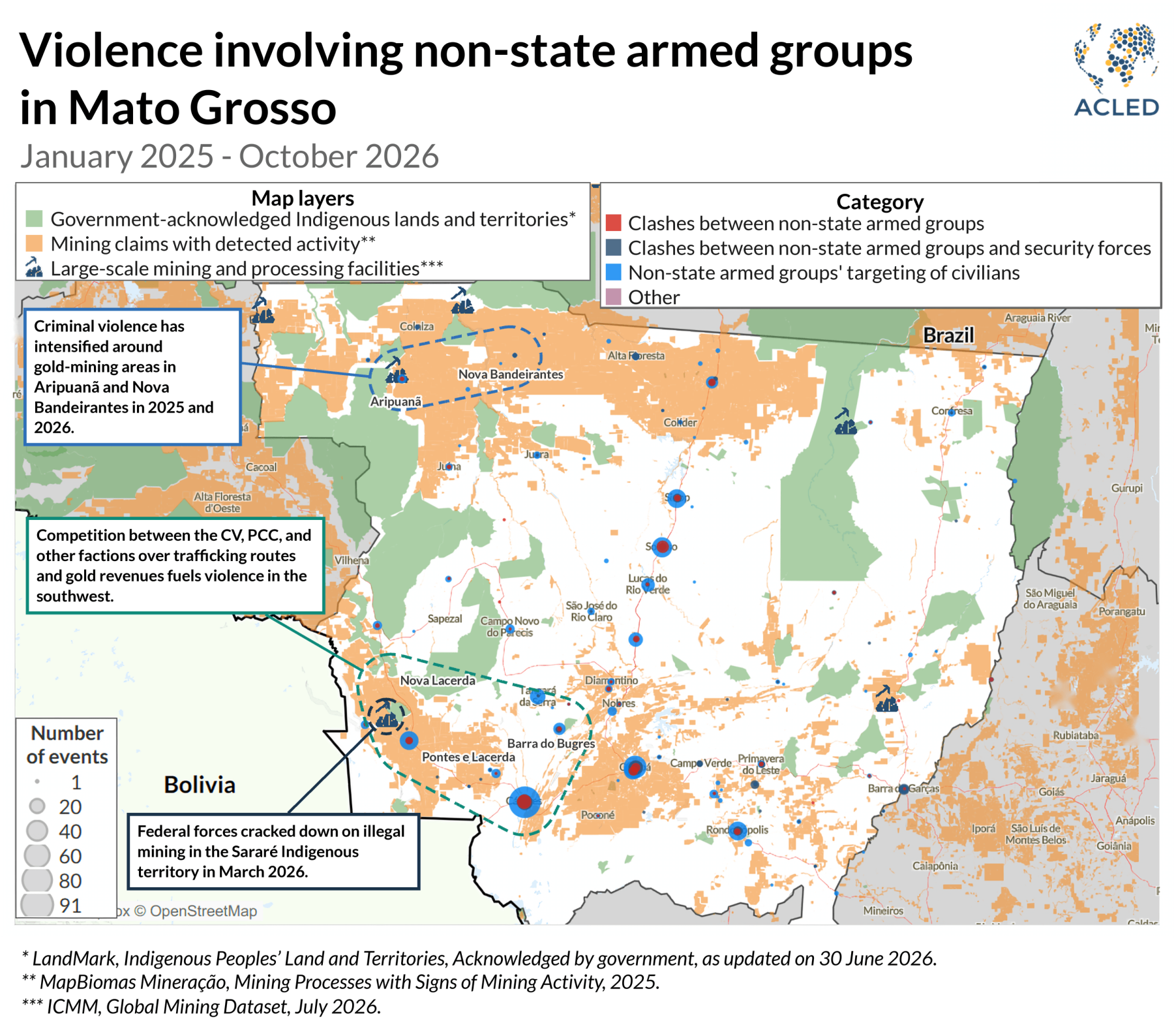
In southwestern Mato Grosso, around Pontes e Lacerda, Nova Lacerda, Barra do Bugres, and Cáceres, competition between the CV, PCC, and other factions such as the Third Pure Command and Bonde dos 40 over the control of drug trafficking routes led to an increase in violence in 2025 and 2026, particularly in Pontes e Lacerda, but also in Cáceres, where proximity to the Bolivian border has made it a strategic trafficking node. There, criminal competition has also turned to controlling gold revenues, particularly in the adjacent Sararé Indigenous territory, a local hotspot of illicit gold mining, where the CV has notably shifted from charging miners for “armed protection” to directly running extraction sites such as Garimpo Cururu.
Similarly, in the northern municipalities of Aripuanã and Nova Bandeirantes, ACLED records an increase in violence in recent years. While violence remains partially linked to the CV’s local drug distribution, the criminal group has extended its control over illegal gold mining revenue as a lucrative secondary income. In Aripuanã, the CV has levied a 2% tax on illegal miners’ gold sales and mining claims.
In 2026, federal forces launched a major crackdown on illegal mining in the state, including in the Sararé Indigenous territory in Marchwhen they detained 67 people involved in illegal mining and destroyed around $5 million worth of machinery, equipment, and infrastructure. These operations have helped disrupt illegal extraction. However, criminal penetration into mineral trading and threats to local logistics have not necessarily been dismantled, and are likely to persist in the coming year amid large investment projects to expand industrial mining or start new projects, notably copper and zinc extraction in Aripuanã, gold extraction in Pontes e Lacerda, and the opening of a new open-pit gold mine in Matupá.
Pará: Criminal expansion in mining areas increases risks beyond gold mining and along strategic logistics corridors
In Pará, criminal groups’ disputes have revolved around the control of key cocaine-trafficking routes connecting the interior of the country to national and international markets through the Amazon waterways and Atlantic ports. As the state with the largest mined surface in Brazil, criminal groups’ interests — including the PCC, CV, and other organizations such as the Comando Classe A and Amigos do Estado — have increasingly coalesced around mining sites. This includes the Tapajós basin, which is rich in gold deposits, where the rise in criminal violence in Itaituba in 2026 reflects both competition to launder illegal mining profits and exploit mining airstrips for transporting drugs (see map below).
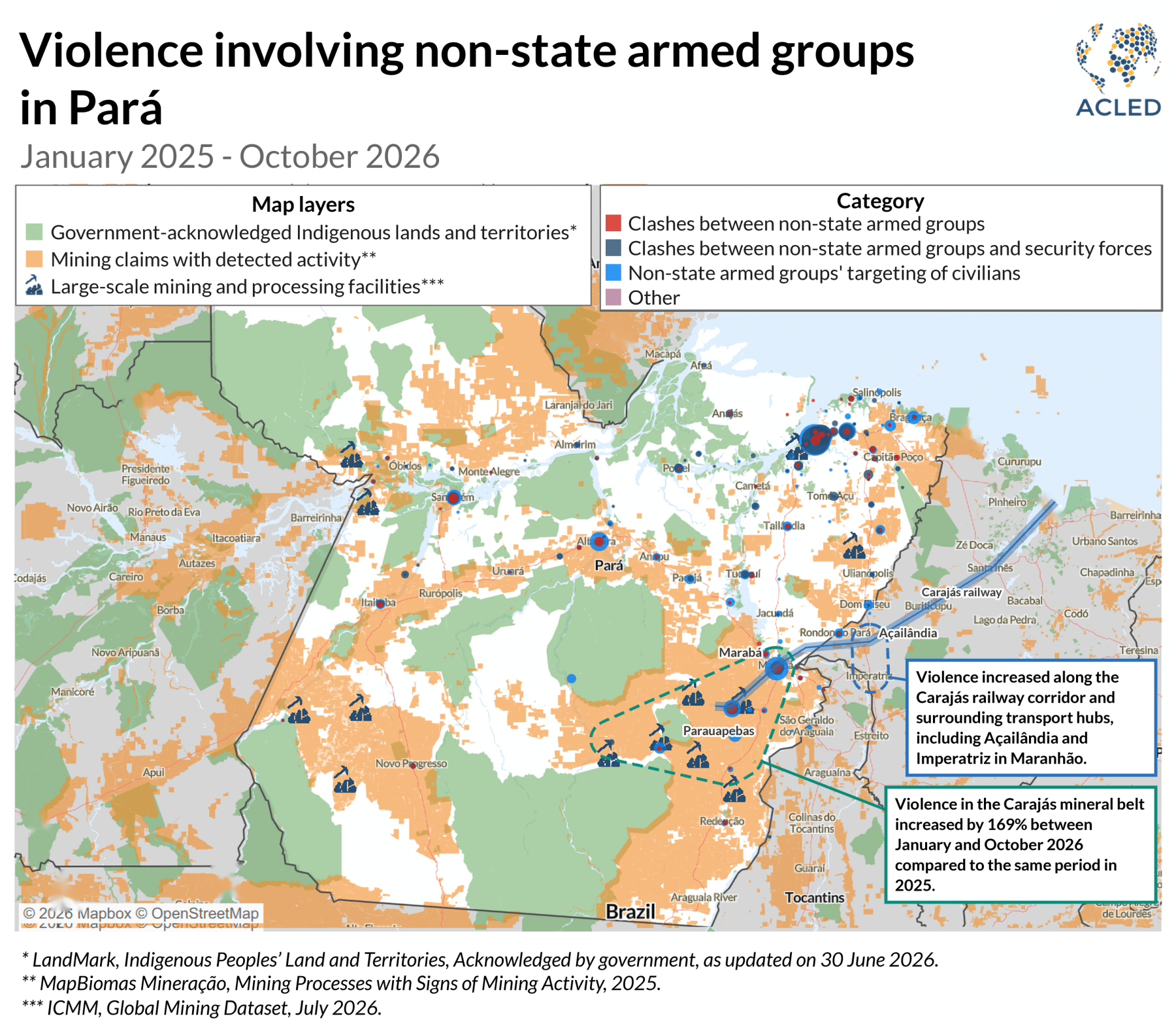
In the Carajás mineral belt, both an important drug trade route and a region with deposits of iron ore, copper, gold, manganese, and nickel, violence has increased by 169% between January and October 2026 compared to the same period in 2025. This has been particularly the case around the municipality of Parauapebas and its surroundings, as well as in Marabá, both areas that are coveted for illegal gold and copper mining (see map above).
Criminal groups have also leveraged their control of key transport routes used as legal mining logistical corridors. In 2026, ACLED records an increase in violence in municipalities along the Carajás railway corridor, extending into neighboring Maranhão state, including Açailândia, which lies directly along the railway, and Imperatriz, a nearby regional transport hub. In August 2025, police forces identified three individuals attempting to steal diesel from a Vale-owned locomotive transporting iron ore. While authorities could not establish a connection to Brazil’s major criminal groups, the incident highlights the exposure of mining transport infrastructure to criminal activity, such as theft and the potential extortion of transportation workers.
In light of new mining investments planned for 2027, the risk extends beyond the Carajás mining region. It includes projects in southern Carajás, around São Felix do Xingu, and in northern and western Pará, around Novas Minas and Barcarena. These projects not only increase the strategic value of controlling transport corridors but are also likely to require the development of additional infrastructure, which, in turn, can facilitate access to mining resources for illicit activity.
Roraima and Amazonas: State and federal security policies can reduce violence but not eliminate mining on Indigenous lands
Unlike Pará and Mato Grosso, where extensive mining activity coincides with increasing levels of violence, Roraima and Amazonas, home to small-scale mining of diamonds, cassiterite, gold, and tin, have recorded significant declines in violence over the last four years.
This decline follows a period of heightened violence, driven by two key factors. On one hand, Amazonas’ long and porous borders with Colombia, Peru, and Venezuela, and Roraima’s with Venezuela and Guyana, together with a dense river network, positioned both states as natural corridors for increasing drug trafficking flows. On the other hand, the rise of gold prices and former President Jair Bolsonaro’s government’s open support and proposed legislation to allow the expansion of mining activities on Indigenous lands further attracted the interests of organized crime groups expanding in northern Brazil, such as the PCC and CV, and fueled an increase in violence during Bolsonaro’s administration.
The decline in violence in subsequent years is partly attributed to federal operations aimed at curtailing drug trafficking and illegal mining operationsincluding in Yanomami Indigenous territory in Roraima, nearby Alto Alegre municipality, and along rivers in the Alto Solimões region in Amazonas, which resulted in the seizure of key mining equipment.
Yet, operations failed to fully dismantle illegal mining activities, and security gains have not been felt evenly throughout these states. Miners in Roraima have adapted by fragmenting into smaller sites, shifting toward the Venezuelan border to use airstrips in the neighboring country, and continuing to operate in a few remaining hotspots like the Rio Couto Magalhães area. The decrease in violence in both states has also been partly attributed to the entrenchment of criminal groups such as the PCC and CV in the interior of Amazonas and Roraima, within and outside of Indigenous territories, as security gains concentrated largely around capitals (see map below).
Source: acleddata.com