
An Ohio State fraternity has been temporarily suspended after a widely circulated video captured two people whose clothes were on fire as a crowd of onlookers in university jerseys watched, an incident police are investigating as potential hazing, according to a preliminary report.
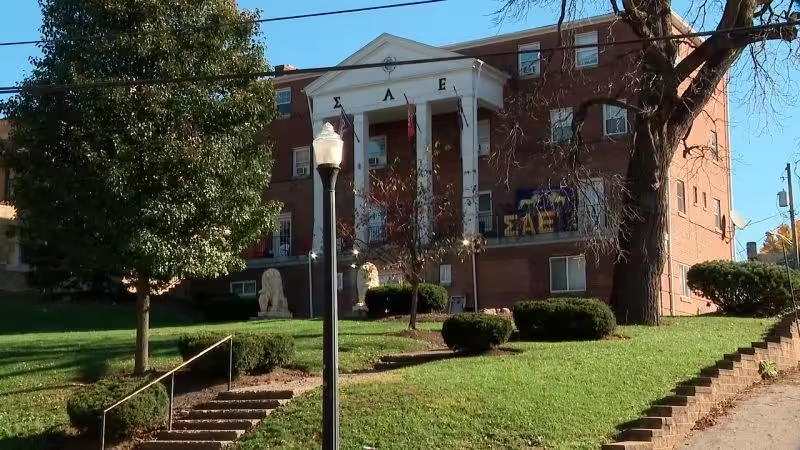
The school’s Sigma Alpha Epsilon chapter is suspended while authorities investigate the “extremely concerning” incident, the university said Monday. The university says it alerted Columbus police about the incident, and police say it appears to have taken place Saturday in a neighborhood dotted with Greek life houses, including the large, four-story brick home of Sigma Alpha Epsilon.
The video begins with a person in gray sweatpants kicking on the ground while their legs are engulfed in flames. A bystander appears to try to put out the fire with an extinguisher but struggles to deploy the fire retardant. The person on fire gets up and runs across the dry, leaf-strewn grass and collides with another person whose pants also appear to be on fire.
A large circle of onlookers in Ohio State jerseys and colors watches as the chaos unfolds, then several people step in to try to extinguish the flames by stomping and pulling the clothes off their bodies.
Both people are “receiving needed medical care,” the university said. The pair in the video suffered second- and third-degree burns, police said in their preliminary report. They were rushed to a hospital in a private vehicle and were in stable condition, a Columbus fire spokesperson told CNN affiliate WSYX. CNN has reached out to the Columbus Division of Fire.
Ohio State fraternity placed on interim suspension after video shows two people on fire

Saturday was a day when Ohio State’s football team played Oregon at home, a game OSU lost 41-28. Though police said the incident happened in a neighborhood with Greek life houses, the exact location isn’t clear. Details about what led to the incident weren’t immediately available.
The university’s action comes amid intensified scrutiny of fraternity conduct – and college administrations’ handling of it – in the fallout from allegations of gang rape at a Cornell University fraternity in New York. A lawsuit filed by a former Cornell student in September returned a spotlight to long-standing concerns about alleged misconduct in Greek life and how schools, investigators and prosecutors respond. On Tuesday, North Carolina State University closed its oldest fraternity indefinitely after hazing allegations prompted a criminal investigation by campus police.
“Ohio State is committed to a safe and healthy environment and expects students and student organizations to uphold that commitment and the university’s values,” Ohio State said Monday.
Police did not receive any calls about the incident on Saturday, but they were alerted on Sunday as the video began proliferating online, Columbus police Sgt. Joe Albert said Monday.
“We will be working with the Ohio State University, as well as the Columbus Division of Fire’s Arson Unit, to determine if any criminal acts occurred,” Albert said. No charges have been announced. The case remains under investigation by Columbus Police and has not yet been referred to the Franklin County Prosecuting Attorney’s Office, a spokesperson for the office told CNN.
A person who called 911 on Sunday night, a day after the incident, told an emergency dispatcher she had seen a 35-second video showing two fraternity pledges on fire, according to a recording of the call obtained by CNN. The concerned caller told police the video was sent to one of her group chats.
“I just want to send (the video) in so that something gets done about it,” she told the dispatcher. “They stood around watching while this kid just burned.”
“One of them got the fire out pretty easily, and the other one was stripped naked and still on fire when the video ended,” the individual said.
The national Sigma Alpha Epsilon organization takes “this matter seriously and are actively investigating the circumstances surrounding the incident while working closely with university officials and local law enforcement,” Steve Mitchell, the fraternity’s national CEO, said in a release.
Ohio State’s chapter represents a national fraternity with a mission of “advancing the highest standards of friendship, scholarship, leadership, and service.”
“Sigma Alpha Epsilon holds its collegiate members to high standards of conduct and accountability,” Mitchell said. “Behavior that violates these standards has no place in our organization. We are committed to holding those responsible accountable and will take appropriate action based on the findings of the investigation.”

The Ohio State Interfraternity Council, a student-led governing body for participating fraternities at the university, said it will revisit its risk management practices and safety education requirements following the incident.
The council encouraged anyone who witnessed or experienced concerning behavior to report it to the university, including through a channel for anonymously reporting suspected hazing.
“We have a responsibility to look out for one another and create an environment where everyone feels safe and respected,” the council said, urging students not to be afraid to speak up or seek help. It also pointed students affected by the incident toward university counseling services and other mental health resources.
Records published by Ohio State show the Sigma Alpha Epsilon chapter has faced disciplinary action several times over the past 25 years, including cases involving hazing, alcohol and behavior the university determined endangered others.
In 2001, Ohio State suspended the chapter for two years after an investigation found violations of university rules governing Greek organizations. The violations included breaches of the Interfraternity Council’s alcohol policy and incidents that the university said “created substantial threat to other persons and property.”
The chapter faced discipline again in 2017, when Ohio State investigated allegations of misconduct. The university found violations involving hazing, endangering behavior and alcohol, resulting in 13 months of probation for the fraternity, university records show.
In 2019, Ohio State’s office of student life investigated Sigma Alpha Epsilon after an intoxicated student was found conscious but nonresponsive and taken to a medical center, according to university records. The chapter was temporarily barred from hosting events involving alcohol after the school determined it violated alcohol policy and failed to comply with previous sanctions, the records say.
Members of North Carolina State University’s Sigma Nu chapter had until Tuesday afternoon to move out of their on-campus house after the school shut down the fraternity indefinitely over hazing allegations that sparked a criminal investigation, the university said.
“NC State does not tolerate hazing. The safety and wellbeing of our students is of the utmost importance,” the university said in a statement on Tuesday.
The university’s police launched a criminal investigation after learning of hazing allegations involving Sigma Nu in September, the school said. The university declined to share details about the allegations in its statement to CNN.
“Anyone found responsible for hazing or in violation of our student conduct policies will be held accountable,” the university said.
CNN has reached out to North Carolina State University police for details about the allegations and the criminal investigation.
The chapter cannot return to campus for at least four years, and school officials will have to agree on conditions for its return, according to the university.
Sigma Nu Fraternity said in a November 5 statement it was “aware of evidence and information” obtained by campus police that “indicates significant and severe violations of not only the laws and principles of Sigma Nu Fraternity and North Carolina State University but also the laws of the State of North Carolina.”
“Those responsible for the heinous and grievous acts found by police must be held accountable by Sigma Nu Fraternity, North Carolina State University, and, if determined applicable, the criminal justice process of North Carolina,” Brad Beacham, Sigma Nu’s executive director and CEO, said in a statement.
Beacham called hazing “an affront to human dignity” and said the national organization fully supports the police investigation and is cooperating with the university and law enforcement.
Source: www.cnn.com