
Tomorrow (11 November), the Peace and Security Council (PSC) of the African Union (AU) is expected to convene its 1378th meeting on Climate, Peace and Security in Africa: Emerging Challenges, Institutional Responses and Future Priorities. The session takes place as the 31st Conference of the Parties (COP31) to the United Nations Framework Convention on Climate Change (UNFCCC) opens in Antalya, Türkiye, coinciding with the first day of the World Leaders’ Summit.
The session is expected to open with remarks by Antonin Benjamin Biéké, Special Envoy of Côte d’Ivoire to the AU and PSC Chairperson for November, followed by a statement by the AU Commissioner for Political Affairs, Peace and Security (PAPS). A statement by the Commissioner for Agriculture, Rural Development, Blue Economy and Sustainable Environment (ARBE) is also expected to feature. In addition, statements are expected from AU Member States, representatives of the Regional Economic Communities/Regional Mechanisms (RECs/RMs), and a representative of the United Nations Office to the African Union (UNOAU).
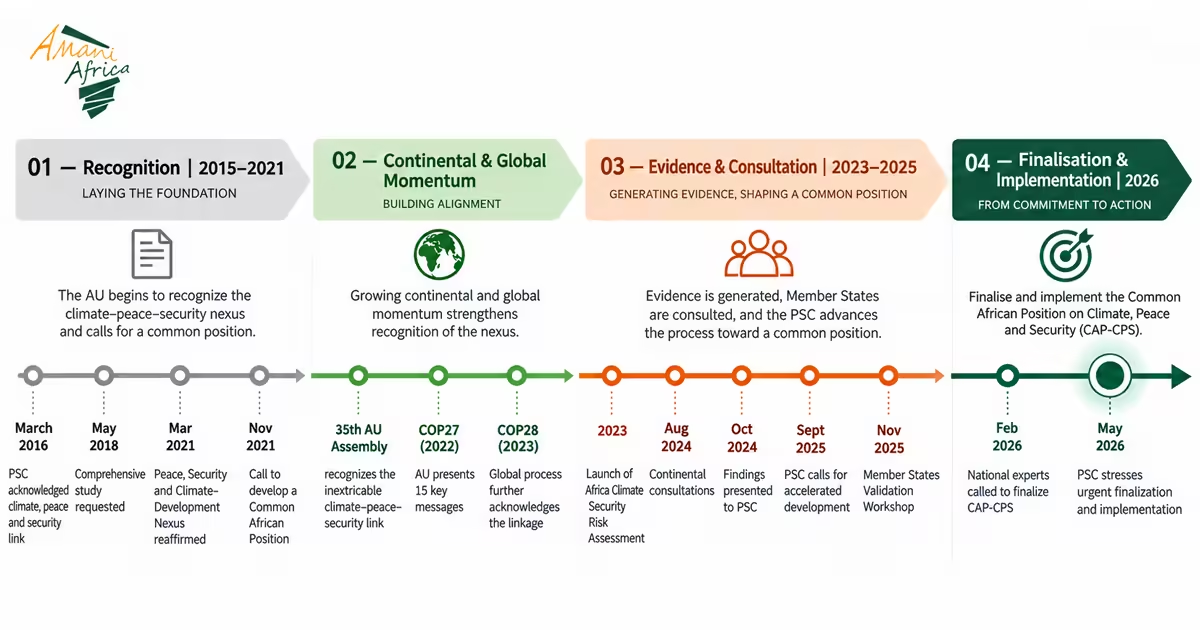
Tomorrow’s session will be the Council’s third dedicated thematic engagement on the issue this year, following its 1331st open session held on 19 February on the nexus between climate, peace and security and its 1344th session held on 4 May on the impact of climate change on the crisis situations in the Sahel and Lake Chad Basin region. The Council’s engagement with the climate-security nexus is a standing thematic agenda of the PSC dating to its 585th session in March 2016, when the PSC first decided to hold annual deliberations on climate change and its implications for peace and security on the continent.
Tomorrow’s session is envisaged to provide an opportunity for the PSC to consider the progress towards and the state of the development of the CAP-CPS and provide guidance on next steps.
The development of the CAP-CPS follows a series of AU and PSC decisions beginning with the PSC’s 774th session in May 2018, which requested a study on the climate–peace and security nexus, and continuing through the PSC’s 1051st session in November 2021 and the AU Assembly’s 35th Ordinary Session in February 2022, both of which called for the finalisation of a climate-security risk assessment and the development of a common African position. In response, the AU Commission, in collaboration with Adelphi, conducted the Africa Continental Climate Security Risk Assessment (ACRA), which analysed key continental climate-security risks and emerging good practices. Its findings, together with the Chairperson’s report on the climate change, peace and security nexus, were considered by the PSC at its 1184th session in November 2023, which requested their consolidation into a comprehensive document and reaffirmed the importance of advancing a CAP-CPS.
Building on these reports, the Commission prepared a draft CAP-CPS and organised a three-day consultation in Nairobi, Kenya, from 27 to 29 August 2024, to further develop the draft. Following the consultations, at its 1240th session, held in October 2024, the PSC, while welcoming the consultations, underscored that the development of the CAP should be data-driven and informed by contributions of Member States and African institutions. Subsequently, in November 2025, an AU Member States validation workshop was convened in Nairobi. The workshop concluded without adopting the draft CAP-CPS, instead producing a five-step roadmap towards its finalisation. Following these developments, the Council, in its February 2026 communiqué, welcomed the progress made and called for validation by national experts from all Member States ahead of Council endorsement. However, rather than undertaking further consultations, the document was subsequently circulated to Member States through digital communication, with Member States invited to provide their inputs. This approach raises questions about the extent to which the consultative and nationally driven process envisaged by the Council or the five-step roadmap adopted during the November 2025 Member States validation workshop has been pursued in the finalisation process.
While considering the key elements of the draft CAP-CPS as updated, having regard to the comments received from Member States that will be presented in tomorrow’s session, some Council members may raise questions that go to its basic rationale, its treatment of sovereignty and ownership, and its institutional design. One of the questions relates to the objective of the CAP, noting that a common position should primarily identify shared political messages for collective voice. If the CAP’s focus were on the question of how AU peace and security policy frameworks and processes, as well as peace initiatives across the conflict policy continuum from prevention to Post-Conflict Reconstruction and Development (PCRD), take account of the impact of climate change, the draft CAP would have been organised to reflect that focus and would be considered as providing guidance on how such account would be given in AU’s engagement, including its coordination globally within the framework of Article 17 of the PSC Protocol. Instead, the draft CAP‑CPS combines diverse issues, including those concerning climate policy writ large as well as impacts of climate change broadly. This raises major policy issues of strategic significance, including risks of securitisation of climate action in Africa and of the blurring of responsibilities for climate, albeit not deliberately but owing to this conflation.
The practice of the development of a CAP within the AU framework is directed towards guiding collective engagement in global policy processes concerning the subject of the CAP. With respect to climate change, the AU already has a strategy and action plan. Unlike such CAPs, the draft, as it currently stands, does not distinguish a common position for international advocacy and policy action, useful for African demands on climate finance, technology transfer, loss and damage, equity and common but differentiated responsibilities, from a mechanism for coordination with respect to CPS at continental and national levels. Instead, it reads as an operational framework providing policy guidance on national action relating to the integration of the peace and security implications of climate change impacts into national security, land, migration and development policy.
The current draft does not establish a substantially new problem. Climate stress, weak institutions, livelihood insecurity, displacement and resource competition are already addressed, in principle, through National Adaptation Plans, Nationally Determined Contributions (NDCs), disaster-risk-reduction strategies, agricultural and pastoral policies, migration frameworks, the AU Climate Change and Resilient Development Strategy, Agenda 2063, the Great Green Wall Initiative, African Governance Architecture, African Peace and Security Architecture and the PCRD Policy. The draft promises complementarity with this policy and institutional frameworks landscape but does not show what a common position adds. Its core justification, that action needs more integrated coordination, treats coordination as an objective rather than a demonstrated gap that demonstrably affects the trajectory of engagement on the CPS agenda. It did so without clarifying whether the real constraint is implementation of existing commitments, financing, capacity, or political will, each requiring a different remedy.
Another point of scrutiny could be the draft’s proposal for an extensive new architecture, integrated early warning, joint risk assessments, continental monitoring, data-sharing platforms, an AU-led Climate Security and Diplomacy Training Academy and new financing instruments. It is not clear whether the AU’s existing Africa Multi-Hazard Early Warning System (AMHEWAS) is the kind of integrated early warning, joint risk assessments, continental monitoring and data-sharing platform that the draft CAP proposed to establish as new. A further issue is how AU’s pursuit of engagement in CPS on the basis of the CAP ensures that it does not deviate from and builds on AU’s existing collective position espoused through the continental strategy and action plan. While it calls for ‘alignment with global frameworks’, it is not specific in affirming existing international legal commitments within the framework of UNFCCC on financing, adaptation, mitigation, and loss and damage. Of significance is the affirmation of the draft CAP of the principle of equity and common but differentiated responsibilities and respective capabilities, although this foundational framework is referenced in the document only in three instances. Another aspect of the draft that deserves attention is the implementation modality. In this respect, the draft leans heavily on partnerships with donors, International Financial Institutions, the UN and the private sector, potentially inviting questions on policy coherence, conditionalities, decisions on priorities and control of data, as well as implications of such arrangements for policy autonomy on agendas on migration, balancing Africa’s development imperative and climate action, border control or critical minerals.
Beyond the CAP-CPS, the session is expected to address both how effective implementation of existing commitments under the UNFCCC in climate finance, adaptation, loss and damage and technology transfer can help address the peace and security implications of the impact of climate change and the need for enhancing access to climate finance for fragile and conflict-affected countries, which currently enjoy the least access. At the continental and global levels, the session may further underscore that climate-peace and security considerations are dealt with as part, rather than outside, of Africa’s climate policy processes and international engagements, including through CAHOSCC, the G20 and COP31, to ensure that the measures required to address the impact of climate change, including loss and damage, take full account of the role of climate as a threat multiplier having a bearing on existing security and conflict dynamics.
The outcome of the session is expected to be a communiqué. The PSC is expected to reaffirm that climate change acts as a risk multiplier, intensifying existing political, socio-economic and governance vulnerabilities rather than serving as a cause of conflict. In this context, the Council is expected to welcome progress towards finalising the Common African Position on Climate Change, Peace and Security (CAP-CPS), while reiterating the importance of Member State ownership, inclusive national consultations, data-driven analysis and coherence with existing AU and regional frameworks. The PSC may also stress that the CAP-CPS is meant to focus on the question of how AU peace and security policy frameworks and processes, as well as peace initiatives across the conflict policy continuum from prevention to Post-Conflict Reconstruction and Development (PCRD), take account of and be informed by the impact of climate change to ensure that preventive diplomacy, peacemaking, mediation, peace support operations and PCRD engagements are fit for purpose. PSC may reiterate its call for practical measures to mainstream climate considerations into conflict prevention and peacebuilding, including the integration of climate-related conflict indicators into early warning and risk assessment systems, improved coordination between early warning, humanitarian and response mechanisms, and stronger collaboration among the AU, RECs/RMs, Member States and relevant regional actors. The PSC is also expected to express concern over the persistent gap between Africa’s climate-financing needs and available resources, and call for scaled-up, predictable, accessible and grant-based financing, with enhanced access to climate finance particularly for fragile and conflict-affected countries. Finally, the PSC may underscore that climate-peace and security considerations are dealt with as part, rather than outside, of Africa’s climate policy processes and international engagements, within the framework of CAHOSCC, the G20 and COP31 as critical considerations to reinforce Africa’s existing positions in global climate policy processes.
Source: amaniafrica-et.org