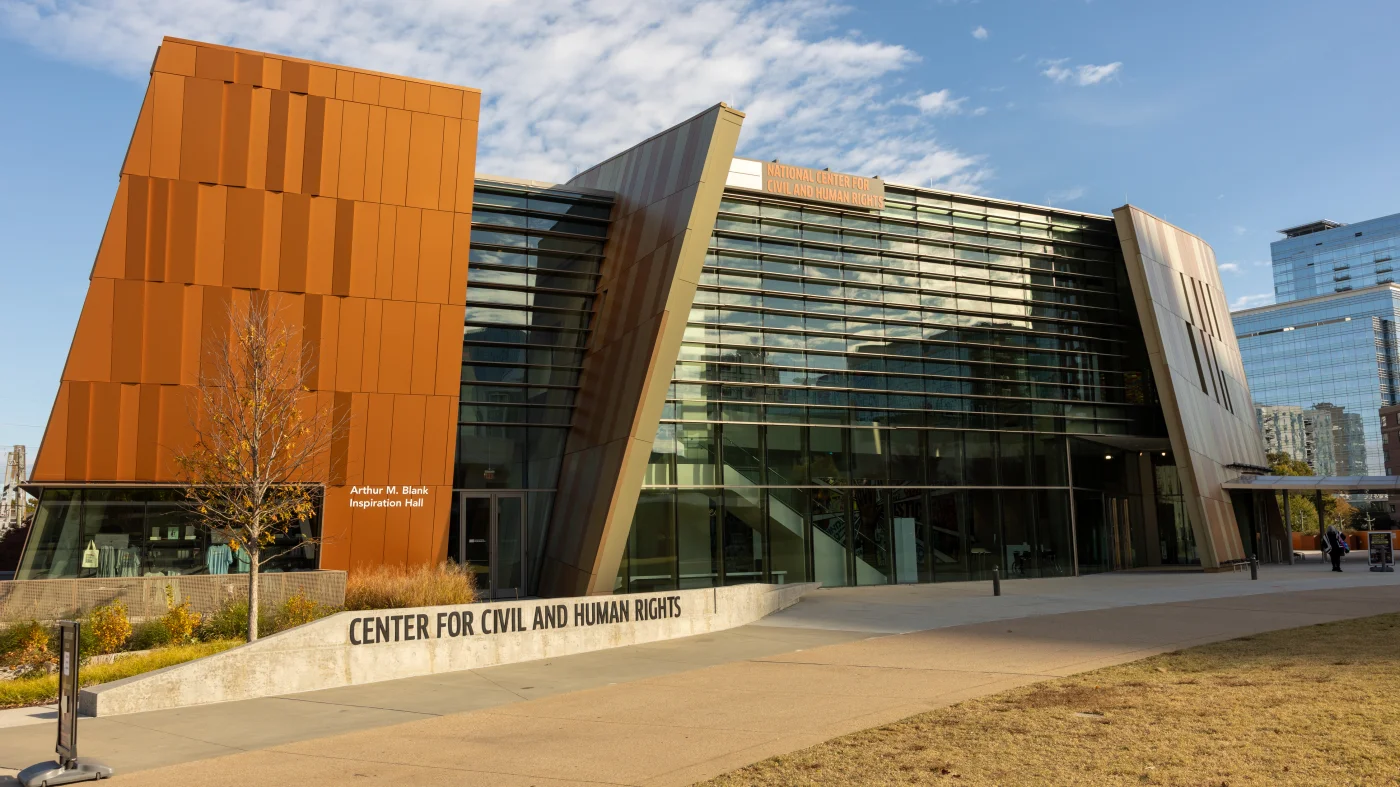

ATLANTA, GA – THURSDAY, NOVEMBER 19, 2026 – Exterior of the National Center for Civil and Human Rights where King’s draft of the speech is displayed.
Lynsey Weatherspoon for NPR
hide caption
Lynsey Weatherspoon for NPR
ATLANTA – The only known draft of one of the most famous speeches in American history is on public display for the first time: The Reverend Martin Luther King Jr.’s remarks at the March on Washington for Jobs and Freedom in 1963. And it’s written in his own hand.
“Just for a few days we have this incredible artifact here, which is Doctor King’s handwritten, final draft of what became known as the ‘I Have a Dream’ speech,” said Jill Savitt, CEO of the National Center for Civil and Human Rights in Atlanta, King’s hometown.
“Nothing has given me chills like this handwritten document, where you see him crafting one of the most iconic speeches in U.S. history.”
It’s written in cursive, blue ink on yellow legal paper. King scratched through entire sections and reworked them, or changed a particular word or phrase.
“You see him on the page wrestling with the words,” Savitt said. “He’s struggling with: How do you make this case to America that we’re not living up to our own ideals?”
The seven-page document, which will be on exhibit here through Sunday, is enclosed in a glass case in a gallery dedicated to the March on Washington. Above the display, footage plays of speeches and the crowd of 250,000 gathered on the National Mall on Aug. 28, 1963.
Savitt said King originally titled the speech “Normalcy Never Again.” Notably, the manuscript does not include what became the most famous lines from that day, “I Have a Dream.”
“Doctor King improvised that,” she said. “The preacher in him connected with a crowd in a particular way. And when you watch footage, you can almost see this electric charge go through him.”
His rousing words that day on the steps of the Lincoln Memorial included:
“I have a dream that my four little children will one day live in a nation where they will not be judged by the color of their skin but by the content of their character. I have a dream today.”
Savitt says King sent the draft to be typed up in the pre-dawn hours from the Willard Hotel in Washington, DC, on the day he was to deliver it.
The handwritten copy of King’s speech was discovered by Xernona Clayton, an Atlanta civil rights leader who worked closely with King and his wife, Coretta Scott King. Her late husband, Edward Clayton, was one of King’s speechwriters.
Now 96, she said in an interview with NPR Thursday she found the papers tucked in a manilla envelope while cleaning out his old desk.
“I knew Doctor King’s handwriting very well, and I said, ‘Oh, this can’t be the speech,'” she recalled. “Then when I started reading it, I knew that it was and then I got scared. Like, what do I do now?”
That was in the late 1990s, and she tucked it back into the desk. She rediscovered it a couple years ago, and it took her back to 1963.
“As I went through the speech, I was reading his words and hearing them in my head,” she said. “Martin Luther King spoke to the world through that speech.”
She decided it was time to share the document with the world. Clayton’s charitable trust is offering it for auction through Christie’s in New York in January, where the auction house says bids could top $10 million. Prior to that, the manuscript also will be on display in Chicago.
Clayton said she wanted it available to the public with the hope that people will find inspiration in King’s words today.
“He used to tell me all the time how much he hated that we as a people can’t live together,” she recalled. “That was his preachment. All of the time he was preoccupied with what can we do to get people to love each other.”
For former Atlanta Mayor Shirley Franklin, who visited the center last week, seeing the document was personal.
“Do you see me?” she asked, pointing to a photograph on display of the crowd at the March on Washington. “I’m sitting right there by the reflecting pool.”
Franklin was Atlanta’s mayor from 2002-2010, the first Black woman elected to lead a city in the Deep South.
“It’s amazing that 60 years later this document has survived,” she said.
Looking at King’s writings, Franklin said she was struck by how thoughtful he was about each and every word.
“As brilliant as he was, as clear as he was about what he was trying to accomplish, it required enhancement and refinement,” she said. “He was making this speech as good as it could be.”
Yet even with all the reviewing and refining, what stuck from that speech never made it on the paper.
“What we remember is the part that came from his heart,” Franklin said. “Gives me the chills.”
Franklin is a living witness to the change wrought by the work of King and others civil rights pioneers, but she said seeing the speech is a reminder that the work is ongoing.
“Sixty years later, we’ve made some progress,” she said. “Much of what he says is relevant today, because we’ve not really fulfilled the full promise of a free and a loving community.”
Franklin helped found the National Center for Civil and Human Rights in Atlanta. She said it’s fitting such a foundational document got its public debut here.
“This is one of my favorite rooms,” she said, as the famous ending of King’s speech played on the screen overhead:
“In the words of the old Negro spiritual, ‘Free at last, free at last. Thank God almighty we are free at last.'”
Source: www.npr.org