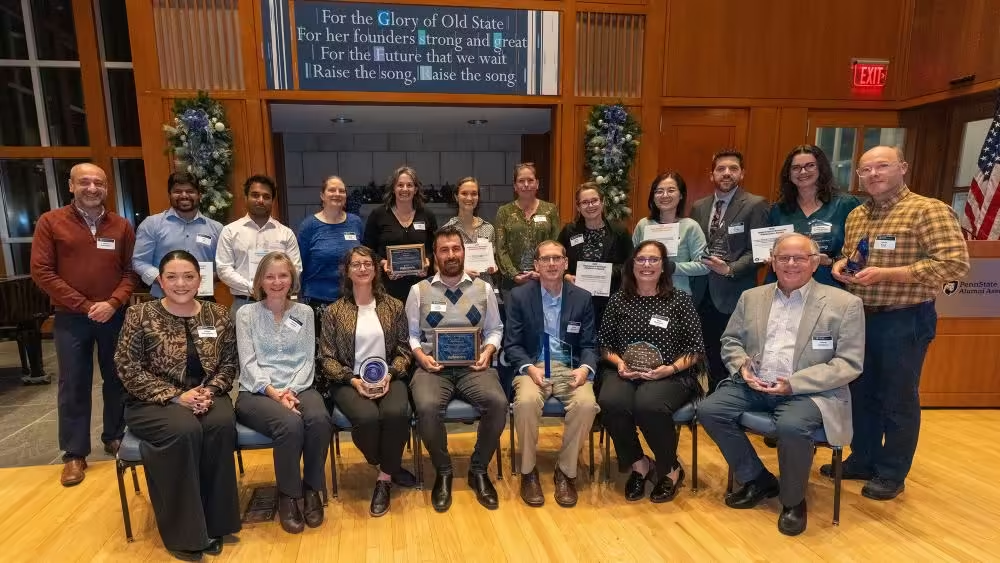

UNIVERSITY PARK, Pa. — Penn State’s College of Agricultural Sciences celebrated research excellence and honored faculty achievements during its 2026 Research Awards Ceremony on Nov. 5 at the Hintz Family Alumni Center on the University Park campus.
Beth Gugino, associate dean for research operations and graduate education and associate director of the Pennsylvania Agricultural State Experiment Station, said the ceremony recognizes the people whose creativity, dedication and collaboration drive the college’s research enterprise forward and strengthen its mission as a land-grant institution.
“Research has always required vision, persistence and a willingness to tackle complex challenges,” said Gugino, adding that the college’s scientists published more than 3,600 peer-reviewed journal articles during the past five years. “This year, more than most, those qualities have been tested and demonstrated across our college community. These awards celebrate not only remarkable achievements, but the resilience, adaptability and commitment that make those achievements possible.”
Troy Ott, Peter and Ann Tombros Dean of the College of Agricultural Sciences, said that despite ongoing uncertainty in the funding environment, college faculty secured $52.3 million in competitive research awards this past year, which is about $10 million more than last year.
“That accomplishment speaks not only to the quality of the science being conducted across the college, but also to the determination and creativity of our researchers in pursuing new opportunities and partnerships,” said Ott, who also serves as the director of the Pennsylvania Agricultural State Experiment Station. “That work advances scientific knowledge. It addresses real-world challenges. It strengthens communities. It supports producers and industry partners. It helps prepare the next generation of leaders who will carry this work forward. And it improves the lives of people and the health of the systems upon which they depend.”
The awards and recipients are:
Alex and Jessie C. Black Excellence in Research Award
The Black Award honors tenure-track faculty for exceptional and original agricultural research. It is named after the late Alex Black, a professor of animal nutrition and associate director of the Agricultural Experiment Station, and his wife, Jessie Clements Black.
This year’s recipient is Kevin Harvatine, professor of nutritional physiology and the C. Lee Rumberger and Family Chair in Agricultural Sciences in the Department of Animal Science, who has established one of the world’s leading research programs in dairy nutrition and lactation physiology.
His pioneering work on fatty-acid metabolism, milk fat synthesis, rumen function and circadian rhythms has advanced understanding of milk production while delivering practical benefits to dairy producers. An internationally recognized scholar, he has authored more than 130 peer-reviewed publications, delivered more than 170 invited presentations worldwide, secured significant competitive research funding and mentored generations of scientists.
Early Achievement in Research Award
Mônica Kersch-Becker, assistant professor of entomology, is the recipient of the Early Achievement in Research Award.
Since joining Penn State in 2022, Kersch-Becker has established an internationally recognized research program examining how plant defenses, insects, microbes and environmental stress interact to shape ecological communities and ecosystem services. Her work advances biodiversity conservation, sustainable agriculture and crop protection.
She has secured more than $2.3 million in competitive funding, published 34 peer-reviewed articles and received the U.S. National Science Foundation CAREER Award for her pioneering research on plant defenses and species interactions.
Research Innovators of the Year
Mark Guiltinan, professor of plant science, and Siela Maximova, research professor of plant science, shared the Research Innovator of the Year honor for their more than 30-year partnership in transforming cacao biotechnology and creating new opportunities for farmers and industry.
Their pioneering research has built the scientific and biotechnology foundation for improving Theobroma cacao, the tree that produces the world’s chocolate. They developed foundational technologies for cacao tissue culture, genetic transformation and plant regeneration that are now used worldwide. Their work has enabled the commercial propagation of more than 75 million cacao plants and established Penn State as a global leader in cacao research.
The award celebrates their achievements in successfully translating insights from model plant systems into licensed technologies for a globally important crop. Recent milestones include licensing of gene-edited, disease-resistant cacao technology to Agronetica, a subsidiary of BetterSeeds, and developing an innovative cell-culture platform to produce cocoa butter and other high-value compounds.
Research Professional Staff Awards
Research Professional Staff Awards were given to Jen Williams, research operations technologist in the Department of Animal Science, and Cody DePew, research technologist in the Department of Plant Science.
Williams provides essential support for laboratory operations, purchasing, safety and compliance, ensuring faculty, staff and students have the resources needed to conduct research, while DePew has helped advance Penn State’s leadership in root and rhizosphere biology by supporting research in crop improvement, root architecture and plant-environment interactions.
Land-Grant Research Impact Fellows
Michela Centinari, associate professor of viticulture in the Department of Plant Science, and Adrian Barragan, associate research professor and extension veterinarian in the Department of Veterinary and Biomedical Sciences, were named as 2026 Land-Grant Research Impact Fellows.
Each will receive $30,000 per year for three years to advance research that turns scientific discoveries into practical solutions with real-world impact.
Through the fellowship, Centinari will develop science-based decision tools to help growers manage spotted lanternfly infestations, reduce unnecessary pesticide use and protect crop yields, building on research conducted through a $7 million multistate U.S. Department of Agriculture initiative.
Barragan will use his fellowship to advance his “Target Cow” approach, integrating microbiome science and animal health data to identify cattle at risk for disease and help producers improve animal welfare, reduce antibiotic use and increase profitability.
Dennis and Janet Scanlon Integrated Team Research Award
The Consortium for Cultivating Human and Naturally reGenerative Enterprises (C-CHANGE) Grass2Gas team received the Dennis and Janet Scanlon Integrated Team Research Award for its integrated approach to improving farm profitability, renewable energy production and environmental outcomes.
Led by Christine Costello, associate professor of agricultural and biological engineering, and Dan Ciolkosz, associate research professor of agricultural and biological engineering, the U.S. Department of Agriculture (USDA)-funded initiative brings together researchers, Penn State Extension educators, engineers, economists, farmers and industry partners to address complex agricultural challenges.
The team has developed decision-support tools, farm business resources and educational programs reaching thousands of stakeholders. Its work has produced 18 peer-reviewed publications and supported students at multiple levels. The team exemplifies how collaborative, stakeholder-driven research can translate scientific discoveries into practical solutions for agriculture and renewable energy.
Interdisciplinary Team Research Award
The Cover Crop Cocktails Long-Term Experiment Team, led by Jason Kaye, distinguished professor of soil biogeochemistry, along with colleagues from across the college, received the Interdisciplinary Team Research Award for more than a decade of collaborative research advancing sustainable agriculture.
Established in 2012 at the Russell E. Larson Agricultural Research Center at Rock Springs, the project examines how cover crop species and mixtures affect soil health, nutrient cycling, crop productivity, pest management and agricultural resilience.
Guided by a farmer advisory board, the team has secured millions of dollars in external funding, produced highly cited research, trained emerging scientists, and translated findings into practical recommendations for farmers in Pennsylvania and beyond.
High-Impact Research Publication Awards
Six research groups received High-Impact Research Publication Awards, recognizing peer-reviewed research that demonstrates significant impact.
Biodiversity: “Complex Multitrophic Species Interactions and Fitness Costs: Intricate Consequences of Jasmonate and Salicylate-induced Plant Defenses,” published in the Journal of Animal Ecology. This research was led by faculty in the Department of Entomology.
Climate-Smart Agriculture and Forestry: “Tomato Defenses Under Stress: The Impact of Salinity on Direct Defenses Against Insect Herbivores,” published in Plant, Cell and Environment. Scientists in the Department of Entomology conducted this research.
Human and Community Dynamics: “Severe Floods Increase Long-term Opioid Overdose Mortality,” published in the Proceedings of the National Academy of Sciences. Faculty in the Department of Agricultural Economics, Sociology, and Education led the study.
Integrated Ecosystems: “Reducing National Water Degradation: Development and Application of a Manure Shed Identification Framework,” published in Agricultural Systems. This research was led by faculty in the Department of Agricultural and Biological Engineering and the USDA Agricultural Research Service.
Nutritional and Food Security: “Variations on the Thrifty Food Plan: Model Diets That Satisfy Cost and Nutrition Constraints,” published in Food Policy. Faculty in the Department of Agricultural Economics, Sociology, and Education led this study.
One Health: “Genomic Evolution of Salmonella Dublin in Cattle and Humans in the United States,” published in Applied and Environmental Microbiology. Scientists in the Department of Animal Science led this study.
Roy C. Buck Faculty Award
Paige Kelly and Andrew Smolski, both assistant professors in the Department of Agricultural Economics, Sociology, and Education, received the Roy C. Buck Faculty Award, which recognizes outstanding research published by early-career, tenure-track faculty in the social and human sciences.
Kelly’s study, “The Local Welfare State and Differences in Racialized Poverty,” was published in Sociological Quarterly. Analyzing data from more than 2,100 U.S. counties, she examined how local government capacity and spending influence poverty outcomes and found that benefits vary across racialized populations.
Smolski’s paper, “Agrarian Frames, Farm Financial Crisis and Farmer Stress: A Qualitative Comparison of Small-Scale Farmers,” was published in Rural Sociology. Based on interviews with small-scale farmers in the southeastern U.S., his research examines how farmers experience financial hardship, stress and mental health challenges.
Source: www.psu.edu