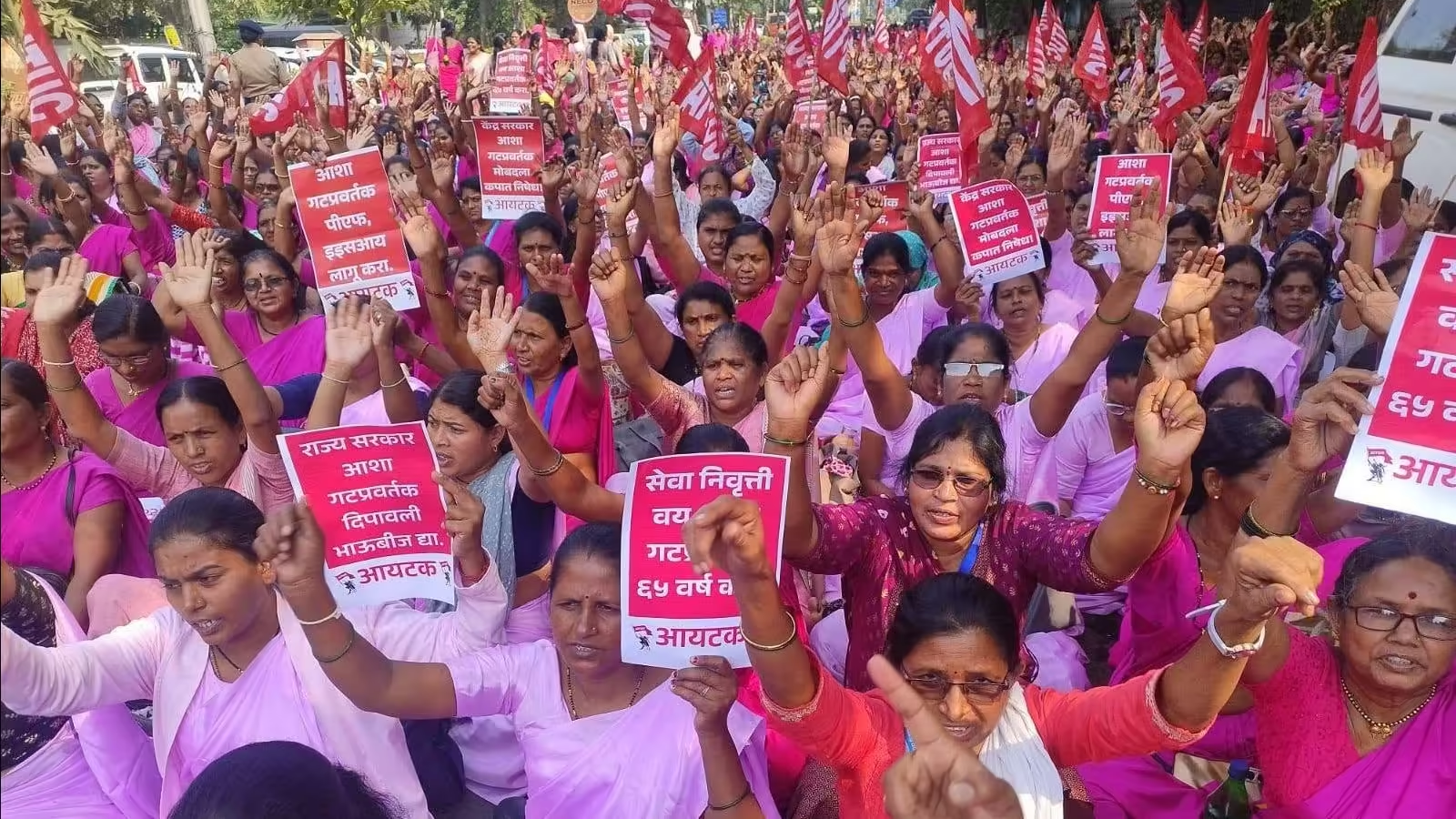

Recent weeks have seen an upsurge in worker struggles across India fueled by rising food and fuel prices, poverty wages, precarious and especially exploitative contract-labour employment and the privatization push of the BJP-led central government and state governments of every political stripe.
Workers numbering in the millions and from numerous economic sectors have been involved. Of particular note are struggles of textile workers in Surat in the west Indian state of Gujarat; ASHA healthcare workers in Uttar Pradesh and Maharashtra (India’s two most populous states); electricity power-grid workers in Haryana; state government employees in Punjab and bank workers across India. Most of these struggles are ongoing, with the unions only calling outside-of-work agitations or time-limited strikes. Frustrated with the foot-dragging of the union apparatuses, there are also growing instances of workers taking matters into their own hands as happened in Noida last April.
A major factor fueling social opposition is the spike in prices triggered by the US-Israeli war on Iran—a criminal war in which India’s Narendra Modi-led government is complicit, as it is a strong military-security ally of both Washington and Tel Aviv. But the wave of strikes and protests is also in response to the government’s continued austerity drive, its implementation of new labour codes meant to further “normalize” hire-and-fire contract employment and the gutting of the state “rural employment guarantee,” which was undertaken with the express aim of depressing rural wages.
These workers’ struggles have developed in parallel with a youth-led wave of protests against the Hindu supremacist BJP government’s purge of the electoral rolls. Under the Election Commission’s Special Intensive Revision (SIR) of the voter lists, millions of Muslims, Dalits and other poor people have been struck from the electoral rolls in a massive voter-suppression drive.
Initiated by the Cockroach Janata Party (CJP)—a newly founded, “Gen Z” student protest movement—the anti-SIR protests have rattled Prime Minister Narendra Modi’s far-right regime.
It has gone to extraordinary lengths to try to stamp them out. In a failed attempt to prevent an October 10 Delhi protest rally called by the CJP and supported by the Stalinist “Left” parties and their student organizations, the authorities pre-emptively arrested thousands across the country, shut down transport to and within India’s capital, and mobilized tens of thousands of police and Central Reserve Police Force (CRBF) paramilitaries. Dozens of trains were cancelled, much of the city’s subway system shut down, and checkpoints set up at all major road entries to the National Capital Territory. In an article published the next day, the World Socialist Web Site observed, “In what is a major step toward consolidating a dictatorial regime, the Modi government is seeking to criminalize a burgeoning opposition movement that has galvanized students and recent college graduates across the country and is increasingly drawing in broader sections of the population.”
In the run up to a subsequent protest, top CJP leaders were detained and only released post-event and after the authorities had extorted legally binding guarantees from them that they will abide by undemocratic government orders banning protests. Neha Bora, the president of the Maoist-aligned All India Students’ Association (AISA), who was detained and “disappeared” for the better part of a day to prevent her from attending the October 16 Delhi protest, is to appear before a Special Magistrate later this month because she has refused to sign a “peace bond.”
Recent days have seen still further repressive moves on the part of the Modi government. At a Supreme Court hearing November 4, Solicitor General Tushar Mehta argued that protest organizers should be forced to pay for any “losses” businesses have incurred due to the “disruption” the protests caused. In fact, far and away the biggest cause of any disruption to “daily life” associated with the recent protests was the draconian security measures implemented at the government’s orders.
To provide a pretext for intensified repression and mobilize its far-right cadre, top BJP leaders like Home Minster Amit Shah and Uttar Pradesh Chief Minister Yogi Adityanath are making wild claims of “foreign involvement” in the protests and organizing counter-protests under the slogan “Save Democracy, Remove Anarchy.” Speaking before CRPF troops in Bastar, Chhattisgarh, on Sunday, Modi boasted that the Indian state had crushed the longstanding Maoist or Naxalite guerrilla insurgency. But, he continued, “there is a need to save our country from ‘Dimagi-Naxals (intellectual Naxalites) … ‘Dimagi-Naxals’ have captured various institutions and are instigating people against the country’s Constitution and democracy.”
The government’s greatest fear is that the working class will intervene in the swelling anti-government protests and do so as an independent political force, using class struggle methods.
Last April, when worker protests and strikes erupted in the Delhi industrial suburbs of Noida, Uttar Pradesh and Manesar, Haryana, they were met with savage repression. Police brutally attacked workers peacefully protesting against miserable wages, long hours and contract jobs. Hundreds were arrested on trumped up charges of rioting, after they sought to defend themselves from the police assault.
Similarly, in Surat, the authorities are working hand-in-glove with the employers in repressing protests by textile workers. Hundreds of workers have been arrested and/or fired for joining demonstrations on August 16 and October 15 to demand payment of their back-wages and enforcement of the legally prescribed limits on forced overtime, including the right to at least one day off per week. In both instances, police lathi-charged the workers.
However, the political forces in the leadership of the youth protests—the petty bourgeois CJP and the various Stalinist parties and their respective student organizations—are implacably opposed to the mobilization of the social power of the working class in an industrial and political offensive against the Modi government and the capitalist oligarchy that stands behind it.
They refuse to link the struggle against the BJP’s drive to suppress the votes of what are primarily working-class people and rural toilers to the fight against ever-increasing worker-exploitation, ever-widening social inequality and the diversion of massive social resources from vitally needed public services to the build-up of India’s military might.
While warning that democracy is in peril, the CJP and Stalinists have limited the protests over the purging of the electoral rolls to calls for the removal of Chief Election Commissioner Gyanesh Kumar, who is nothing more than a flunky of Modi and the BJP government, and for the suspension of the SIR.
This goes hand in hand with their efforts to politically chain the youth protests to the parties and institutions of India’s capitalist elite, whose wealth has grown exponentially since the turn of the century even as the workers and toilers, who comprise the vast bulk of the population, remain mired in hunger, squalor and want.
While the CJP has been oriented to pressuring the government and political elite since its emergence last June and the Stalinists have long been an integral part of the political establishment, their respective efforts to corral the youth protests behind the Congress Party-led INDIA opposition bloc greatly intensified in the wake of the Modi government’s dictatorial response to the October 10 Delhi protest.
Acting on the instructions of the Maoist Communist Party of India (Marxist-Leninist) Liberation, AISA President Bora appeared just two days later at a Congress Party-led anti-SIR rally, arm-in-arm with Rahul Gandhi, the Congress Party’s dynastic leader and the head of the Official Opposition in parliament. The Congress Party had instructed its own youth organization to stay away from the October 10 protest, because it didn’t want to be seen countenancing a “radical” protest held in defiance of a government ban.
The CJP has similarly declared its support for the Congress and INDIA bloc organized protests, while curtailing its own activities in the face of the repressive actions of the state.
Comprised of more than two-dozen parties, many of them one-time BJP allies, the INDIA bloc offers the Indian ruling class an instrument for establishing an alternative right-wing government—no less committed than the BJP to pro-investor reform and India’s anti-China “global strategic partnership” with US imperialism—should Modi falter. Any differences the Congress Party and its INDIA bloc allies have with the Modi regime’s class-war agenda are tactical, with many of them born of their anger and resentment over the extent to which the BJP, in cahoots with various billionaire oligarchs like Adani and Ambani, has monopolized political power, thereby cutting them off from access to state largesse.
The Congress Party led-state government in Karnataka has repeatedly demonstrated that like the Modi government, it is ready to repress left-wing opposition: first banning a CJP demonstration and then an October 31 protest by sugarcane farmers. In the latter case, the state government carried out a massive deployment of state police to prevent the farmers from blocking the Pune-Bengaluru National Highway.
Keenly aware of the need to burnish the Congress Party’s tattered “progressive” credentials under conditions of mounting popular anger against the BJP government, its leadership gave prominence to the “Left” parties at its November 1, “Vote Bachao, Desh Bachao” (Save the Vote, Save the Nation!) rally in Delhi and the latter were more than happy to oblige. The leaders of all three Stalinist parties—the CPM’s M.A. Baby, the CPI’s D. Raja and Dipankar Bhattacharya, the general-secretary of the CPI (ML) Liberation—all appeared alongside Gandhi.
In the name of blocking the rise of the Hindu right, the Stalinists have for decades suppressed the class struggle. They have confined the mass working class opposition to poverty wages, privatization, and the explosive growth of contract labour to isolated collective bargaining struggles, while politically harnessing workers to the Congress and other right-wing capitalist parties. With the working class prevented from advancing its own socialist solution to the social misery wrought by capitalism, the BJP has only grown stronger, emerging as the premier party of the Indian bourgeoisie, which is desperate to secure its “place in the sun” under conditions of deepening global capitalist crisis.
Now with the Modi regime facing mounting popular opposition, the Stalinists are once again in the forefront of the efforts to politically derail it. On the one hand they tie opposition to the BJP’s voter-suppression, evisceration of democratic rights and communalist incitement to the right-wing INDIA bloc and boost fatal political illusions that democratic rights can be defended through the courts, and the other rotting, increasingly Hindutva-ized institutions of Indian capitalist democracy. On the other, they are seeking to prevent the unification of the burgeoning struggles of the working class over vital social-economic issues into a general working-class industrial and political counter-offensive. Their various union fronts, beginning with the CITU and the AITUC, have done nothing to mobilize the working class in the struggle against SIR. Moreover, were they obliged to call protests against the voter-suppression drive or the government’s brutal repression of the students, it would be from the standpoint of preventing the working class intervening as an independent political force and tying it to the INDIA bloc.
The pivotal question is the development of a new revolutionary party of the Indian working class based on the Trotskyist program of Permanent Revolution that animated the October 1917 Russian Revolution and the struggle against its Stalinist degeneration. The social and democratic rights of India’s workers and toilers can only be secured in so far as the working class separates itself from all the political representatives of the Indian bourgeoisie and mobilizes the rural poor behind it in the fight against the Modi government and Indian capitalism as an integral part of an offensive of the global working class for socialism.
Source: www.wsws.org