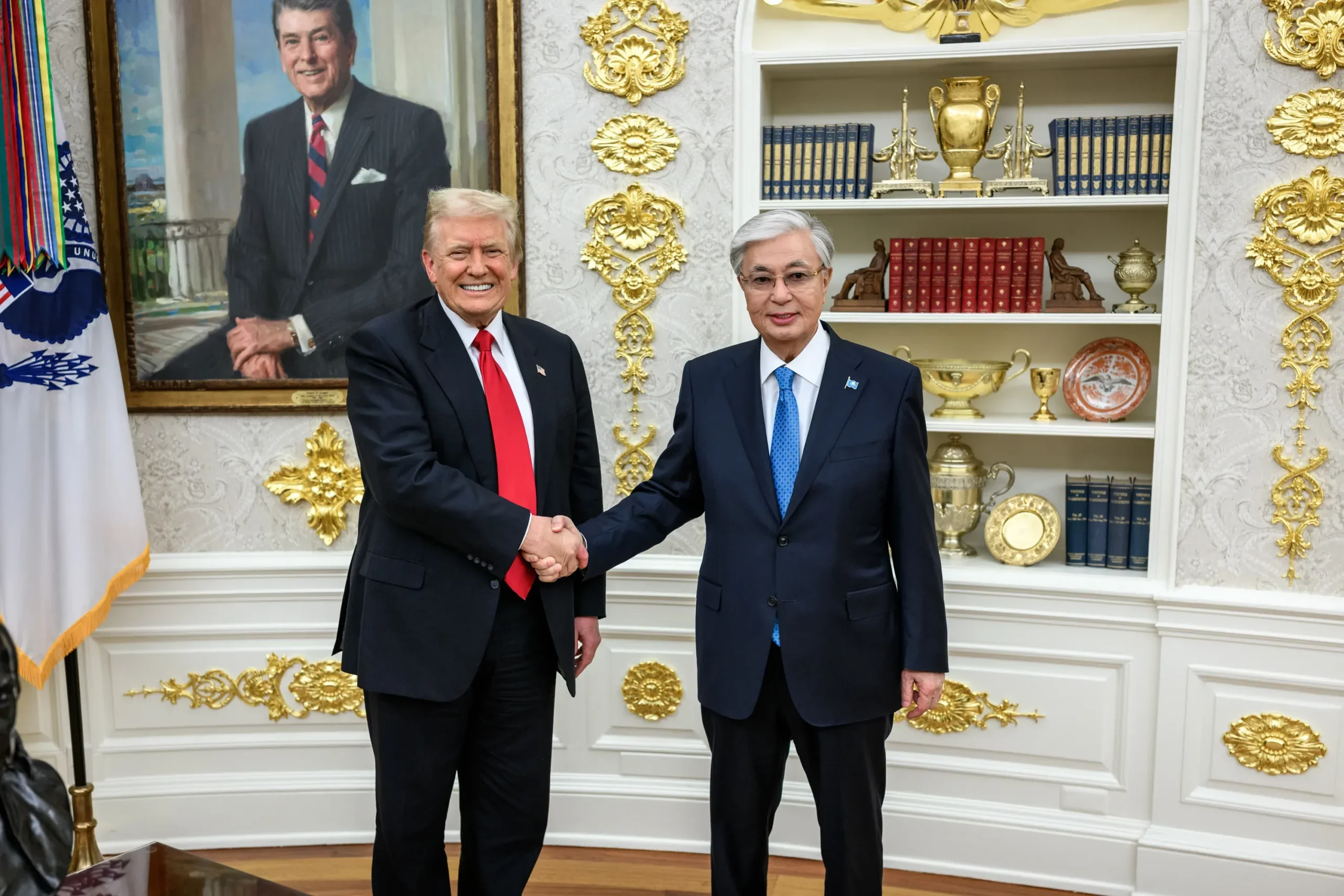

When Secretary of State Marco Rubio announced his plans to attend Samarkand this past October for a C5+1 ministerial, he said that more than a hundred American companies would accompany him in a historic business delegation. It was the latest sign of Washington’s renewed interest in Central Asia, and yet it also served as a blatant reminder of who was not there. After over thirty years of diplomatic relations, no sitting U.S. president has ever visited Kazakhstan. This lack of a presidential visit risks ceding ground to Russian and Chinese inroads in the region, and has the potential to leave the United States less connected to a country it increasingly needs. The Trump administration has the opportunity to strengthen U.S. engagement with Kazakhstan and preserve Washington’s strategic foothold in Central Asia by breaking this longstanding precedent and making a presidential visit to Astana in order to prove that the United States takes Kazakhstan seriously as a partner.
Kazakhstan’s Significance
Kazakhstan’s strategic importance is tied directly to its resources As the world’s largest uranium producer, Kazakhstan has accounted for approximately 40 percent of global uranium mine production in 2025. It also accounted for 28% of uranium delivery to U.S. reactors in the same year, second only to Canada. Its largest oil fields are run by consortia that include ExxonMobil and Chevron, giving American companies a direct stake in the country’s stability.
Kazakhstan’s significance is also geographic. Landlocked between Russia and China, it sits at the center of the Eurasian land bridge that made the region a corridor of the ancient Silk Road, and today it serves as a transit hub for trade and energy moving between Asia and Europe. But this position comes with challenges. According to the U.S. Energy Information AdministrationKazakhstan relies heavily on pipelines crossing through Russian territory, exposing its energy sector to disruptions beyond its control. The Caspian Pipeline Consortium (CPC) is responsible for carrying upwards of 80% of Kazakhstan’s crude oil, which runs directly through Russia’s port of Novorossiysk. Kazakhstan’s reliance on the pipeline has made it susceptible to disruptions made by Russian authorities. According to the World Bankthe Russian government has repeatedly closed the CPC on various occasions due to reports of storm damage and the discovery of unexploded mines nearby two of their facilities. Just last year, Ukraine targeted multiple facilities within the pipeline in strategic strikes against Russia, forcing Kazakhstan to bear the brunt of the fallout.
Alternative export routes would reduce Kazakhstan’s dependence on Russian transit and help keep oil and uranium shipments moving during disruptions. Expanding routes across the Caspian Sea, for example, would give Kazakhstan and its international partners a way to keep more of its oil in the global markets. These efforts to develop alternative export routes therefore carry strategic implications for Kazakhstan and its international partners.
A History of Engagement
Kazakhstan’s strategic importance has long been reflected in its relationship with the United States. Since Kazakhstan gained its independence, the two countries have built a steady partnership. Thirty years ago, the United States cooperated with Kazakhstan in Operation Project Sapphiredisposing of 600 kilograms of highly-enriched uranium found within Kazakh territory after the Soviet Union collapsed, strengthening nonproliferation efforts. Just eleven years ago, the Obama Administration established the C5+1 diplomatic platformpromoting regional diplomacy within the Central Asian republics, including Kazakhstan, the Kyrgyz Republic, Tajikistan, Turkmenistan, and Uzbekistan. Moreover, last November, Kazakhstan President Tokayev made his first ever visit to Washington for the first-ever C5+1 summit hosted in the United States, where the two leaders announced Kazakhstan’s entrance into the Abraham Accords, along with commercial deals exceeding $17 billion. These developments are promising, but the lack of a presidential visit to Kazakhstan demonstrates Astana’s continuing secondary status in Washington’s Central Asian strategy.
What a Presidential Trip Does
A presidential trip does something a secretary cannot. While a secretary of state can represent the president and advance their policies abroad, a president’s decision to show up in person signals to the host country that the relationship warrants the president’s own time and attention. Since presidential time and attention are finite, and the decision to meet face-to-face carries particular weight, the value of a presidential visit becomes a lot stronger. Taking the time to pursue a diplomatic relationship abroad is weighed as an opportunity cost against staying behind and pushing for domestic policies at home, or pursuing foreign policy objectives elsewhere. Choices like these give a presidential visit its diplomatic weight. Thus, engaging in a presidential visit portrays a sense of importance that sending other government officials cannot convey.
Through repeated visits to Astana, Russian and Chinese presidents have signaled that Kazakhstan remains a diplomatic priority for both countries. Washington announced a New Silk Road initiative in 2011, but did not accompany it with a U.S. visit from a top official. Instead, the country was visited a year later by the Principal Deputy Assistant Secretary for the Bureau of South and Central Asian Affairs. A top official visit to Astana from the very start could have given Washington and Kazakhstan a chance to identify areas that served Kazakhstan’s own trade priorities, proving the United States’ interests in diplomacy to be genuine. Ultimately, the New Silk Road initiative fell through.
In contrast, just two years later, China launched its own “Silk Road Economic Belt,” with President Xi Jinping personally traveling to Astana to make the speech. Not only has the Silk Road Economic Belt in, China has recently overtaken Russia as the largest trading partner of the Central Asian republics. President Jinping has also visited Kazakhstan multiple times within the last five years, solidifying a desire to expand relations further between the two countries. Through China’s clear diplomatic endeavors, the familiar label of Kazakhstan being “Russia’s backyard” is now becoming obsolete. Regardless, President Vladimir Putin has also made multiple state visits to Kazakhstan, most notably for a CSTO security summit in November of 2024. Meanwhile, no U.S. president has set foot on Kazakh soil.
A presidential visit to Astana should have two priorities. The first would be to expand upon civilian nuclear energy cooperation by making Kazakh uranium more available to U.S. energy markets. The second would be to encourage American investment in Caspian ports and shipping so that Kazakhstan can bypass Russia through its oil exports. The broader security implications for these ideas would be Kazakhstan’s ability to pursue foreign policy independently of Russian and Chinese interests, as increased ties with the United States would allow Astana more leeway to engage with Russia and China on its own terms. Being able to communicate this with a presidential visit would alert Russia and China that the United States takes a serious interest in Kazakhstan.
What Does This All Mean?
The United States acknowledges Kazakhstan as a strategically important ally, but has not communicated this effectively enough through action. Today, the United States has demonstrated its stake in Kazakhstan primarily through cooperation on uranium and oil. Even though the current C5+1 forums have been successful, engagement between the two countries dates all the way back to Kazakhstan’s independence over thirty years ago. This kind of record makes the absence of a presidential visit from the United States even more striking. Meanwhile, Russia, China, and various other state leaders have all visited Kazakhstan routinely over the last few decades, showcasing a commitment to diplomacy in the strategically critical region. A presidential visit to Astana would show that Washington values its partnership with Kazakhstan just as much as they do.
What To Do About It
The case for a presidential visit is not that Kazakhstan deserves attention, but that Washington has an opportunity to turn existing cooperation into lasting influence. The question is whether the United States can build deeper ties with Kazakhstan and keep a foothold in a region where Russia and China have considerable sway.
To do that, the Trump Administration can build on existing momentum. The 2025 C5+1 summit and this October’s ministerial in Samarkand are starting points. Tokayev invited Trump to Kazakhstan, and Trump has called a visit “very possible.” Then, it should treat the coming months as a sequence. If Tokayev attends the G20 summit in Miami in December, the two presidents could set a date for a 2027 Central Asia tour with Astana as a principal stop. Visiting Kazakhstan would build upon the diplomatic symbolism of the summit by advancing nuclear-energy cooperation and expanding upon American investment in the region, further supporting regional connectivity. After over thirty years of diplomatic relations, it is time for an American president to make the journey.
Image Credit: The White House, Daniel Torok
Source: gssr.georgetown.edu