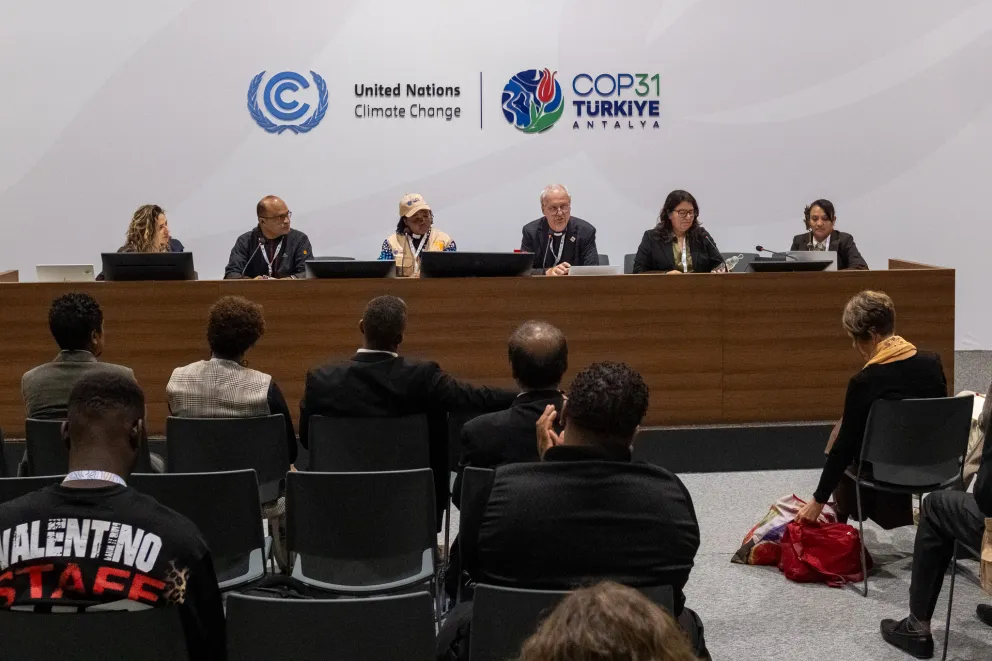

The event was called “Just Transitions away from Fossil Fuels: Voices from Faith Communities.” The WCC organized it with Franciscans International, the Lutheran World Federation, Dominicans for Justice and Peace, and the All Africa Conference of Churches.
“Consultation is not consent. A meeting is not a mandate,” said Gunadule theologian Jocabed Solano, one of five panellists. Negotiator for Panama and a member of the WCC’s Ecumenical Indigenous Peoples’ Reference Group, she asked that Indigenous peoples move from stakeholders to co-governors of the transition, with a seat where decisions are made. She called for free, prior, and informed consent, the right of a people to say yes or no before a project on their land goes ahead, to be applied in full.
Solano, who is also a member of the WCC’s Commission on Climate Justice and Sustanoable Development, said this includes peoples in voluntary isolation and initial contact, who live apart by choice or have only recently met outsiders. Their choice to remain apart must be protected. Traditional knowledge, she added, is not a database for others to use, and less than 1 percent of international climate funding for land and forests reaches Indigenous peoples and local communities.
Source: www.oikoumene.org