

Federal regulators approved the Watchman heart implant for a limited group of patients.
But that didn’t stop Boston Scientific from courting thousands of doctors and buying TV ads to promote it to a far broader population, creating a $2 billion juggernaut.
Despite all the setbacks, Boston Scientific won’t stop pushing the Watchman.
The medical-device giant committed hundreds of millions to acquire the tiny heart implant more than a decade ago, and then endured a years-long debate at the Food and Drug Administration over whether to approve it.
When that approval finally came through, for a limited pool of patients, Boston Scientific was prepared with a plan for something much larger.
The Watchman, company executives believed, had all the makings of a blockbuster.
It was a new kind of treatment for millions of people with atrial fibrillation, also known as A-fib, an irregular heartbeat that can feel like a chest full of angry butterflies. More dangerously, A-fib increases a person’s risk of stroke by five times.
For generations, the best way to ward off stroke was taking a blood thinner pill every day, basically forever, to stop clots from forming. But those medications have their own risks, ranging from extra-bloody shaving nicks to internal bleeding after a bad fall.
The Watchman was designed to prevent strokes in a different way. The quarter-sized, umbrella-shaped device is meant to seal off a corner of the heart where many clots form, as if capping a well.
Exchange a lifetime of blood thinners for one surgery — that was the pitch.
Then the Marlborough-based company set out to sell it.
The global headquarters for Boston Scientific. (Lane Turner/Globe Staff)
Immediately, there were so-called regional heart centers, including at a hospital in Manchester, N.H., where the company granted deep discounts on cardiac devices, flew a star technician in from Europe to consult, and put company representatives in the operating room to advise surgeons.
By 2017, there was a Watchman specialty center near you — at least 200 across the nation.
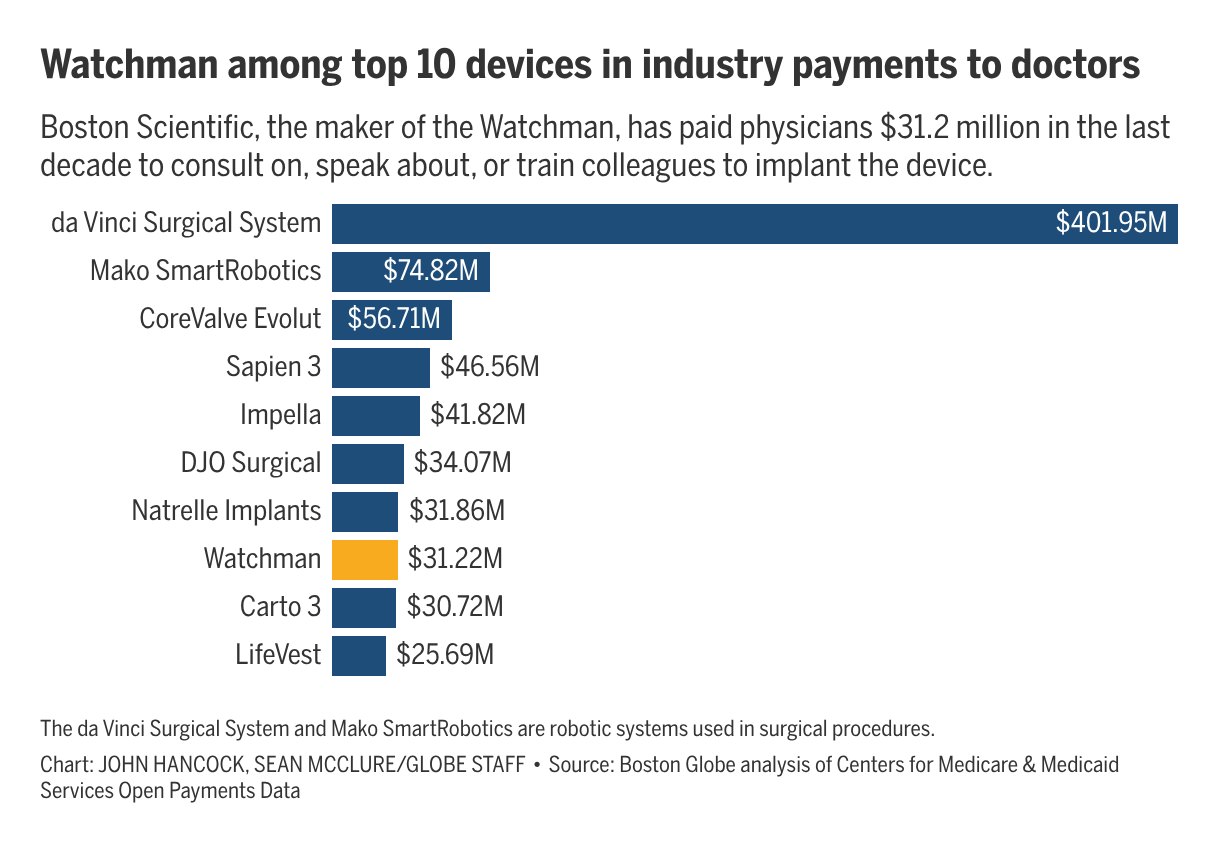
There were consulting and other fees to doctors, more than $30 million and counting.
In 2019, the company launched a national television advertising campaign, a tactic common for prescription medications, but rare for a surgical device classified as high-risk. A “one-time implant that reduces stroke risk and bleeding worry — for life,” the ads promised.
The Watchman — an umbrella-shaped device made of metal and mesh — is typically placed in a patient’s heart after being threaded through a catheter. (Portland Press Herald)
So far, doctors have implanted more than 800,000 devices in patients around the world. In 2025 alone, sales of the device reached nearly $2 billion, up some 30 percent from the year before — “clearly a gem for Boston Scientific,” as company CEO Mike Mahoney declared on an investor call last year.
A gem indeed, at least for Boston Scientific’s bottom line. But there’s been just one complication: The science is far less clear.

There is an ever-expanding gray zone in American health care where medicine and money uneasily mix.
It’s a place where what’s good for patients and what’s good for business can sometimes come into conflict, in a way that may not cross regulatory boundaries but triggers ethical questions just the same.
Should a patient be encouraged to consider an invasive surgical procedure when simply popping a pill gives results that are as good or better?
Enter the Watchman.
Boston Scientific has pushed its flagship heart implant to the far edges of the gray zone, according to The Boston Globe Spotlight Team’s analysis of clinical studies, regulatory documents, and years of financial records and marketing data. The Globe also interviewed more than two dozen cardiologists, clinicians, and researchers across the country who have grown concerned about the device.
The doubts in the medical community increased after recent clinical trials, which showed the Watchman is often no better, and in some cases worse, than a time-tested blood thinner.
And yet the company has ramped up its sales and marketing efforts to help bolster demand for what many cardiologists say are needless procedures.
“Many of us feel that sometimes they’re done inappropriately, that [providers] are too cavalier in how ready they are to place these devices,” said Dr. Gregory Marcus, a cardiologist at University of California San Francisco. “I don’t think it’s responsible medical practice to push for such a device in the great majority of A-fib patients.”
Cardiologist Dr. Gregory Marcus, working in his Parnassus Campus office at the University of California San Francisco. (Jakub Mosur for The Boston Globe)
A doctor who served on two early FDA panels said experts worried about what’s known as “drift,” when the target audience for a drug or device is expanded beyond its proven or intended use. He now believes that’s exactly what’s happening.
Few high-risk devices in recent history have been promoted as heavily as the Watchman. Over the past decade, Boston Scientific has paid doctors more than $30 million to spread the word about it, teach colleagues how to use it, and for consulting. It’s also sunk at least $23 million more into TV commercials targeting patients, according to an industry estimate.
And all of that for a device being placed in patients’ hearts “on the basis of borderline evidence,” as cardiologist Dr. Petr Widimsky put it in a New England Journal of Medicine editorial in March.
The long-simmering debate over the Watchman burst into full boil in medical circles that month, when the prestigious journal published two studies and two editorials that led to serious questions about Boston Scientific’s effort to put the device on par with blood thinners as a “first line” treatment for A-fib.
A change in guidance could grow the pool of people potentially eligible for a Watchman from the current 5 million worldwide to more than 20 million, according to a Boston Scientific estimate.
In an interview, Boston Scientific’s global chief medical officer, Dr. Kenneth Stein, called the Watchman a “proven alternative” to blood thinners, one supported by clinical data.
Stein, a cardiologist, pointed to the estimated 30 to 40 percent of A-fib sufferers who cannot or will not take blood thinners. That group — which includes people with disorders that make them prone to bleeding, those who don’t like the side effects of blood thinners including bruising, as well as people who just don’t like being on the medication — adds up to millions of people who aren’t getting medical help to lower their risk of stroke.
“It’s a tragedy when people who could be prevented from having a stroke have a stroke because they’re left unprotected,” Stein said. “They deserve to be informed about the alternative and to make the decision themselves over whether they want that.”
Boston Scientific does not believe the device “is broadly overused,” company spokesperson Chanel Hastings told the Globe. “We remain unwavering in our confidence in the Watchman device and the extensive clinical evidence supporting its safety, effectiveness and important role in reducing stroke risk for appropriate patients with atrial fibrillation.”
But to others, the rise of the Watchman tells a broader story, a worrisome one, about our health care system.
“The Watchman is emblematic of the flaws of how medical enterprise works,” said Dr. Gregory Katz, a cardiologist at NYU Langone Health. “We do a lot of things that may not actually be the right things for patients.”
The treatment of A-fib is one of the fastest growing areas in medicine.
More than 10 million Americans have been diagnosed with the condition, the most common arrhythmia. It’s an expanding patient pool that comes with opportunity.
One procedure on the rise is ablation, which uses sophisticated tools to disable defective heart tissue and stop an irregular heartbeat. It costs about $50,000 in Massachusetts, where private insurers spend more on ablations than any other outpatient procedure. Nearly 10,000 ablations were performed here last year, according to the Massachusetts Health Policy Commission, triple the number from 2020.
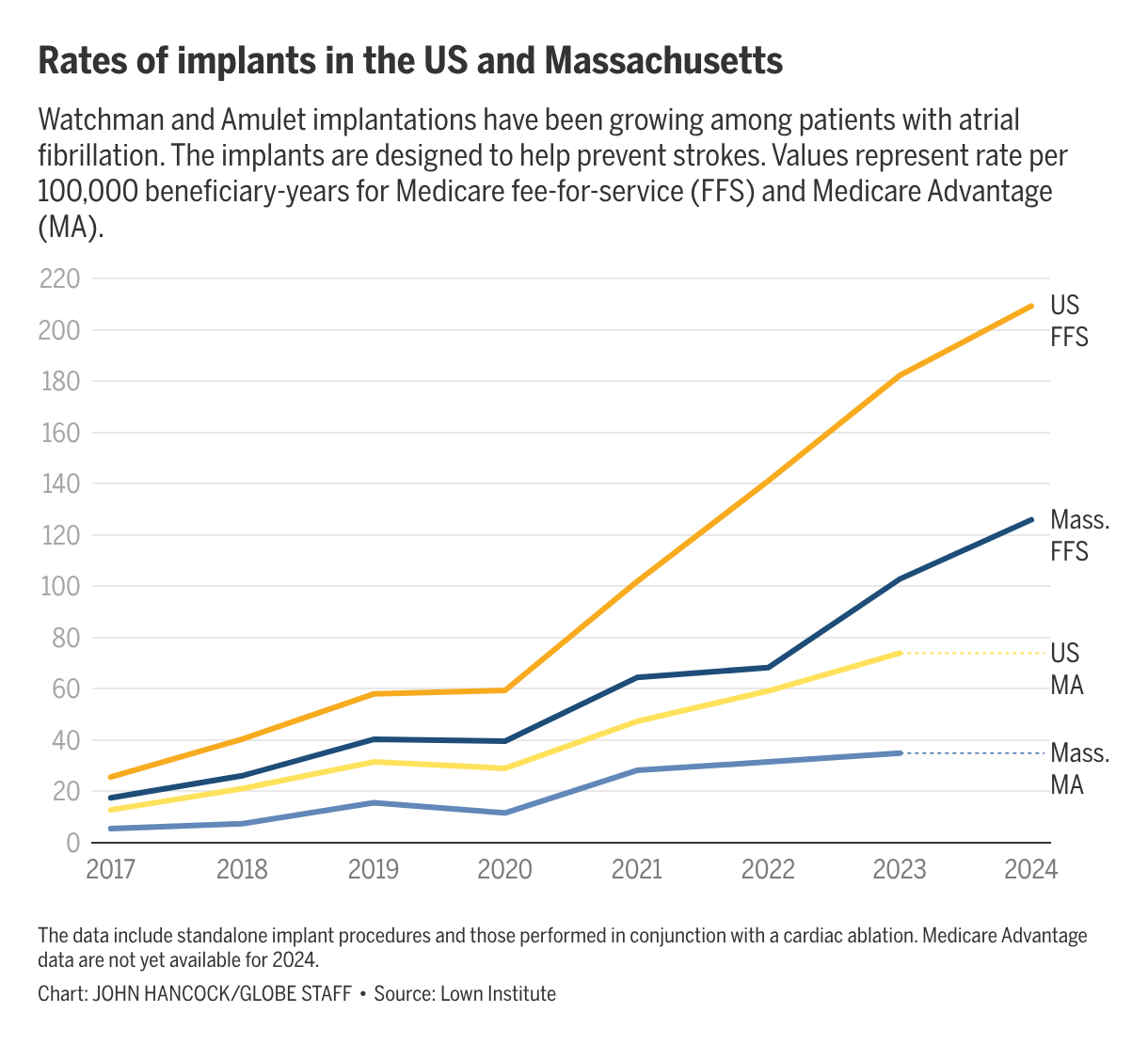
Implantations of the Watchman, and its distant competitor Amulet, for which Medicare pays about $25,000, have grown even more quickly — about sevenfold nationally over the past six years.
The device was invented by a small Minnesota company named Atritech. Although early clinical trial results were encouraging, they were inconclusive and the FDA declined to approve the Watchman in its first review in 2010.
A year later, Boston Scientific bought Atritech in a deal worth up to $375 million. As one of the largest medical device makers in the world — now with 59,000 employees and $21 billion in annual revenue — the firm trusted it had the expertise and resources to win over the agency.
But trouble lay ahead.
As Boston Scientific pushed toward approval in 2013, the FDA twice requested more data related to how Watchman patients had been faring since the last study results. When updated information came in the next year, agency officials grew uneasy.
The data “raises new questions about the effectiveness of the device,” they wrote.
The Watchman had been designed to prevent ischemic strokes, a type caused by blood clots traveling from the heart to the brain. Yet 13 of the 269 people in the study who got a Watchman experienced that kind of stroke, compared to one of the 138 people taking the blood thinner warfarin. The rate in Watchman patients was nearly seven times higher.
To make sense of this finding, the FDA took the unusual step of convening a third expert panel to assess the device’s safety and efficacy. Ultimately, in a narrow 6-5 vote, the panel recommended the FDA approve the Watchman, saying its benefits outweighed its risks — but only if its use was limited to certain patients.
Immediately after FDA approval finally came through, on March 13, 2015, Boston Scientific’s share price jumped 4 percent, adding more than $800 million to the company’s market valuation. It didn’t seem to matter much to investors that the FDA was cautious in its guidelines.
The FDA classified the Watchman as a “restricted device” — meaning doctors required special training to implant it — and it was indicated only for A-fib patients who met certain conditions. Their health history had to put them at a high risk of stroke, for one. And they also had to have a medically sound reason for not taking blood thinners long term, what the FDA called an “appropriate rationale.”
For Boston Scientific, there would be billions of dollars’ worth of latitude in those two words.
Dr. Richard Lange, a cardiologist and president of Texas Tech University Health Sciences Center, twice voted against recommending the FDA approve the Watchman on agency panels. He did not see enough evidence that it was as good as blood thinners.
“It was not as effective as current therapy,” he told the Globe.
Lange said he and other panel members also worried about drift, or “indication creep.” The Watchman has a place for people who can’t tolerate blood thinners, but they worried nothing could stop the company from pitching it far more broadly. “With almost every device there is drift,” Lange said. “That was a concern of the panel.”
Ten years on, Lange believes the Watchman has drifted. “I think it’s being overused,” he said. “Most of us think it’s being overused.”
Catholic Medical Center in Manchester, N.H. (Erin Clark / Globe Staff)
Boston Scientific wasted no time getting Watchman devices into patients.
Ten days after FDA approval, doctors in California performed the first commercial implant of the device in the US. Less than two months after that, the first Watchman in New England was implanted at Catholic Medical Center in Manchester, N.H.
Boston Scientific “wanted it everywhere,” said Dr. Daniel Philbin, a former CMC electrophysiologist now at Brown University Health Cardiovascular Institute.
CMC would become one of the busiest Watchman centers in the region, implanting more than 900 devices since that first one. But the hospital also became a place where tensions ran high over allegations of overuse and questions emerged about whether the hospital’s ties to Boston Scientific influenced its clinical decisions.
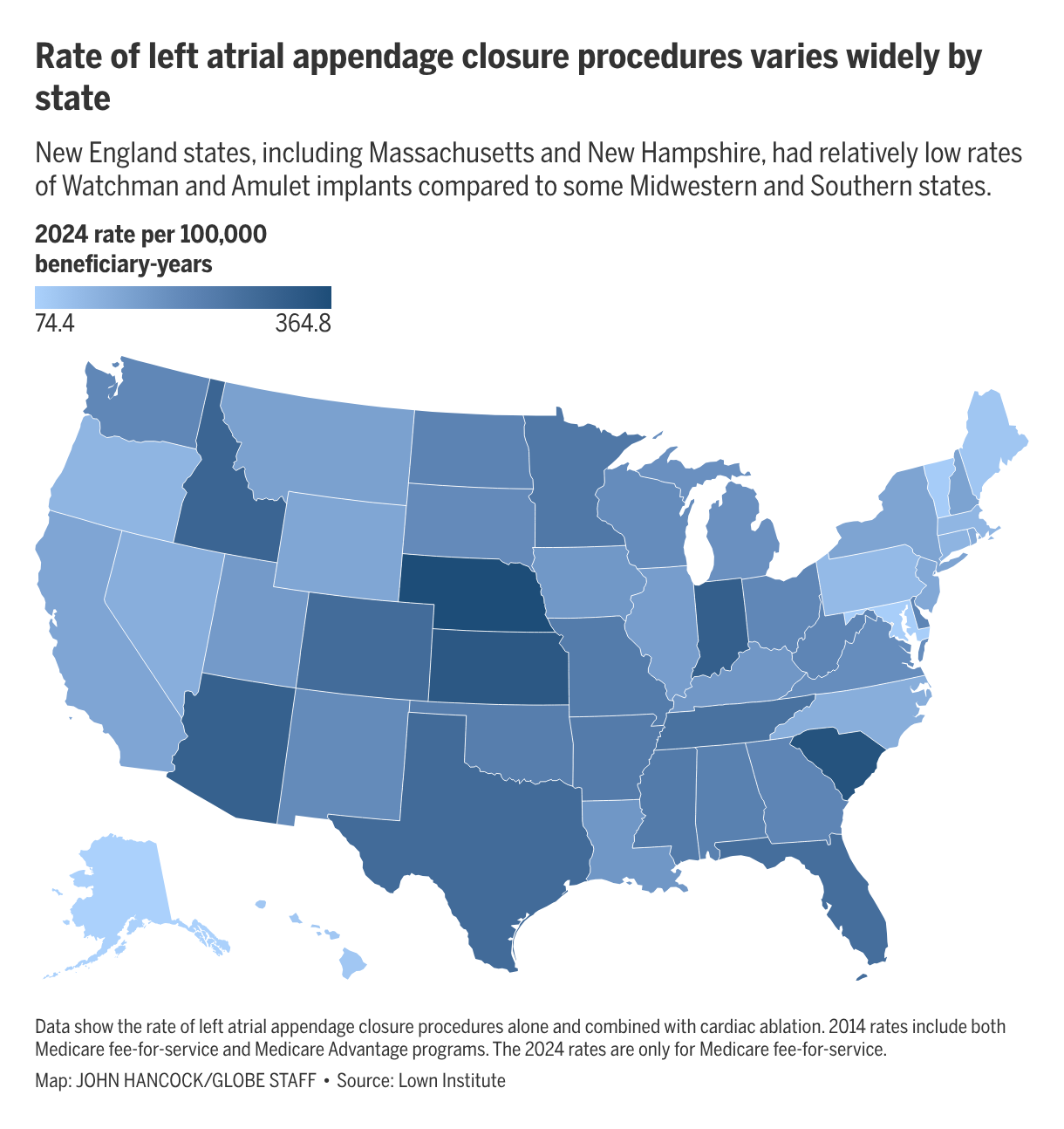
What’s clear is that CMC’s high rate of implants became an outlier in New England, according to an analysis of the most recent data available by the nonprofit Lown Institute, a think tank based in Needham.
In 2024, CMC doctors implanted the Watchman or Amulet in about 125 patients in Medicare’s fee-for-service program, nearly eight devices for every 1,000 of those patients. The rate was more than double any hospital in Massachusetts, and the second-highest in New England. (The highest was St. Vincent’s Medical Center in Bridgeport, Conn.)
Rate of left atrial appendage closure implants at New England hospitals
The rate of Watchman and Amulet implants for patients with atrial fibrillation varies significantly by hospital. More investigation is needed to determine the role of referral patterns, doctor enthusiasm for new technology, and marketing efforts in high rates.
Implants per 1,000 Medicare recipients, 2024
CMC says its high rates are a function of its role as a regional referral center that draws an outsized number of Medicare patients with A-fib. Hospital spokesperson Laura Montenegro stressed that a “rigorous review process” ensures that the devices “are recommended based on each patient’s individual medical needs and circumstances.”
One of CMC’s top electrophysiologists, Dr. Jamie Kim, saw the Watchman as a new way to address an unmet need for A-fib patients. After the FDA approved a new version of the Watchman in 2020, Kim implanted the first one in New England, an achievement marked on local news sites.
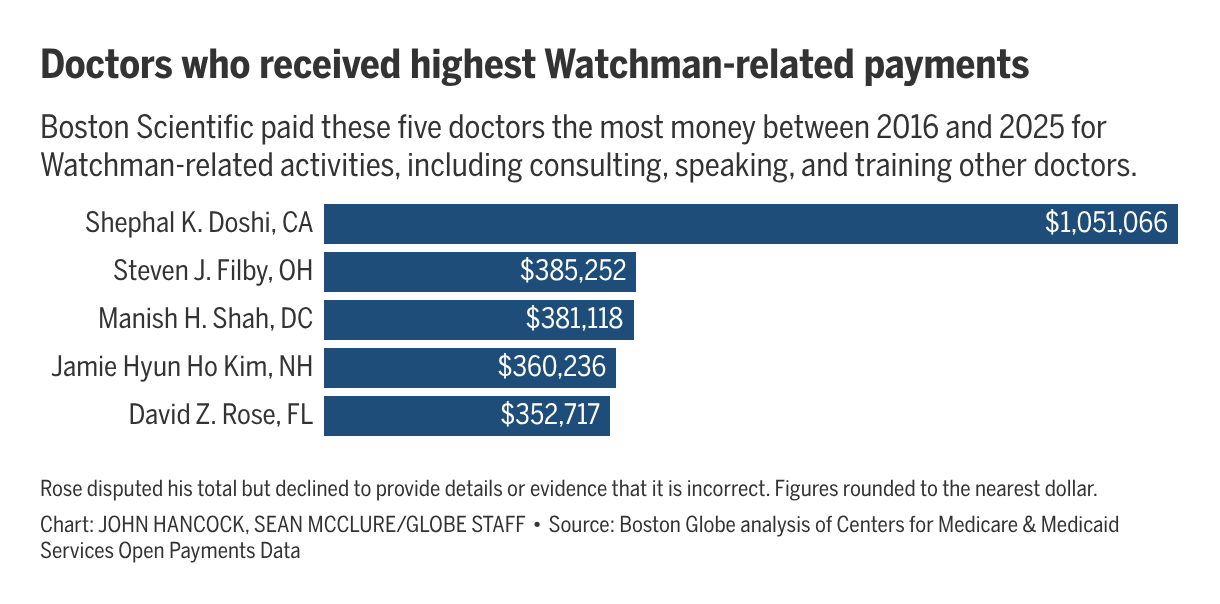
Kim promoted the product in other ways too. From 2016 through 2025, according to a federal database of physician payments, the company paid him more than $360,000 in Watchman consulting and speaking fees, to train other doctors and for related food and travel. Boston Scientific paid only three doctors in the country more for Watchman-related work during that period.
Since 2016, Boston Scientific has paid 41,000 physicians a total of $31.2 million as consultants, speakers, and trainers. That puts the Watchman in the top ten of all medical devices supported by such payments, according to a Globe update of research published in the Journal of the American Medical Association in 2024.
A post from Cardiovascular Specialists of New England on March 13, 2025, shows Dr. Jamie Kim, holding a picture of the Watchman, with the team at Catholic Medical Center after they performed CMC’s first concomitant atrial fibrillation ablation and left atrial appendage closure procedure.
Kim said through a spokesperson that he always puts patients first and always chooses the best device for them, regardless of the brand. He said being an early adopter of the Watchman gave him the experience to teach others the procedure.
“At no time did any payment Dr. Kim received from Boston Scientific play a role in his use of the Watchman or any other Boston Scientific device,” said Kim’s spokesperson, Joe Baerlein. “All decisions were made in the best interests of his patients.”
Questions about CMC’s overall cardiology referral patterns and compensation decisions were raised in 2018, when a former CMC doctor filed a federal whistleblower lawsuit. Some allegations focused on Boston Scientific’s close relationship with CMC.
The suit said the company gave special benefits to a private cardiologist who funneled business to CMC cardiologists, insisting they implant Boston Scientific devices in her patients, and got free weekend and holiday coverage from hospital doctors when she was away. As part of the alleged deal, the company provided CMC “early access” to the Watchman and “unprecedented support” for the program.
The government and CMC eventually reached a $3.8 million settlement related to the free coverage part of the whistleblower case only, though the hospital did not admit liability. The US attorney’s office did not pursue allegations related to Boston Scientific.
Around the time CMC doctors began implanting the Watchman, a former Medtronic employee told the Globe, the hospital suddenly shifted much of its cardiac device business to Boston Scientific.
“Within three to six months, we fell off the cliff,” said the former employee of Medtronic, a Boston Scientific competitor, who asked to remain anonymous because of potential career repercussions.
Another former Boston Scientific and Medtronic salesman in New Hampshire, Mark Sherwood, said Boston Scientific also gave CMC deep discounts on its cardiac products.
Hastings, the Boston Scientific spokesperson, said the company provides “appropriate and legitimate support to its customers,” and added that its pricing programs are “consistent with standard industry practices.”
Within the corridors of CMC, there has long been talk of drift contributing to more Watchman procedures. Five former and current CMC medical providers told the Globe they know of patients who lacked a compelling reason to swear off blood thinners. (Each clinician requested anonymity because they feared speaking out would hurt their careers.)
For example, a patient got a Watchman after pricking his finger while gardening and bled too much, a former CMC doctor recalled. “I was like, that is not a proven indication,” the doctor said. “It’s supposed to be life-threatening bleeding.”
Dr. Vikas Saini, at his home in Cambridge. Saini and his organization have examined the unnecessary use of medical procedures and analyzed data on the procedure using the Watchman or its competitor. (Josh Reynolds for The Boston Globe)
The debate over what counts as drift often comes down to parsing FDA labeling language. Some doctors follow it conservatively, but the “appropriate rationale” standard allows subjectivity in determining what is best for individual patients. “This is sort of some of the art of medicine,” Stein said.
Dr. Vikas Saini, president of the Lown Institute and a cardiologist, said he is generally skeptical about the Watchman-type procedure, which is known as left atrial appendage closure. He said any hospital performing a lot of implantations deserves scrutiny for possible overuse.
“The evidence for using these devices is really so weak,” he said.
A common part of the marketing playbook for introducing a medical device is spreading the word among doctors. But there’s another chapter device companies turn to less often: making their case directly to potential patients on TV.
At first, even the prospect of running ads caused “a lot of hand-wringing” inside the company, then-chief medical officer Dr. Ian Meredith told the Globe in 2017.
As anyone who watches TV knows, such marketing is ubiquitous for prescription drugs. The makers of Eliquis, a leading blood thinner, spent $142 million on TV ads that year, making it one of the top five drugs by spending. But ads targeting the general public were, and still are, rare for devices that require an invasive heart procedure, several medical marketing experts said in interviews.
So Boston Scientific started small, with a pilot campaign in Tampa, Detroit, San Diego, and Phoenix. When the results came in, any doubts dissipated: Consumers who saw a Watchman commercial were six times more likely to ask their doctors about it.
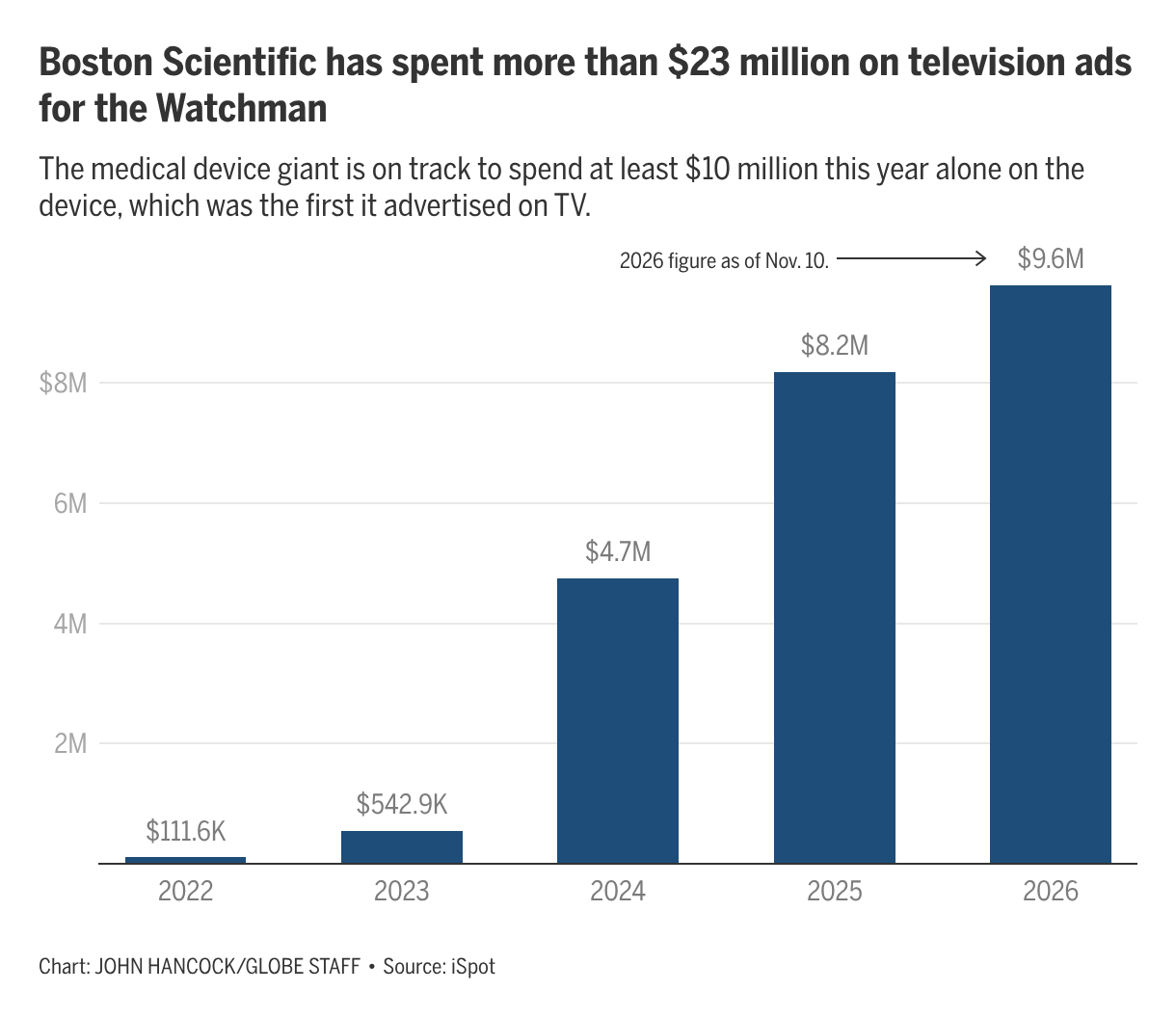
Boston Scientific took the campaign nationwide in 2019. It went on to increase TV spending more than seventy-fold, from about $111,000 in 2022 to $8.1 million in 2025, according to estimates from iSpot, an advertising tracking firm.
Watchman commercials tend to depict older, active people dodging peril. The message is clear: Dangers lurk everywhere when you’re on blood thinners. One ad shows a woman running around a backyard with a child and just missing the sharp tines of a rake. In another, an elderly man climbs a vertiginous treehouse ladder, dodging a splinter along the way.
“‘If I fall off my bike I could bleed to death’ — that’s what those ads are tapping into,’’ said Dr. Sanket Dhruva, a cardiologist at the University of California San Francisco.
Blood thinners do have risks. Beyond extra bleeding from nicks and cuts, they can interact poorly with other medications and cause potentially fatal internal hemorrhages after a bad fall. A 2024 study estimated that about 300,000 people a year in the US end up in the emergency room for bleeding.
Stein, the Boston Scientific chief medical officer, said more awareness of treatment options for people with A-fib isn’t a bad thing. “An educated consumer is our best customer,” he said. “It’s important that patients be aware that there are alternatives to blood thinning medications.”
To that end, the company has also been advertising the Watchman on Facebook and recruiting volunteer “ambassadors” who had positive experiences with the procedure.
“I get riled even before I go to the Dentist,” an ambassador responded in a Facebook group the company created, “but I can honestly say getting a Watchman was easier!”
Boston Scientific’s marketing campaign has worked so well that doctors have found their patients requesting a Watchman — even when they don’t have A-fib.
“I’m surprised at how much demand I’m seeing for this that is patient-directed,” said Katz, the NYU cardiologist. “They have marketed it and convinced a lot of patients that this is a really important thing.”
Katz recently asked a patient, who lives part time in Florida, why he got a Watchman. “Everybody in Sarasota gets it,” the man responded. “I think you get off the plane and they give you one.”
Katz believes the ads are glossing over an important point. A small percentage of Watchman patients will still need blood thinners, even if the procedure is successful.
Richard Bender, an 80-year-old Cape Cod resident, received a Watchman in 2022. (Jonathan Wiggs/Globe Staff)
That was a surprise to Richard Bender, 80. He managed his stroke risk with medication for more than a decade, until he developed gastrointestinal bleeding, possibly related to a blood thinner. His cardiologist at Cape Cod Hospital suggested a Watchman.
Bender received the device in 2022 and was pleased until doctors discovered blood clots in his right leg two years later. Now he’s on Eliquis, paying about $200 a month, even though he has a Watchman.
“My wife often asks me, did you really need this?” Bender said.
Richard Bender, holding the blood thinner he still takes. (Jonathan Wiggs/Globe Staff)
If the Watchman was just a simple pill, the stakes might not be so high. But it’s an invasive procedure, and an elective one at that. So when cardiologists and their patients sit down to talk, they have to weigh the hoped-for benefits of the device against the inherent dangers involved in getting it.
For many patients, Watchman critics told the Globe, the benefits are questionable at best, and are outweighed by the risks.
Those risks can include a range of complications including leaks or blood clots forming around the device, according to reports Boston Scientific filed to the FDA. They can also include more serious injuries, including strokes — the outcome the device is meant to prevent. In rare cases, the Watchman has been linked to deaths.
The Globe reviewed roughly 10,600 adverse patient cases Boston Scientific filed about the Watchman procedure since April 2015. The FDA database that collects the reports has limitations: Manufacturers must file them when they learn a device may have malfunctioned or contributed to a death or injury, but the reports often cannot prove the devices actually caused the problems.
However, scientific studies use the database because it shows what companies have told regulators about patients’ outcomes, and what possibilities patients might face on the operating table.
Boston Scientific argues the database is a flawed way to make inferences about the device’s safety. The company reports that 0.5 percent of patients experience a major complication — such as death, stroke, or corrective surgery — though that only counts problems within a week of the procedure or hospital discharge.
A Watchman procedure in progress at Maine Medical Center in Portland in 2017. (Portland Press Herald)
The risk of getting a Watchman “is not zero,” Stein acknowledged. “That’s why the decision whether you want to undergo a medical procedure really becomes a very personal decision that the patient has to make along with the guidance of their treating physician.”
However, experts say the choices patients are offered — and the pros and cons that come with each — can be difficult for non-professionals to understand, regardless of how well they’re spelled out.
That’s something Paulette Daly experienced firsthand.
Brian Daly, her husband, took warfarin for years and never liked it. He needed to go to the doctor every few weeks to check his medication level and had to stop taking it for even minor procedures.
“It was getting kind of ridiculous,” Paulette said.
After Brian started treatment for prostate cancer in 2021, he told his doctor he frequently noticed blood when he used the bathroom. The doctor suggested he get evaluated for a Watchman.
Brian decided to get the device and, in January 2023, the couple drove to St. Elizabeth’s Medical Center anticipating a brief operation and an overnight stay. Paulette remembers the surgeon saying the procedure was routine, though there was “always a risk.”
Brian, then 81, was nervous. “He said, ‘If I don’t make it, I love you,’” Paulette recalled. She assured him it was going to be all right.
He never made it home. A medical examiner later ruled he died of a “therapeutic complication,” a cardiac arrest following the surgery.
Paulette says if she and Brian had understood the risks better, they wouldn’t have gone through with the procedure.
“I should have told him no,” she said. “I really should have said no.”
This was supposed to be a banner year for Boston Scientific.
Watchman sales were soaring, and results were coming soon from the largest trial yet, named Champion, which followed 3,000 patients over three years. The results of the study — which Boston Scientific funded — would be unveiled at a cardiology conference in New Orleans in March and simultaneously published in the New England Journal of Medicine.
Importantly, the company hoped the new clinical evidence would support expanding the FDA’s guidelines on who is a suitable candidate for a Watchman.
The guidelines have largely defined it as a secondary treatment to blood thinners. That means most A-fib patients with an elevated stroke risk are supposed to try medication first, if they can, and then move on to a Watchman if they can’t tolerate the drugs or have a legitimate reason not to take them long term.
If the FDA decided to expand its indications, doctors could potentially recommend the device as soon as an A-fib patient was diagnosed.
In business terms, these distinctions make a big difference. A broader classification, in the United States and abroad, could triple the potential global market to more than $6 billion.
But 2026 hasn’t unfolded the way Boston Scientific expected.
Not long before the Champion study’s release, a group from Germany published their own findings in the New England Journal of Medicine.
The Closure study found patients with a Watchman or Amulet suffered more strokes, blood clots, major bleeding, or cardiovascular or unexplained death, in a combined measure, than those in the group receiving “best medical care,” including blood thinners.
“The message for the clinician is clear,” Widimsky wrote in a related editorial. The procedure “failed to fulfill its theoretical promise to become an alternative treatment to best medical therapy — at least for older patients.”
Boston Scientific, which occupies a sprawling campus in Marlborough, has built the Watchman into a business blockbuster.
Boston Scientific, which occupies a sprawling campus in Marlborough, has built the Watchman into a business blockbuster.
Boston Scientific and some doctors criticized the study design. Participants got older Watchman devices, as well as Amulets, the competing product from Abbott, and there were only around 900 patients. The rate of complications and bleeding from the surgeries in Germany was also higher than in the U.S., suggesting a disparity between the two countries’ health care systems, Stein said.
A week and a half after Closure was published, it was time for the Champion researchers to present their findings in New Orleans. At one of its booths, Boston Scientific had brought along puppies wearing tiny Watchman bandanas.
From a stage at the convention center, one of the study’s authors told the several hundred attendees that Champion had met its goals. The headline was that the Watchman FLX device worked about as well as blood thinners — it was “statistically noninferior,” in science terms — on the trial’s combined measure of cardiovascular death, stroke, and systemic embolism.
The response among many doctors, and medical publications there that day, was muted. “A win for Watchman FLX, but with caveats,” is how the Cardiovascular Research Foundation’s news site summed up the results.
Those caveats included that the Champion study was paid for by Boston Scientific, while the Closure study was independently funded by the German government. And Champion’s lead author, Dr. Shephal Doshi, had been paid more $1 million by the company for consulting and education over the years.
But the more worrisome finding had to do with ischemic stroke, the kind caused by blood clots. In the Champion study, 18 more people with the Watchman suffered such strokes than those on medication.
The difference was small: Out of 1,501 patients in the blood thinner group, 27 suffered ischemic strokes, or 2 percent. Out of the 1,499 in the Watchman group, it was 45, or 3.2 percent. But even a difference of one percentage point adds up when a device is potentially being considered by millions of people.
Katz, speaking to a reporter that day, cautioned that the study’s mixed results should not lead to a lot more procedures. “I’m hopeful that’s not what happens in the real world,” he said.
The Watchman has a role, he said, but “It’s not a godsend, it’s not a panacea.” And certainly not a replacement for blood thinners.
In an editorial accompanying the Champion study in the New England Journal of Medicine that day, Marcus, the University of California cardiologist, wrote that the data did not support the company’s hope to make it a first line treatment.
Boston Scientific, however, accentuated the positive. That evening, at a celebration hosted by the company, waiters passed champagne to celebrate the results. On the walls, posters signaled that Champion was the dawn of a new era.
In hospitals and doctors’ offices, the reception to the two studies was more negative than Boston Scientific expected. A significant chunk of the cardiology community essentially hit pause on referrals. Before long, Watchman sales growth that had grown nearly 30 percent the prior year fell to around 4, sending shockwaves through the company.
By the morning of July 29, when Mahoney, the CEO, dialed into an 8 a.m. earnings call, his company had been beset by financial distress for months.
The stock price had set an all-time high the previous September but plunged more than 50 percent since, wiping some $78 billion from the company’s market capitalization.
“We’re clearly not pleased with this change,” Mahoney said on the call.
Boston Scientific CEO Mike Mahoney in 2019. (Jessica Rinaldi/Globe Staff)
It was not just the Watchman studies that were the problem — the company’s whole cardiac business had substantially slowed, due to competition.
“We absolutely believe in this therapy,” Mahoney assured everyone on the call. Still, most analysts had questions about the disappointing results.
“I think we’ve all seen these studies,” one said. “The question is, what can you do to change that?”
Mahoney kicked the question over to his chief medical officer. “I think it’s pretty clear that there was a much bigger impact than we anticipated,” Stein said. They’d seen the biggest drop-off in “so-called soft indications for the device,” he said, “patients who really just prefer not to be on an oral anticoagulant without having a really well-defined reason to seek an alternative.”
What Stein called “soft indications” critics would call drift.
Whatever the term, Boston Scientific had a familiar solution to the crashing sales: It would respond to growing skepticism about the Watchman with still more promotion.
They would increase sales efforts in hospitals, Mahoney said, and also communicate more with doctors, to “educate them on the totality of the clinical data.”
(A few months later, Boston Scientific reported it had put on more than 200 medical education events, reaching more than 2,000 Watchman referrers and implanters.)
Lastly, they’d be leaning into more advertising to consumers. “We’re accelerating direct-to-patient investments to stimulate demand, increase patient activation, and reach more patients,” Mahoney said.
He didn’t specify how much money they’d put into that effort, but estimates suggest Boston Scientific will spend more than $10 million this year on TV ads for the Watchman, well over the amount in 2025.
The company surely hoped plenty of people would see the ads, then ask their doctor about a Watchman by name.
For comments or tips, please email [email protected], or call 617-929-7483. Or contact the reporters at [email protected] or [email protected].
About this story
Reporting by Elizabeth Koh and Liz Kowalczyk. Editing by Gordon Russell, Patricia Wen, and Francis Storrs. Data analysis by Sean McClure. Design, graphics, and development by John Hancock. Data editing and project management by Yoohyun Jung. Animation by Alois Di Leo for the Boston Globe. Design review by Ryan Huddle. Photo editing by Leanne Burden Seidel. Video production by Olivia Yarvis and Raphael Chinca. Video editing by Anush Elbakyan. Audience engagement by Cecilia Mazanec. Copy editing by Michael J. Bailey. SEO editing by Marc Choquette. Technical editing by Nalini Dokula.
© 2026 Boston Globe Media Partners, LLC
Source: apps.bostonglobe.com