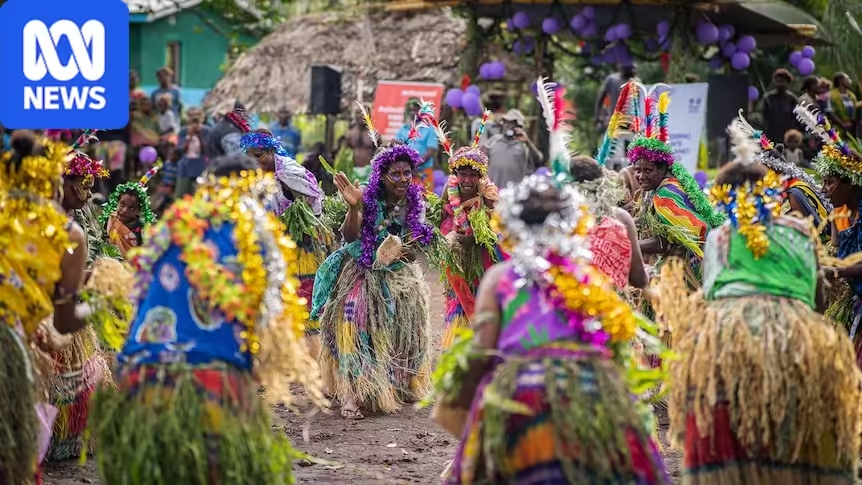

When the sun sets on Tanna in Vanuatu, some women lock themselves in their homes for the night with a machete under their pillow for protection, according to a local NGO.
In the village of Lawital, Dalila Laus Lalulu describes a similar sense of fear.
There are no lights in many of the traditional villages on the island and men often attack women after dark, she says.
“It’s not safe to walk around at night for girls,” Ms Lalulu told the ABC in Bislama.
But women can also face threats at home.
Vanuatu has one of the world’s highest rates of intimate partner violence, according to Vanuatu Women’s Centre, although the figure has fallen over the past 15 years.
The latest national survey on Women’s Lives and Family Relationships found half of the respondents who had been in a relationship had experienced physical or sexual violence, or both, from their partner during their lifetime.
Meanwhile, about one in five women had been sexually attacked by someone who was not their partner.
Solar power and lights have been installed in 120 homes in Lawital. (Supplied: ActionAid)
But in Lawital, the women have overturned their fear of being attacked.
Their simple project, which involved switching from candles to solar power, will receive international praise at the world’s biggest climate summit on Monday.
Lawital is a village on the South Pacific island of Tanna, home to many of Vanuatu’s best resorts.
But most of the traditional villages on the island have no access to running water, electricity or even lights.
ActionAid Vanuatu’s Lizzie Moli said women were even scared to use an outside bathroom at night if there was no light.
“Women are sleeping with machetes at night as their protection because there’s no lights,” she told the ABC.
“Women have to feel safe. Women have to feel protected.“
Fed up with seeing relatives and friends attacked at night, Ms Lalulu initiated and helped lead a project to install solar-powered lights in streets and nearly 120 homes in her village with the help of other local women.
Vanuatu woman Dalila Laus Lalulu will be recognised at COP-31 for the women-led solar light project in Lawital village. (Supplied: ActionAid)
Dozens of solar lanterns were also purchased for women to use while walking at night, in partnership with the Australian government, organisation ActionAid, Women I TokTok Tugeta and business Powerwells.
There is only anecdotal evidence at this stage, but Ms Lalulu said the violence had decreased and the community felt safer.
“Now you go to the garden … and come back at night. Before you had to come before sunset,”
she said.
The lights have also helped women become more respected in the community because many have taken on jobs to increase their household’s income, either by maintaining the solar-energy scheme or selling goods at market stalls now that they can stay out after dark, according to Ms Moli.
Dalila Laus Lalulu’s daughter Annette helps install and maintain the solar-powered lights. (Supplied: ActionAid)
Having lights in homes has also helped children complete their homework at night.
Women in Tanna have not traditionally held roles in politics but, because of the success of the project, Ms Lalulu has been invited to become the first woman to join the Tanna Chief’s Council, a traditional governing body.
Pacific Island Affairs Minister Pat Conroy said Australia was “proud” to have helped with the project.
“The successful, women-led project provided clean energy, lighting and charging systems to 1,380 people, enabling safer, more connected and economically active communities,” he said.
Homes in Vanuatu’s remote village of Lawital now have access to solar energy and lights. (Supplied: Australian Infrastructure Financing Facility for the Pacific)
Calls to extend program
This week Ms Lalulu has travelled to Türkiye — her first time out of Vanuatu — to receive a Gender Just Climate Solutions Award for the Lawital light project at the COP-31 climate change conference.
Despite being quite shy about it, she told the ABC it was a blessing and would help her community continue its work.
“When we heard that our sister here got an award, we scream and we run,” Ms Moli said of Ms Lalulu.
“For all the sacrifices, the sleepless nights, the body pain, she finally did it.
“We’re very proud.”
Many villages on Tanna Island have no access to electricity, running water or lights. (AP: Perry)
Now the women want to roll out the off-grid solar scheme to the rest of Vanuatu.
“There will be more and more work. People start to know and call out for me to do more work,” Ms Lalulu said.
“With climate change, there are different kinds of weather patterns. The crops don’t grow … There is more violence.”
Ms Moli said some women in other villages still felt like “prisoners in their homes” and that needed to change.
“If Australia is listening, from the bottom of her heart, she wants all the lights to reach every house in Tanna to stop or decrease the level of violence,”
she said.
“Please, you have done it for Lawital, now you can help us fund all the lights across remote places where there is no light, there is still darkness.
“So the women can feel protected when they want to go to church, when they want to go to the shops. They want to have this freedom to walk at night.”
Women wash clothes on Tanna Island, where most villages do not have running water, electricity or lights. (AP: Nick Perry)
Does lighting reduce violence?
Nicole Kalms is the director of Monash University’s XYX Lab, which leads national and international research into gender-sensitive design in urban space and planning.
She told the ABC lighting alone would not reduce violence perpetrated by men but could it help public places feel safer for women.
“[Lighting] is incredibly important, but unfortunately no single intervention will stop all violence,” Professor Kalms said.
“But what we’re talking about is a form of crime prevention that centres women’s experiences.
“I think it’s really important that this project was led by women and that they see the value and are part of the change.“
Professor Kalms has done research work on this topic in Asia, South America, Europe, Africa and Australia.
She said lighting was a universal concern and the biggest change women wanted to see in public spaces.
Nicole Kalms says better public lighting can help women feel safer. (Supplied: Ella Mitchell)
She said projects like Lawital’s off-grid energy initiative helped women to participate more in society.
“Women feel safer when there are other women around and when there is more diversity of women that feel they can safely occupy public spaces. Then that shapes what happens in public spaces,” she said.
The ABC contacted the government of Vanuatu for a response.
Source: www.abc.net.au