Welcome to the 240th edition of The Week in Polls (TWIP), a polling newsletter that always welcomes new readers. So please don’t keep TWIP a secret; share it with your friends and colleagues:
This time, it’s another of my smorgasbord of updates to previous stories, including on the state of public opinion over Brexit.
This is followed by summaries of the latest national voting intention polls, seat projections from MRPs and the most recent party leader ratings.
Subscribers who pay for the full edition can also read ten insights from the latest polls and analyses, including:
Older generations have mixed views of Gen Z;
What voters think of the idea of an early general election; and
The importance of gaming in young men’s social lives.
If you are not yet a paid subscriber, you can read all ten by starting a free trial now:
For more polling news as it comes in ahead of next week’s edition, you can also follow The Week in Polls on Bluesky.
Before we get to all that, the Journal of Elections, Public Opinion, & Parties is now on Bluesky. You can also follow not only that account but a batch of other political polling accounts via my political polling list.
Also, an update on my previously raised eyebrows over The Independent’s (mis)reporting of a poll. On the third time of asking, I got a response, from Managing Editor Richard Best. He didn’t agree there was a problem with his paper’s story. However, his reasoning – including that “there are different polls giving differing results most days” – to my mind points to the exact opposite conclusion. That’s all the more reason to put any one poll in a proper context, particularly if – as the paper did – you are running a story based on one poll with a headline that is contradicted by another poll published the very same day.
Turning to better news, the latest annual compendium of council by-elections from Andrew Teale is now available to purchase – Andrew’s Previews 2025: Discussions of British parliamentary and local by-elections in the year 2025.
And with that, on with the show.
Skip the boring socks. Pass on yet another box of chocolates. Forget the ‘amusing’ mug. Instead, this Christmas give the gift of polling insight, crosstab wisdom and raised eyebrows at media coverage with a paid-for subscription to The Week in Polls.
You can buy a gift subscription here.
Or go for that reliable standby, a book:
You can order Polling UnPacked, my guide to opinion polls, from Bookshop.org (independent bookshops), Waterstones, Amazon (including Kindle version) or direct from the publisher.
In my recent piece Brexit, ten years on: what the polls say about Europe now I pointed out how poorly Brexit does in headline polling, but that things look rather closer between rejoin and stay out when specific details and arguments are tested out.
Further polling released since then repeats and reinforces that picture.
The headline anti-Brexit mood comes through in the data recently reported by The Guardian:
Voters in four out of five UK parliamentary seats back rejoining EU: survey of more than 7,000 shows that people in hundreds of former leave areas now want to rejoin EU.
(The story, though, provides few details of the poll and the pollster is not a member of the British Polling Council.)
Likewise:
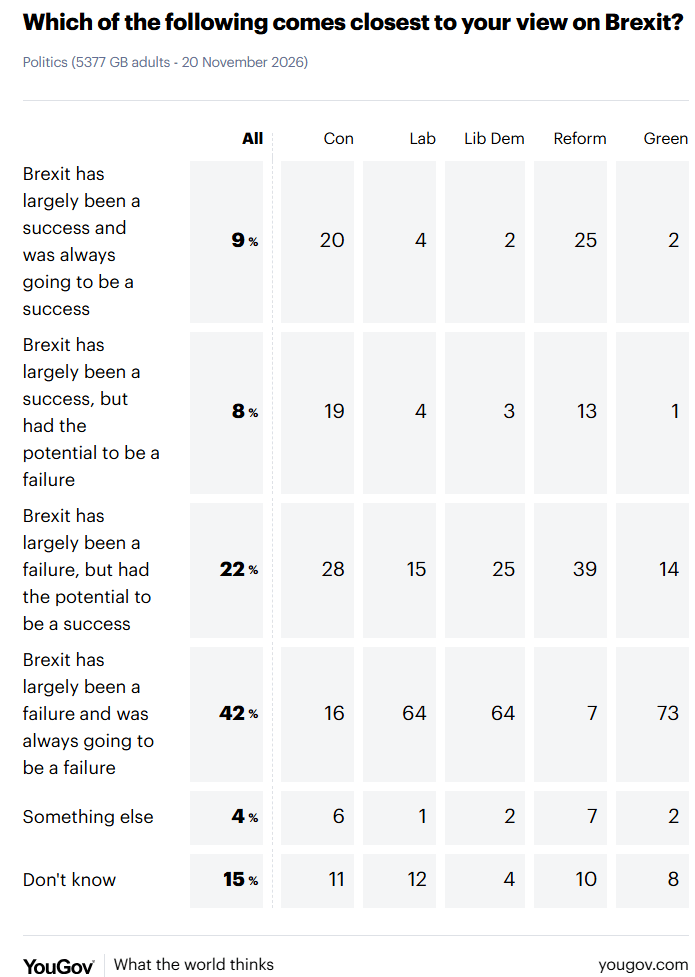
Turning to more specific questions, More in Common report that:
Driving the debate is a persistent sense from the public that Brexit has not worked. Less than one in ten (8 per cent) feel that Brexit is currently working well, although 42 per cent say that it could have worked, but has been handled badly by politicians.
[But] in a crude choice, 46 per cent think the government should be focusing on making Brexit work, rather than 38 per cent who want the government to prioritise rejoining.
However, 47 per cent do want a referendum on rejoining, compared to 38 per cent who oppose. 2024 Labour voters back a second referendum by 64 per cent to 28 per cent…
[Moreover,] many conditions that could be demanded [as part of Britain rejoining the EU], such as contributing £20bn to the EU budget, are seen as unacceptable by the public (53 to 20). And a good example of how sensitive many of these issues to a campaign could be comes in free movement. We ran an experiment: we asked voters whether they supported freedom of movement in general. We then asked half the sample whether they supported “the right to live, work and study in the EU”- which boosted support to 51 per cent, and the other half whether they supported “giving up control of borders”, which knocked support down to 26 per cent and opposition to 48 per cent.
It is a similar picture with new YouGov data:
54% of Britons think it would be acceptable to have a rejoin referendum in the next five years. But [the] public are split on whether attempting to rejoin the EU should be a priority for the government: 37% say it is the right priority, 45% say it is not.
In addition, YouGov say that:
Terms of hypothetical rejoin deal make a great deal of difference to voting intention, with the rejoin vote lead ranging from +33 to -8 across 18 scenarios YouGov tested.
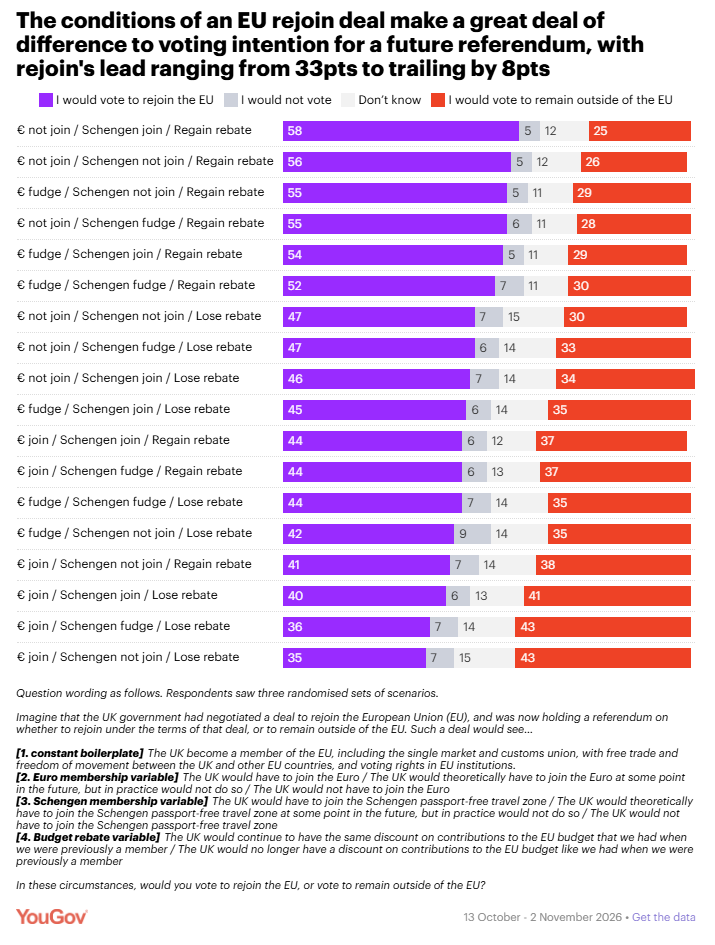
This mirrors the Steve Akehurst polling I covered in my original piece.
Lord Ashcroft’s polling has also recently considered certain possible conditions for future British membership of the EU:
Voters said that joining the euro would be an unacceptable condition of EU membership by a 41-point margin. Clear majorities of Conservative, Labour, Lib Dem and Reform voters were against joining the euro, as were a plurality of Green voters. SNP supporters were more likely to support than oppose joining the euro. Paying a higher membership fee than before Brexit was also rejected by a 49-point margin. All parties’ voters agreed, with the exception of current Green supporters who said this would be acceptable [by] a 1-point margin. Voters said joining the Schengen area was acceptable by a 10-point margin. Majorities of Labour, Lib Dem, Green and SNP voters agreed, while majorities of Conservative and Reform voters said this would be an unacceptable condition.
Speaking of him, my piece last week about Lord Ashcroft’s polls and Reform also brought a bundle of feedback, with some keen to rubbish him and/or his numbers for Reform. So let’s turn to some of the points made and what other evidence also tells us.
Variations of this response are common any time I’ve commented on Reform’s long-term decline in the polls or the long-term fall in Nigel Farage’s ratings.
I looked at this in more detail earlier in the year, comparing polls about specific elections against Reform’s performance in those.
As I concluded:
We have a growing pattern in Parliamentary elections – both general and by-elections – of Reform’s support when the votes are tallied being less than it was in the polls in advance of polling day. This pattern needs to be treated with caution and caveats, and it’s not a certain prediction for the future either.
Very much not what is claimed, then, and perhaps even the opposite. You can read the full piece here.
There is one little rabbit hole some people go down, claiming that Lord Ashcroft specifically underestimated Reform by a high single-digit number of points in the May local elections. I can’t find any poll from him that substantiates this claim, and it is tempting to conclude that people are comparing apples and oranges, i.e. taking his national vote share poll and comparing it with council election vote shares – when in fact it’s perfectly normal for the two to be different. That happens for different pollsters and different parties all the time, as people don’t behave the same for national and local elections.
But perhaps there’s a poll that I’ve missed? So far, no-one I’ve responded to asking this has come back with one. Perhaps after this newsletter my inbox will receive details of one…?
Another strand of reactions has been Reform supporters pointing to gains for their party in council by-elections, saying these show that Lord Ashcroft’s polls, and perhaps others too, are wrong.
The seats that are up vary so much from week to week that it’s wise only to look at changes in seat and vote shares in council by-elections over a longer period. So here’s the data for those contests since the May scheduled local elections:
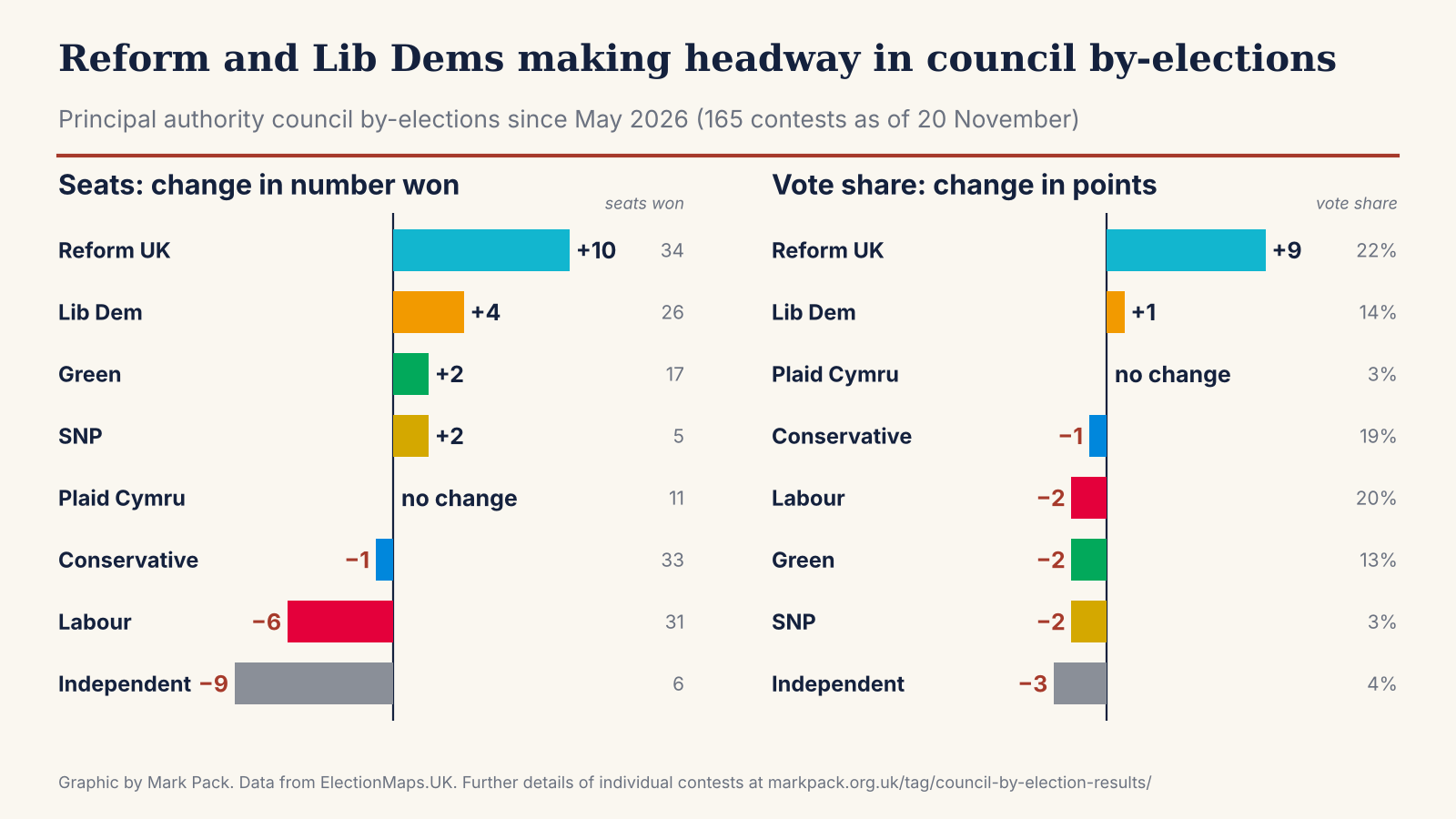
Reform are certainly making the most headway, but, first, Reform’s progress is not as strong as it was earlier in the year (mirroring the decline in their poll ratings with all pollsters) and, second, council by-elections are not national general elections. Being top of the form in by-elections doesn’t mean that polls showing you slipping or even in third place for national general election vote share are wrong.
Borrowing an idea from Stuart Ritchie and others, if you spot a factual error in an edition of this newsletter, I will give you a free 12-month subscription to the paid-for version (or an extra 12 months on your existing one). Factual errors qualify, but grammatical errors or disagreements over interpretation do not, and my decision is final. Messages about both of those are always welcome, though.
Here are the latest voting intention polls from different pollsters. Note that for all the media talk about the Conservatives overtaking Reform, it’s still a pretty mixed picture across all the pollsters. That’s definitely a shift from when they consistently showed Reform ahead of the Conservatives, of course.
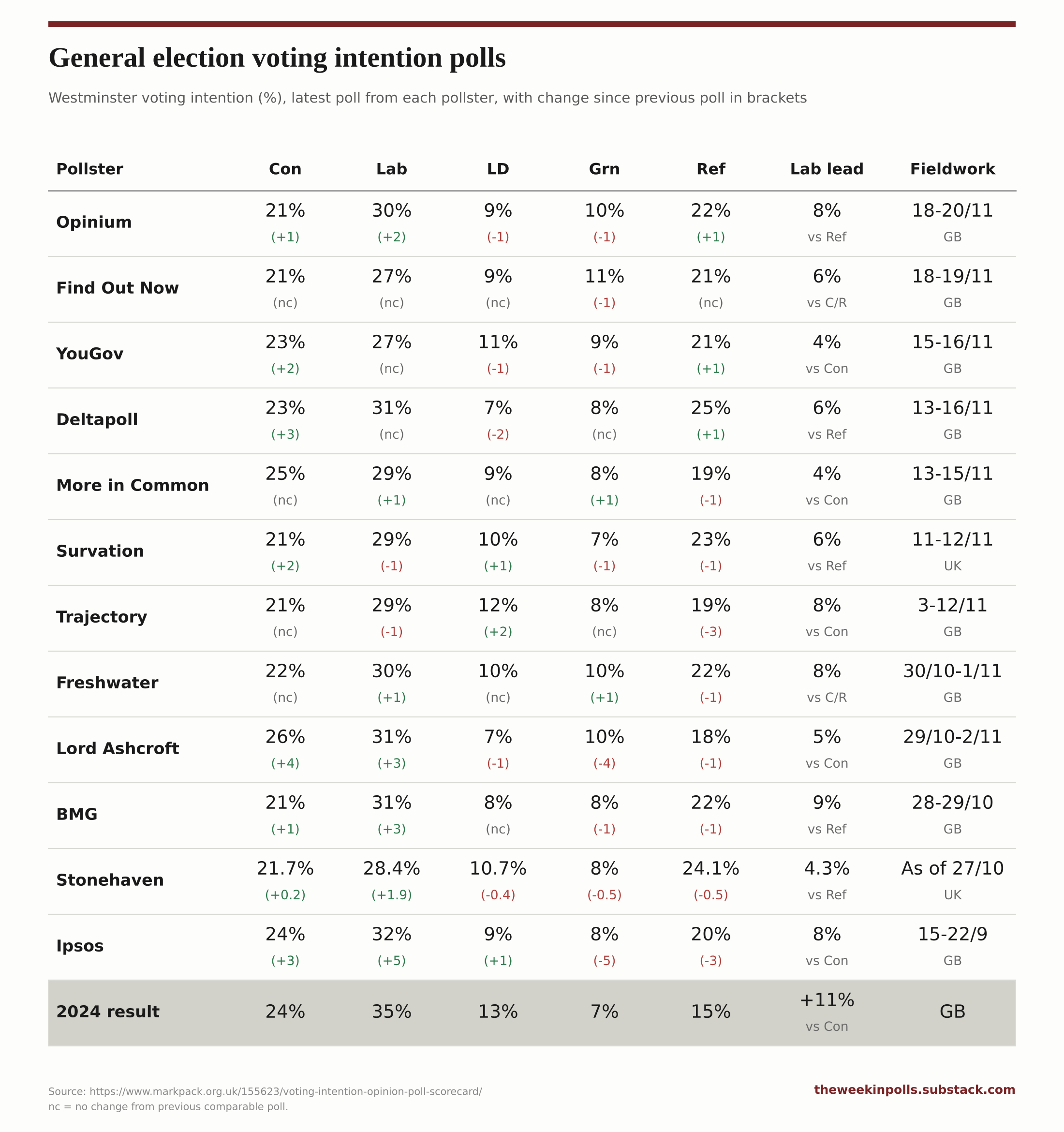
The table is also online here, along with a more detailed explanation of its content. It is updated regularly throughout the week as new polls are released.
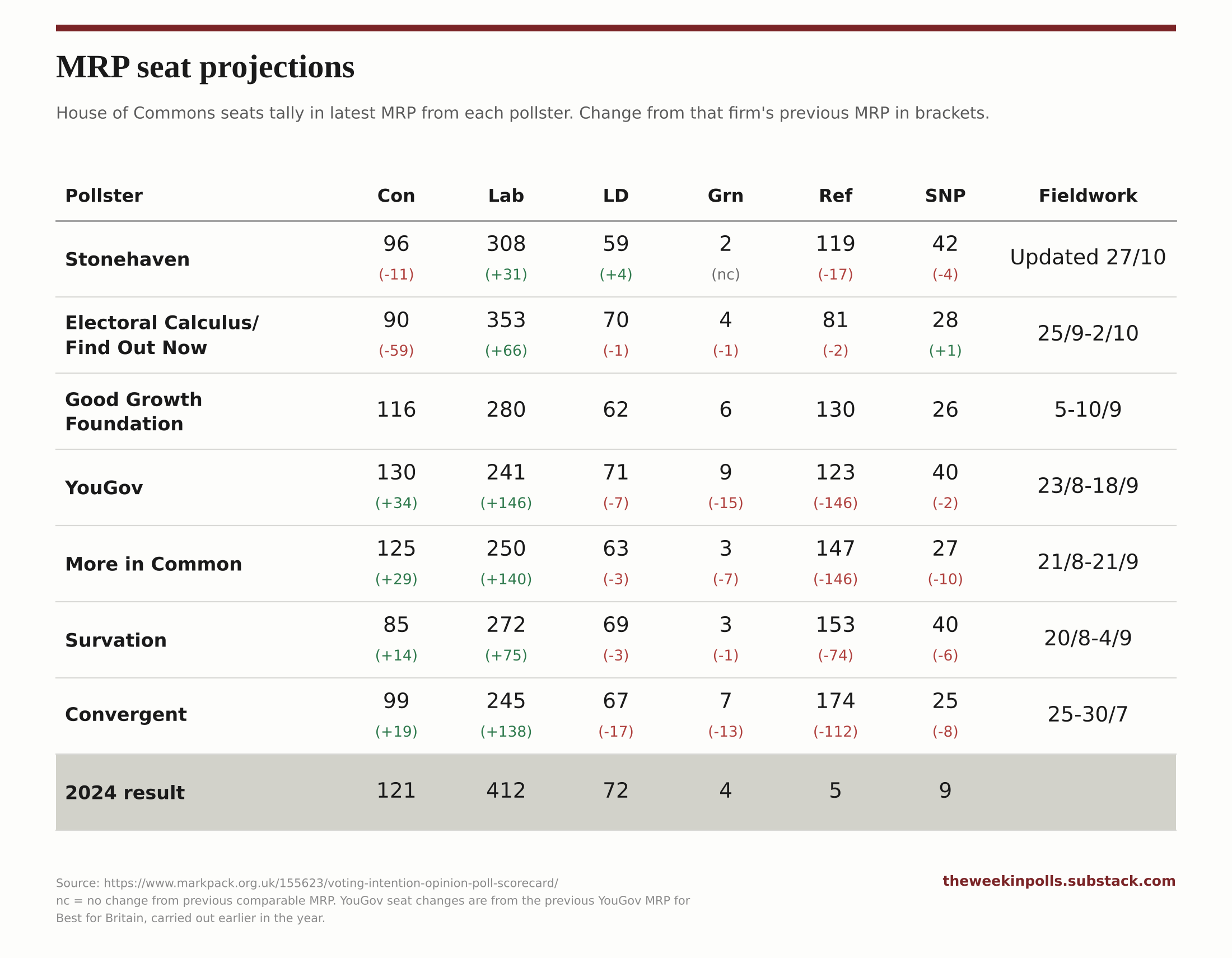
Next are the seat projections from MRPs, also sorted by fieldwork dates, listing those which are based on dedicated fieldwork (rather than models built on averages of other polls).
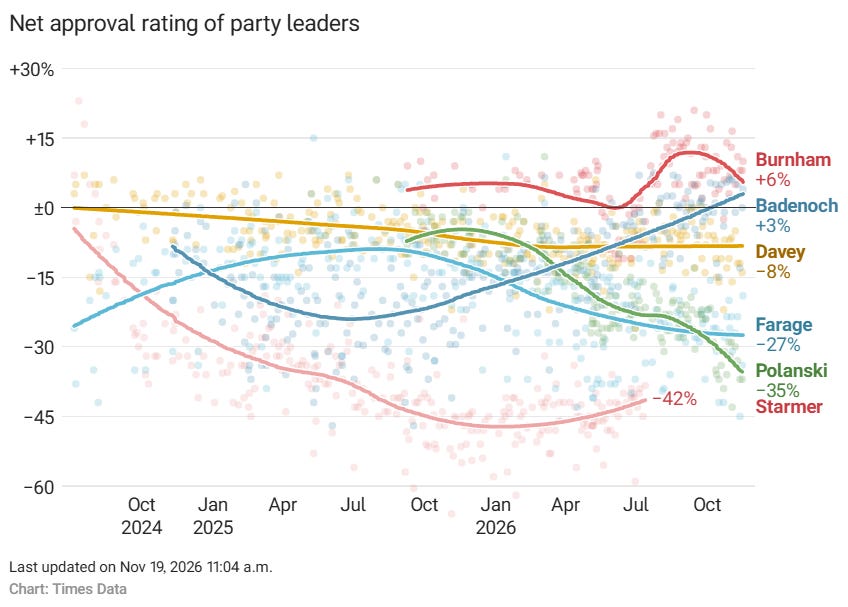
Finally, here is a summary of leadership ratings, with a graph from The Times:
Detailed numbers from the latest polls are updated regularly throughout the week on my website here.
For historical figures on both voting intention and leadership ratings stretching back to the 1930s, including Parliamentary by-election polls, see PollBase.

My privacy policy and other legal information are available here. Links to purchase books or other items are usually affiliate links which pay a commission for each sale.
Quotes from social media messages are occasionally lightly edited for punctuation and clarity.
If you are subscribed to other email lists of mine, please note that unsubscribing from this one will not automatically remove you from the others. If you wish to be removed from all my lists, simply reply to this email to let me know.
The following ten findings from the most recent polls and analyses are available only to subscribers who pay for the full edition, but you can sign up for a free trial to read them straight away.
Polling by More in Common finds that Gen Z generates mixed views among older
Source: theweekinpolls.substack.com