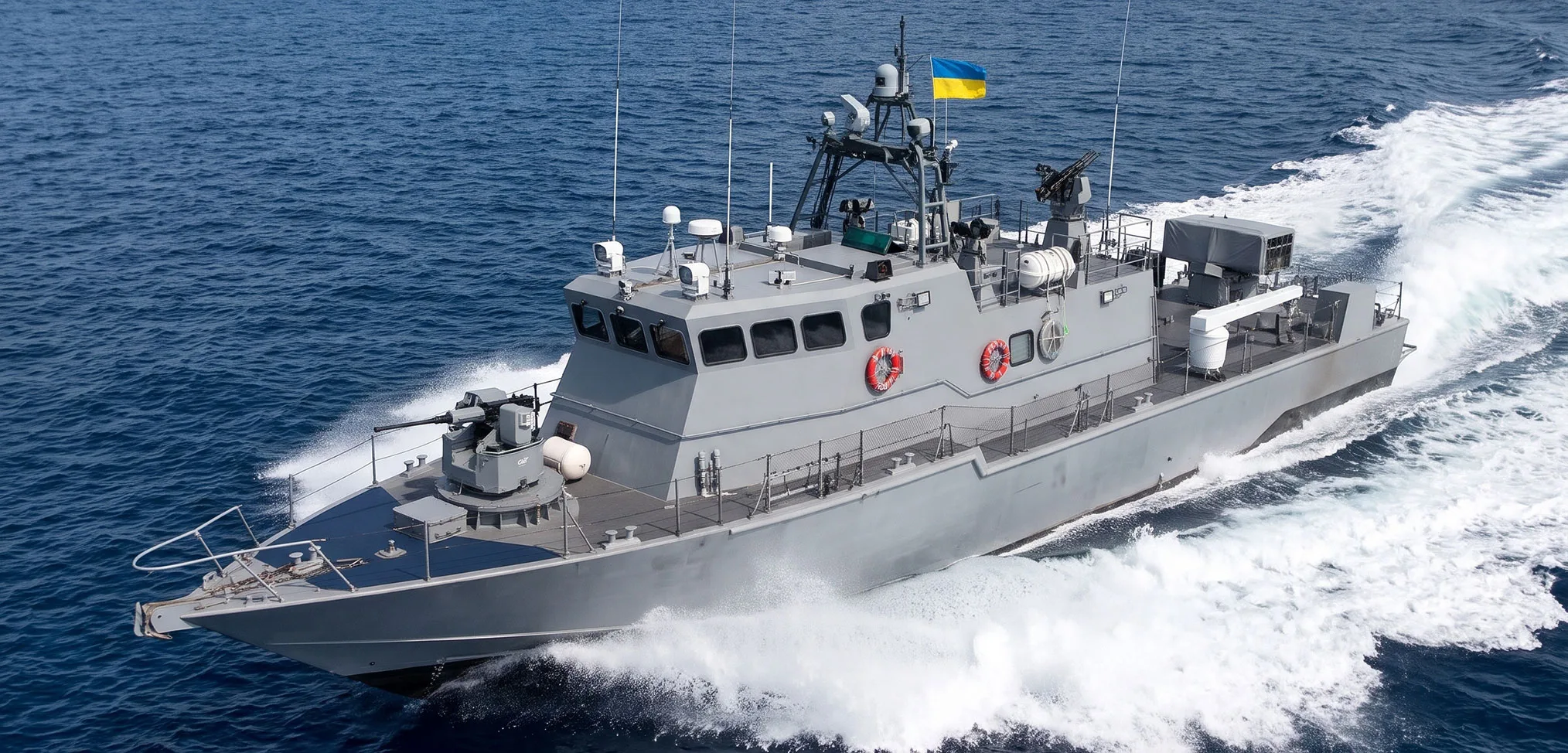

Britain and Norway have pledged more than £100 million for two British-built “advanced fast attack boats” for Ukraine in a partial revival of a project first announced in October 2020. The most striking figure in the announcement is their stated length of just 30 metres. £50 million per vessel appears to be very expensive for their size, and the official claim of “frigate-like capability” seems at odds with such a small platform.
The UK announcement explicitly gives the 30-metre figure. Missile-armed boats of this size are operated by navies around the world but clearly do not have the range, sensors, all-weather capability or combat power of a frigate. For example, the Philippine Navy’s 32.65-metre Acero-class Fast Inshore Attack Craft (basis for image above) carry a 30mm cannon and two 12.7mm machine guns, with four also armed with Spike NLOS surface-to-surface missiles. The nine-boat programme, contracted in 2021, averaged about £17 million ($23 million) per boat.
Announced in Berlin on 19 November, the programme will be funded equally by Britain and Norway through the Maritime Capability Coalition. The boats are intended to defend Ukraine’s coastline and help protect merchant ships carrying grain and other exports through the Black Sea. The UK Government claims they will give the Ukrainian Navy “agile and powerful offensive and air defence capabilities at a fraction of the price” of a frigate. European suppliers will provide missile and self-defence systems, although it is too early to be specific about equipment fit.
It is unclear whether the boats will escort merchant ships directly and whether their air defence systems can protect nearby vessels as well as the boats themselves. In the longer term, Britain and Norway see them as part of Ukraine’s coastal defences after the war.
One possible reason for choosing a 30-metre craft is that it might allow them to get into the Black Sea theatre, whether there is a cease-fire or not. The Dardanelles are closed to combatant nations, but a smaller vessel could potentially reach the Sea by passing through mainland Europe via the Rhine–Main–Danube waterway. Passage by a commissioned Ukrainian naval vessel would, however, require agreement with the Danube states concerned.
The announcement revives an idea dating back to the UK-Ukrainian naval agreement of 2020. In September 2021, Babcock had unveiled the P50-U, a 50-metre development of FBM Marine’s Protector design. The plan envisaged eight boats, with a proposed armament of eight anti-ship missiles, a main gun and a lightweight air defence system. Even this substantially larger craft was conceived as a means for Ukraine to threaten larger Russian warships close to home.
Babcock intended to build the first one or two boats at Rosyth, using the robotic panel line installed for Type 31 frigate construction. Assembly would take place in the neighbouring Syncrolift Hall, then used to refit the Royal Navy’s Sandown-class minehunters. Ukrainian yards were to build the remaining six or seven vessels. Neither Babcock nor Rosyth has been named in the new programme.

The programme average could cover missiles, training and support as well as construction, but no breakdown has been published. A 30-metre craft might carry weapons capable of defeating an incoming threat to the boat itself, but providing sustained air defence for merchant ships places much greater demands on radar coverage, missile capacity and endurance. Until the design and weapons fit are disclosed, even assuming some use of drone-based effectors, the frigate comparison is difficult to take seriously.
Main image: Mock-up of 30m FIAC for Ukraine based on the Philippine Acero-class.
Source: www.navylookout.com