Setting the stage for additional duty burden on exports, the US Trade Representative on Wednesday proposed 17 per cent additional tariffs on Indian goods, which can rise to 25 per cent if the bilateral trade deal is not signed.Citing the findings of its Section 301 investigation against 16 countries for alleged structural excess capacity, the Trump administration has proposed additional levies of 15-20 per cent against 14 offending countries, with the developed nations at the lower end of the band and China, Vietnam and Singapore at the top. The move, though not surprising, creates fresh complications for exporters, with two important exports from India, pharma and mobile phones, exempted from additional tariffs.While most developing countries are in the 18 per cent bracket, India has a one-percentage-point “comparative advantage”, provided the first tranche of the agreement which was finalised last Feb, is signed by the time the final hearings are completed and tariffs are announced. With the hearings scheduled on Jan 25, 2027, the fresh levies are likely to kick in next Feb. In India’s case, the probe flagged PLI schemes as part of the Atmanirbhar Bharat push and sector-specific acts, policies and practices in the steel, solar, health and ICT sectors.
Intense trade negotiations with US likely in coming weeks
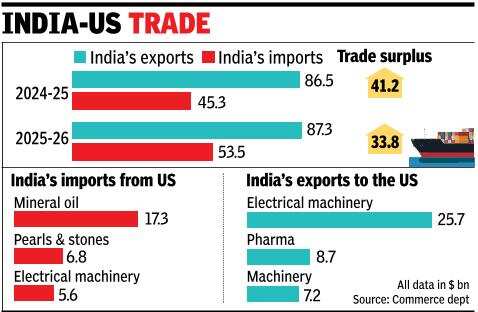
The US Trade Representative (USTR) also cited the rise in imports from China — which government ironically has struggled to check for its own reasons — as an instance of failure to address imports and FDI from non-market economies.Going by USTR’s statement, the Section 301 probe faulted countries, some following economic models vastly different from others, for actions that almost every government takes to support domestic industry: plans and policies that expand manufacturing and exports, financial repression, market access barriers and failure to address global excess capacity including through imports and FDI from non-market economies like China.In the absence of a trade deal, additional tariffs can be imposed, setting the stage for intense negotiations in the coming weeks.Although fresh tariffs were expected, the announcement plunges the industry into fresh uncertainty as it negotiates contracts for the 2027 winter with exporters keen to ship goods before the new tariffs kick in.Exporters will be watching the next move from government.The first Section 301 action is already facing a legal challenge in the US, and the latest move too is likely to land in American courts.USTR’s move signals that Trump has not lost his appetite for tariffs as one of the favourite items on his policy menu despite higher inflation causing a setback in the midterm elections.USTR’s big grouse is India’s trade surplus, estimated at $57 billion in 2025, when the country had a global trade deficit of $309 billion.“In particular, India’s acts, policies, and practices: (1) create unfair competition and reduce commercial opportunities for US producers and exporters; (2) harm the US economy through loss of US domestic manufacturing and exports; and (3) increase US economic security risks, including through reliance on NME inputs,” it concluded.
Government rejects structural excess capacity charge
The government on Wednesday rejected charges of structural excess capacity in any sector, and said it will work with the US for early conclusion of a bilateral trade agreement. “India and the US are engaged in negotiations for a BTA. It has been India’s position that any trade-related concerns should be addressed within the framework of these negotiations,” government said, adding it was examining the USTR notice.
Share your thoughts in the comments
Be respectful · TOI community guidelines
While India and the US had announced an agreement on Feb 2, agreeing to 18 per cent additional tariff, it had to be suspended due to the reciprocal tariffs being struck down by the US Supreme Court.The government officials have said that the agreement has largely been finalised and will be sealed once the US tariff framework is ready.
Source: timesofindia.indiatimes.com