
The quarter-million-mile expanse between Earth and the moon, known as cislunar space, has transformed into one of the most competitive frontiers within the national security arena in recent years. What was once solely a passageway for scientific discovery is now a strategic domain that the United States must work to secure and defend.
With a lunar exploration renaissance underway, the United States Space Force is engaging strategic academic allies.
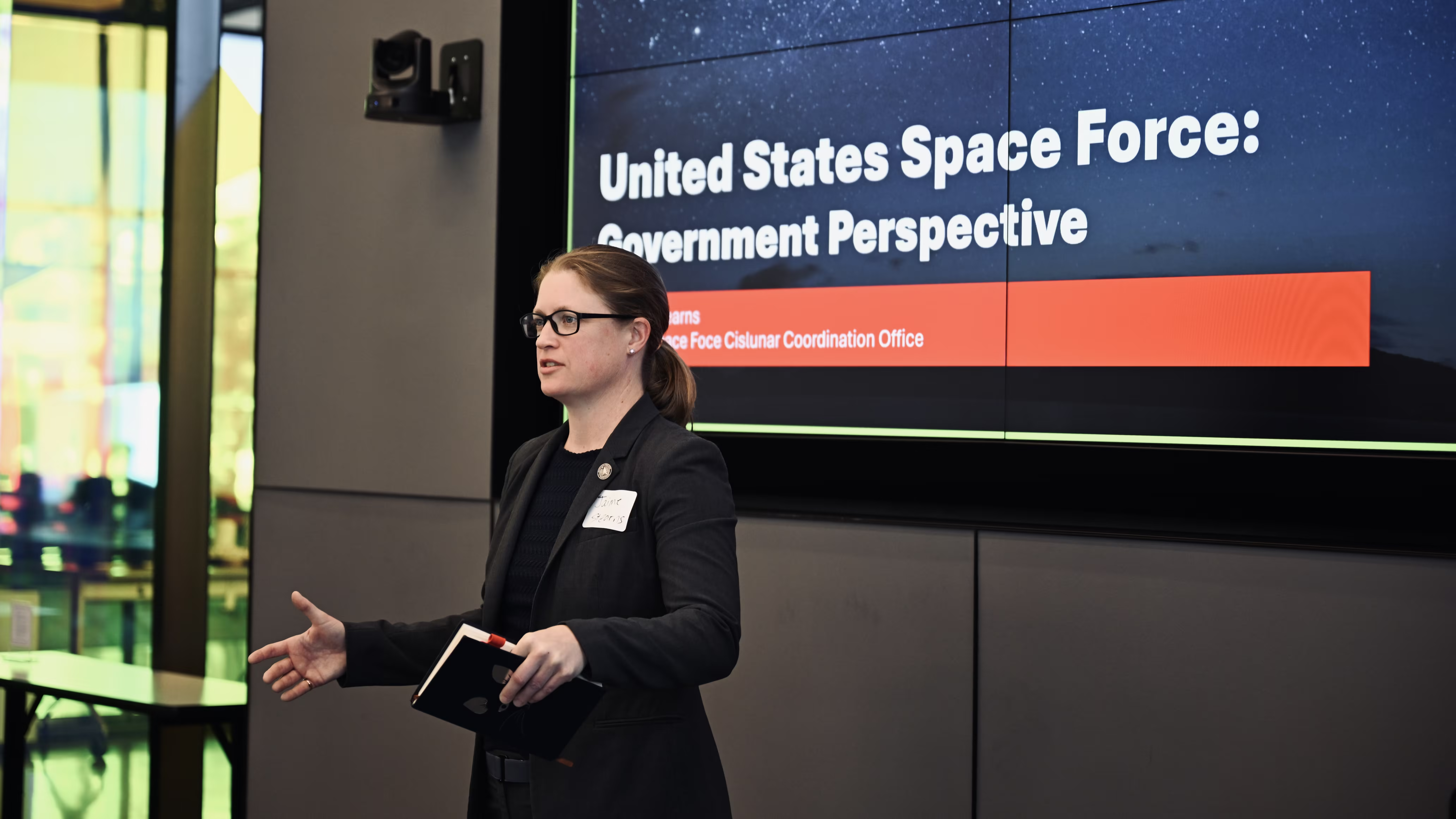
Senior Space Force leaders and university space science experts attend the 2026 Cislunar Capabilities Forum, hosted by the University of Arizona Kyl Institute for National Security on Aug. 19.
Photo by Laine Kowalski, U of A Office of Research and Partnerships
Senior Space Force military operators, acquisition leaders and government scientists visited Tucson in mid-August for the 2026 Cislunar Capabilities Forum to convene with some of the nation’s finest space sciences experts at the University of Arizona.
Hosted by the U of A’s Kyl Institute for National Security alongside the university’s Steward Observatory, Lunar and Planetary Laboratory and Space4 Center, the forum provided a valuable opportunity to jointly address challenges in continuous cislunar surveillance, maintaining custody of objects down to the lunar surface, high-resolution imaging of distant spacecraft, monitoring lunar activity, daylight tracking and detecting orbital maneuvers.
Determining how U of A’s specialized astronomy expertise could more broadly support these national cislunar monitoring efforts was a main objective.
“Our goal is to match university strength with national security needs, and our number one focus area is space,” said retired Gen. Robin RandKyl Institute president and CEO. Rand made clear how much the institute values the relationship, describing the Space Force as one of its most important collaborators.
The depth of the Space Force’s interest in U of A’s space-based competencies is evident in who attended. The forum drew senior Space Force leaders and U.S. Space Command planners, all key figures shaping how the nation operates in cislunar space.
This included Jaime StearnsPh.D., director of the Department of the Airforce’s newly established Cislunar Coordination Officewho discussed the government perspective behind coordinating with academia.
“The Space Force does not have the capacity to build all of our own architecture, and we don’t need to if we can collaborate with institutions like the U of A,” Stearns said. “We must align with academia to determine how and where their research expertise can contribute.”
Senior Space Force officials and university personnel watch a presentation highlighting U of A’s space domain expertise.
Photo by Laine Kowalski, U of A Office of Research and Partnerships
Cislunar objects sit roughly ten times farther away than the satellites the Space Force typically tracks, presenting numerous surveillance challenges. As NASA’s Ignition initiative drives focus toward a permanent Moon base and accelerates the cadence of lunar launcher over the next decade, the region beyond geosynchronous orbit will grow more congested and consequential.
Few universities are better positioned to deliver timely solutions.
U of A’s lunar legacy extends as far back as mapping the lunar surface for the Apollo missions in the 1960s to recording movement beneath the lunar surface today through LEMS – U of A-developed lunar seismometers set to fly with NASA’s Artemis program in 2028.
U.S. Space Command chose the U of A as its first Academic Engagement Enterprise Partner, the 2026 U.S. News & World Report ranks the university No. 3 globally in space science research and the National Science Foundation’s 2024 HERD survey ranks it No. 2 in the nation for astronomy and astrophysics research expenditures and No. 4 in NASA-funded activity among public universities.
This nationally recognized astronomy expertise applies directly to space domain awarenessor SDA, the work of finding, tracking and characterizing objects in space. Steward astronomer Eric Pearce explained that astronomy is uniquely suited to address this national security challenge, since it is both capabilities driven and broadly applicable to the greater cislunar domain.
Department of the Airforce’s Cislunar Coordination Office director Jaime Stearns (left), USSF Director of Operations Mia Walsch, and LPL’s Shane Bryne and Veronica Bray (right) hold a roundtable discussion to assess areas of opportunity for U of A to contribute to cislunar monitoring.
Photo by Laine Kowalski, U of A Office of Research and Partnerships
“The astronomers I’ve worked with over the past decade tend to offer a completely different perspective of observing space that has been incredibly useful for us Air Force folks to understand,” Stearns said.
U of A researchers operate a dedicated Space Domain Awareness Observatory alongside a network of advanced ground-based telescopes and sensors. In 2022, the university’s Space4 team identified a lunar impactor as a Chinese rocket booster.
More recently, the university secured an $8.6 million Space Force agreement to build the SURe imaging system, which links a network of radio antennas to capture high-resolution images of satellites in orbit – a testament to its developing SDA expertise.
Decades of leadership in optics and adaptive optics, the science of correcting image distortion to capture faint, distant objects, also translate naturally to tracking and characterizing spacecraft. World-class strengths in high-resolution and high-contrast imaging, astrodynamics and orbital modeling for the complex cislunar domain, along with lunar reconnaissance and surface monitoring, are equally applicable.
Drawing on its unparalleled space science foundation, the university aims to further develop its space science prowess in service of the nation, keeping the U.S. ahead of adversaries in the contest to secure cislunar space.
Stearns predicts the Space Force may eventually begin interacting with academia similar to how it does with industry to streamline development pipelines from research to operational development.
If the Cislunar Capabilities Forum was any indication, that future is already be underway.
Source: research.arizona.edu