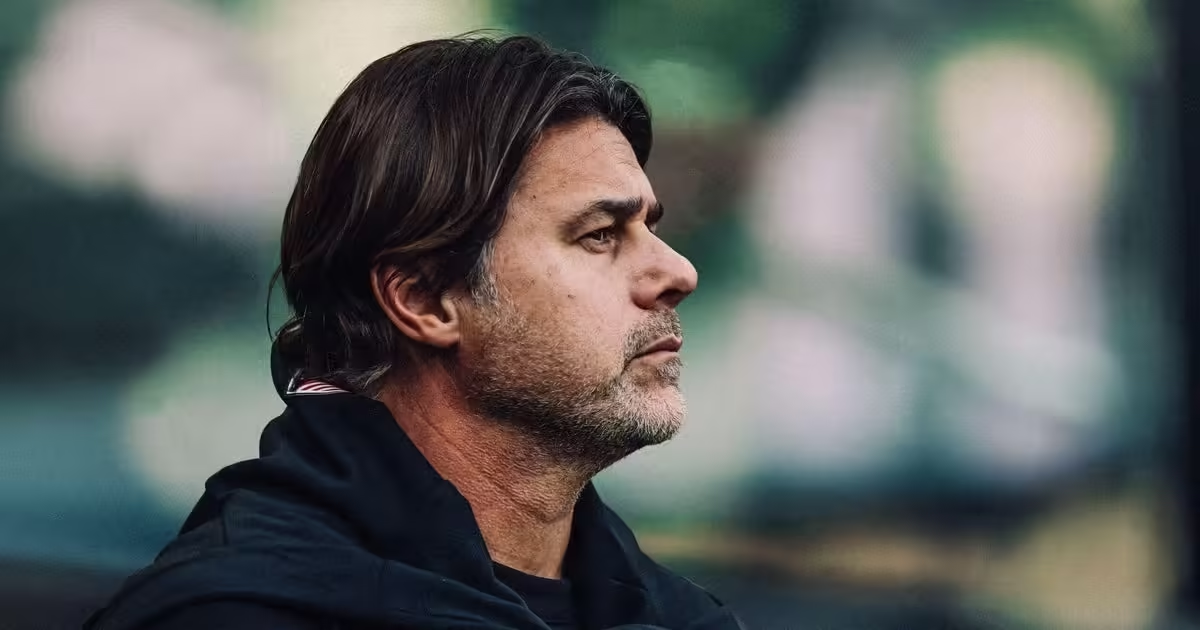

The first U.S. players had already begun to arrive at the Trilith Guesthouse in Georgia when Mauricio Pochettino’s phone buzzed.
It was Nov. 8, a Sunday afternoon, not long after Manchester United’s 4-4 draw with Aston Villa. Pochettino and his trusted assistants were preparing for a training camp at U.S. Soccer’s headquarters south of Atlanta. All was relatively quiet — until it wasn’t.
That afternoon — Sunday evening in Manchester — United executives accelerated talks with Pochettino and his representatives. And thus began a wild week that ended with Pochettino coaching the U.S. men’s national team yet preparing to take over at United, a club he had long aspired to lead.
The following, based on interviews and conversations with a variety of people close to the USMNT and the Pochettino negotiations, is the inside story of that week, Pochettino’s last at a place he came to love. It began in the background, then quickly became the hottest story in soccer.
On Monday morning, Pochettino’s representatives reached out to U.S. Soccer CEO JT Batson. By Monday night, when Batson and COO Dan Helfrich sat down with Pochettino and staff for dinner in the team’s meal room, they knew about the Pochettino-United talks and the genuine interest.
By Wednesday morning, the whole world was. “Obviously everyone’s on social media,” defender Chris Richards told The Athletic that day. “Everybody sees all the reports and stuff.” Sitting on a sofa several steps from the USMNT’s training field, he seemed resigned to losing Pochettino — but players insisted, publicly and privately, that amid the noise, the camp must remain “business as usual.”
Finally, on Thursday, as players gathered for a pre-training meeting, Pochettino invited the team’s entire staff into the room. “Players are very sensitive,” Pochettino would later explain. “But the staff are very sensitive too, and they started to feel something.” With the United agreement in place, he felt a need to address them all and, to start, tell them what they already suspected.
“Guys,” he said, roughly, “I’m sure you’ve seen the news. An opportunity came up, and I’m gonna take it.”
It was, he said, one of the toughest decisions of his career.
Then he reflected on his American adventure. At first, upon arrival in 2024, Pochettino didn’t quite know what to expect. Throughout his first year in charge, some aspects of U.S. soccer culture shocked him. The lack of enthusiasm within and around the team as a home World Cup neared was, he would later reveal, “a big punch — and we were knocked out for a while.”
But he recovered and instilled his ethos in the USMNT. The U.S., in return, adopted him. The past two years revived his drive, he said, and “our capacity to dream big.”
He told players and staff some of this on Thursday, and thanked them.
“The American culture, the people, the team,” he said, according to captain Tyler Adams, “made him believe in something bigger than just football.”
An awkward week for U.S. Soccer, Pochettino and Man Utd
Henry Bushnell
Why he re-signed in the first place
Outside U.S. Soccer, after his arrival in 2024, Pochettino was seen as something of a mercenary. When asked this past March about talks with European clubs, he said he was “open” to staying with the USMNT beyond the World Cup, but the tone of his insistence framed it as an improbability. “You can never say never,” he said. In other settings, he would speak openly about his desire to someday return to European club football. Two giants were known to be at or near the top of his dream-job list: Manchester United and Real Madrid.
Inquiries arrived sporadically from other clubs, and each time, Pochettino’s representatives would inform Batson and U.S. Soccer, in case talks progressed and leaked. Around a week before World Cup camp opened in May, “Team Poch” met with Milan, the Serie A club on the verge of firing Massimiliano Allegri. There was never any real worry that Pochettino would ditch the U.S. before the World Cup, but many assumed he would leave afterward.
The first turning point, it seems, was a dinner at Jean-Georges in Manhattan.
In late May, as the USMNT opened World Cup camp with promotional activities in New York, Batson sat down with Pochettino and assistants at the upscale French restaurant on Central Park West and offered them contract extensions through 2030. After two March losses, with pundits questioning Pochettino, the gesture touched him. He always knew he’d wait until after the tournament to chart his next steps, but he felt Batson’s support and belief. “That,” Pochettino told Batson months later, “is why you are always going to be in my heart.”
Pochettino then felt the red-white-and-blue wave that followed the USMNT through the World Cup. The morning after wins, he and his assistants would watch and share videos of patriotic crowds and wild celebrations. “The magic thing that happened during the World Cup,” he’d later say, “the connection with the people,” built a tighter bond with the country — and the job. He embraced America. He played country music on loop. And he saw soccer’s potential here, in a visceral way he hadn’t previously.
Mauricio Pochettino was a hit with U.S. fans during the 2026 World Cup. (Kirby Lee, David Gonzales, Lindsey Wasson / Imagn Images, AP Photo)
He also saw a rising generation of players who could help fulfill it. Even during the World Cup, he invited one of those players, Mathis Albert, to the team’s base in Southern California and spent an hour getting to know the 17-year-old. Then, and in weeks of reflection and talks afterward, he began to see a future with the U.S., one where he could influence soccer beyond the senior national team.
But the unstated reason for his re-signing in August, on a four-year contract through 2030, was that no plum jobs were available. Milan went with Ruben Amorim. Madrid appointed Jose Mourinho. Manchester United, unwilling to wait until mid- or late-July for its next boss, chose to retain Michael Carrick. By the time Pochettino’s U.S. flopped against Belgium, every desirable job was filled.
So, he returned, but in talks with U.S. Soccer, his representatives negotiated a $10 million exit clause — which ensured he’d remain semi-available if a club like United came calling.
His main rep, lawyer Mariano Aguilar, alerted United to that exit clause in late October — a clear indication of his interest in the job as United considered firing Carrick.
All the while, Pochettino worked as if he were here to stay. His chief assistant, Jesús Pérez, spent a week in back-to-back meetings at U.S. Soccer’s National Training Center in mid-August, laying groundwork for deeper integration across departments. In September, Pochettino called in 13 uncapped players, including eight teenagers, as he began building toward 2030.
And in that camp, he felt their youthful energy. “It’s contagious,” he said. “After you talk with them, you feel younger.” He felt chills watching them soak in their debuts. And he felt proud of the World Cup vets who guided them. He sensed that the culture he’d preached all along had taken hold. “The mentality is to play for us, to play for the people that you love, and to play for this,” he said in a team meeting as he reached for the U.S. Soccer badge on his shirt. “When you don’t put conditions (on that commitment), that is true love.”
He reprised that line in his locker-room speech after the fourth of four wins in September and October, against Canada in Minnesota. “True love. Remember, true love,” he told the players as he sent them off back to their clubs. “When you are in adversity, true love. When you are tired, true love. True love. That is a thing that we need to flourish.”
Players felt it as they dispersed, and again when they returned to Georgia a week ago. They filtered in throughout last Sunday and Monday, touching down at Hartsfield-Jackson Atlanta International Airport, riding in black cars down to Trilith, the quirky master-planned community near the NTC that is now their home base. They hugged staffers and reunited. “The energy, the vibes in camp was something I’ve definitely missed,” striker Folarin Balogun said. It gave him, like other players, “a new sense of life.”
Little did they know that, a few days earlier, on Thursday, Nov. 5, Man United executives had made a decision that would overshadow the camp.

Mauricio Pochettino and his staff lead a training session before the Concacaf Nations League quarterfinals vs. Haiti (Mike Stewart / AP Photo)
The elephant in the room — and on the training pitch
United’s executive committee met that day and, after some discussion, unanimously decided to zero in on Pochettino if they chose to move on from Carrick. And after their eighth consecutive Premier League game without a win, despite a furious stoppage-time comeback to rescue a draw with Villa, they decided to move. According to Pochettino, and according to what his representative told U.S. Soccer the following morning, this was when “the situation started to appear.”
Behind the scenes, it then gathered speed Monday and Tuesday. By Tuesday afternoon, an agreement between Pochettino’s camp and United was largely in place. As the talks progressed, Pochettino and Aguilar “were very transparent” with Batson and U.S. Soccer, the Argentine coach said.
In team meetings and at training, though, Pochettino and his assistants tried to maintain normalcy.
On Tuesday morning, he strode from an indoor portion of the facility onto the “superpitch” where the USMNT practices; hugged U.S. Soccer president Cindy Parlow Cone and her assistant, Molly Dwyer; and casually greeted some reporters, as if nothing were brewing.
On Wednesday morning, on the same vast pitch, Pochettino chatted with Batson; he half-hugged midfielders Cavan Sullivan and Malik Tillman; he had an extended conversation with two Under-20 players called up for the day, Pedro Guimaraes and Jaidyn Contreras. He convened the team in a circle, as he or Pérez always does, and, as he twirled his whistle, he spoke about the upcoming training session. “OK guys,” he said as they broke into rondos, “vamos!”
Outside the camp, and in Manchester, there were natural assumptions that Pochettino would bolt across the pond as soon as a deal was finalized. If he had, U.S. Soccer would have been stuck without a simple Plan B for two Concacaf Nations League quarterfinal legs against Haiti.
Steve Cherundolo, the Olympic team coach and a natural interim choice, was leading his own U-23 camp in Spain. Gonzalo Segares, the Under-20s coach, was on campus but has never coached at a senior level. Emma Hayes, the renowned U.S. women’s national team coach, is preparing for World Cup qualifying and would not have been pulled away from that for the men’s Concacaf Nations League.
Ultimately, though, backup plans were never seriously explored. Man United execs contacted U.S. Soccer on Wednesday, and agreed to pay the full $10 million buyout, plus over $2 million more for Pochettino’s core staff — Pérez, Miguel D’Agostino, Toni Jiménez, strength and conditioning coach Sílvia Tuyà, analyst Alec Scott and sports scientist Sebastiano Pochettino (Mauricio’s son) will all follow him to United. All parties also agreed that Mauricio would remain with the U.S. for both matches — though Pérez, Jiménez and Sebastiano would end up departing earlier.
Pochettino later assured everyone that the impending move to Manchester “is not going to change our commitment and the way we are going to take the next two games.”
It was, though, the elephant in every room until Pochettino addressed it.

An emotional Mauricio Pochettino announces his farewell to U.S. Soccer (Kevin C. Cox / Getty Images)
Country roads wind up leading to Manchester
When he finally did on Thursday morning, in that room with staff and players, he spoke for about 10 minutes. He didn’t sob, but “he was emotional,” according to Adams. Pochettino had seen a culture grow and a nation rally around his team. They’d shared unforgettable moments, such as that “Country Roads” serenade after their World Cup win over Australia. “Even if I’m not American, after the game, I was emotional,” Pochettino said that day in Seattle, “because the atmosphere was amazing.” It was the type of memory he would reflect on in his final days before jetting to Manchester.
Thursday, though, was not a time for nostalgia. After all, within the hour, players had to train. And two days later, they kicked off a quarterfinal with Pochettino still at the helm.
“It’s obviously a little bit strange,” Adams admitted.
“It’s true that it’s not ideal,” Pochettino said. “But it’s never an ideal situation when this type of thing happens. Like in life, football goes quick — so quick.”
Most players seemed to understand his decision to leave. “It’s not some rinky-dink opportunity,” Adams noted. Manchester United, as Adams and Balogun both said, echoing Pochettino’s reasoning, is “once-in-a-lifetime.” When Pochettino spoke publicly one day later, at a pre-match news conference that became a farewell, he said he couldn’t turn down a club “the size of Manchester United.”
But that day also made it clear how much all of this had weighed on him. He choked up, and eventually reached for a tissue to wipe his cheeks and eyelids. U.S. Soccer had, for much of two years, made him “feel really happy doing my job, sharing an amazing project, being part of this family.”
After lunch on Thursday, he took some time to enjoy it. He wandered over to a north field, where Colombia Under-20s were playing Paraguay, and sat on a ledge by the scoreboard, next to team security officer Jerry Rawlins, a few feet from assistants, dangling his legs and watching.
A few hours later, at 6 p.m., he returned to the NTC flanked by Rawlins and assistants. After hugs and laughs in the hallway, he spoke onstage in a multi-purpose room to kick off U.S. Soccer’s National Referee Coach Camp. For 15 minutes, after a hearty round of applause, he gave a coach’s perspective on refereeing. No one mentioned Man United. Then he left, walking through the empty hallway, past TVs that 30 minutes earlier had been lit with speculation about who should replace him.
He spent the night as a celebrity savoring the final steps of the adventure. With temperatures dropping, at 8 p.m., he tugged on a puffy blue U.S. Soccer coat and watched the U.S. U-20s play Japan, reclining in his balcony seat. Midway through the first half, Batson arrived and plopped down next to him, as assistants stood and followed the action. When they all strolled down a ramp to exit at halftime (of a 2-0 U.S. loss), Pochettino posed with an attendee for a photo.
The following morning, everything became official. U.S. Soccer informed staff (via Slack, with all Microsoft systems down) and its board of directors. In coordination with Man United, it published its announcement at 7 a.m. ET. Around 9:15 a.m., a makeshift media room filled with reporters and federation employees. Some staffers, and even some executives, fought back tears as Pochettino battled his own at the news conference. Batson and Parlow Cone patted him on the thigh. They later hugged Pochettino and his assistants as the coaches headed toward training, where one U.S. player casually sang: “Glory, glory Man Uniiiited!”
In some U.S. Soccer circles, people felt complicated about Pochettino’s semi-abrupt departure. There was some disappointment, and for some, a hint of sourness. Just three months ago, he had signed a four-year contract. Just one month ago, he had preached commitment and “true love.” Not everyone was as appreciative and reverent as Batson and Parlow Cone were in public.

Mauricio Pochettino gives his farewell press conference, flanked by U.S. Soccer CEO JT Batson and president Cindy Parlow Cone (Kevin C. Cox / Getty Images)
But there were far more congratulations than accusations of hypocrisy. “There’s no one sitting here holding grudges,” Adams said. In the NTC’s cafeteria on Friday, federation employees joked about switching their Premier League allegiances to United, or speculated about which U.S. players — Balogun? Alex Freeman? — Pochettino might try to bring to Old Trafford. Pundits, meanwhile, debated the merits of candidates to succeed Pochettino, such as Pep Guardiola. “That’s the world of football,” midfielder Weston McKennie said. “You say goodbyes and new people come in.”
Inside the camp, there was calmness as the team touched down in Miami on Friday afternoon — just before the FAA’s nationwide groundstop — and zeroed in on Haiti. The following day, they cruised to a 6-0 victory.
Hours later, a trio of Pochettino’s assistants, led by Pérez, got on a plane to start the next project. But Pochettino stayed, led a post-match review, prepared one last gameplan, and spent Sunday night at Paycor Stadium watching the NFL’s Cincinnati Bengals beat the Pittsburgh Steelers.
On Monday, after a short training session at TQL Stadium in Cincinnati, he reflected on his legacy with the U.S., focusing on the people and relationships he built rather than wins or losses. “All that we’ve made in these last two years,” he told a small group of reporters at the team hotel, “is the beginning of the new soccer in the USA.”
He will soon leave it all behind. On Tuesday night, after one final game, he will head to the airport with three staff members to board a Manchester United-chartered plane to England. Upon landing, he will go straight to Carrington, United’s training ground, to prepare for a game at Liverpool on Sunday. “The schedule is so busy,” he said with a smile.
But he will always feel that connection to America. As he talked about those next steps and his new life in Manchester, he was asked what he would say to any candidate who called him with questions about the U.S. job, such as Guardiola.
“Take (it). Like that,” he said, snapping his fingers, relaying his simple advice. “Take. Because it’s a perfect moment to arrive at the federation. Everything is in the right direction.
“Of course, take it.”
The Athletic’s Tom Bogert, Felipe Cardenas, Laurie Whitwell and Adam Crafton contributed reporting to this story.
Source: www.nytimes.com