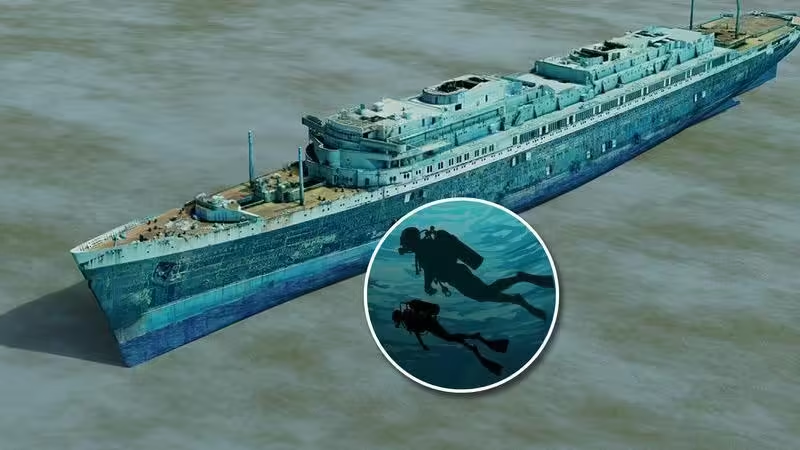

The SS United States will be the largest artificial reef in the world. The second-largest, the USS Oriskany, won’t be far away.
“We’re going to be working with Pensacola in Escambia County, because we’ll have the two largest artificial reefs in the world,” Adams said. The ships will be about 13 nautical miles apart. “You could conceivably dive both of them on a daylong trip, unless you’re going to be doing the deep dive, which is going to take a lot longer.”
In addition to the submerged ship, divers will see a variety of aquatic life.
“Marine life will quickly start to gravitate to the wreck and start living there,” Christy said. “We’ll have fish that are important to our commercial fisheries — snappers, groupers, Amberjack, things like that. You’ll see sharks and turtles and small reef fish.
“You’ll get crustaceans, crabs and shrimp,” Christy said. “You’ll see different things that will live and grow on the marine life that adheres to the wreck surface. It’s going to be an entire ecosystem.”
Crews prepare to sink the SS United States on Wednesday in the Gulf of Mexico.
Tony Giberson, USA Today Network
Will divers need special training?
The SS United States will sit in water 180 to 200 feet deep. With its funnels, radar mast and other deck structures removed, “the top of it will be in 55 to 60 feet of water,” said Alex Fogg, Okaloosa County’s chief of natural resources.
“A lot of those top decks are going to be easily accessible to the beginner diver and novice diver,” he said. “Technical divers who want to go down and see what the bottom looks like can go down there.”
“There’s probably going to be plenty of cave divers and other penetration divers who are going to be exploring the inside of the ship, going down to the engine room, going to the pool, and other places like that,” Fogg said. “But that’s not something a recreational novice diver is going to be able to tackle.”
Source: tucson.com