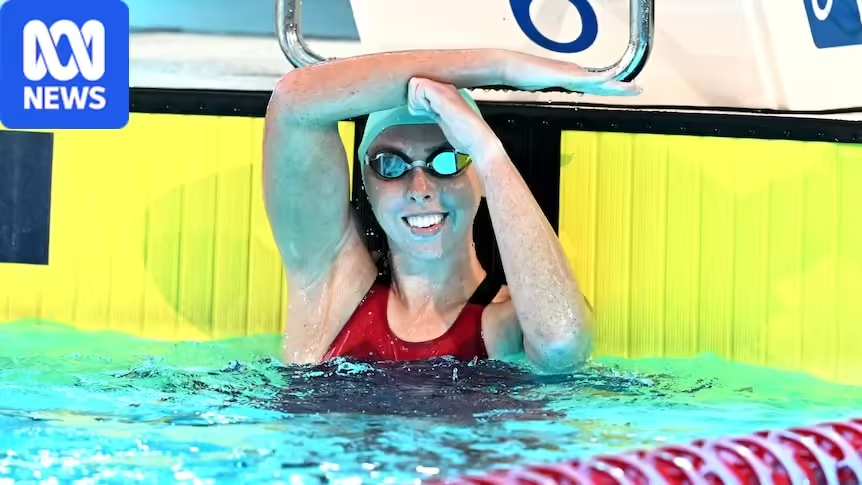

Swim GP’s made for TV, all-action racing format has proven a hit with swimmers and spectators alike.
But the biggest benefit may well be the innovations that placed para-swimmers front and centre of the competition at the Melbourne Sports and Aquatics Centre.
In front of a sold-out crowd, four teams: Kraken, Wahoo, King Tide and Tsunami, competed in a variety of races ranging from skins events through to mystery medley relays.
Times are not important. It’s all about who touches the wall first.
“It is an opportunity for our athletes, our Paralympic team and our Olympic team, to come together and really showcase what they do,” Swimming Australia Paralympic head coach Mel Tantrum said ahead of Saturday’s evening events.
“This is about building the brand, building the profile of the athletes, swimming in prime time in preparation for the next six years.”
The Melbourne Sports and Aquatic Centre was sold-out for day two. (Supplied: Swimming Australia/Delly Carr)
Swim GP is not a new idea, and indeed has built on the concepts reintroduced at last year’s Australia vs the World in Brisbane.
However, crucially, Swim GP has seen para-swimmers take a leading role.
Swimming Australia chief executive Rob Woodhouse told ABC Sport that involving the para-swimmers “was one of the most important factors” and a “no-brainer” in Swim GP’s planning for a couple of reasons.
“Both our head coaches, Mel Tantrum and Rohan Taylor, they absolutely want a packed stadium for our trials, ideally Sydney next year, but particularly the Olympic/Paralympic trials in ’28 in Chandler, one of the reasons being, for the Olympics, SoFi Stadium, with 40,000 screaming Americans and Long Beach for the Paralympics,” Woodhouse said.
“Some of those [para-]athletes do have sensory issues, so for them to have some experience coming out to all of that noise and those bright lights, the flashing lights and all those sorts of things is really, really important.
“So there’s quite an important benefit from Swim GP for those para-athletes that do have to deal with those things to get more accustomed to a noisy venue, to a bright flashy venue and things like that.
“[Also] that aspirational view that these athletes can provide, whether they’re para-athletes or able-bodied athletes, to the young kids at home, and there’s a lot of kids with various disabilities that don’t have opportunities to get into a pool or to even just get involved in the other sports. So, just being able to showcase our amazing para-athletes and what they do is a really critical factor.”
A big atmosphere is vital for Australia’s swimmers to prepare for LA Olympic Games in 2028. (Supplied: Swimming Australia/Delly Carr)
Tantrum agreed, saying integrating the two programs was vital.
“Swimming Australia is really inclusive in terms of the parity between Olympic and Paralympic programs and making sure our swimmers across both programs are really profiled and really supported,” Tantrum said.
“The athletes are loving being part of a bigger team. Those sort of innovative, creative competitions make the athletes feel they’re part of an elite team.
“It’s not just para, it’s not separate, it’s part of being the Australian Dolphins swim team and both programs coming together.
“The athletes are fully integrated team members. They don’t sit separately. They’ve got the same uniform, same bleachers, same team meetings.
“And I think that’s, for the athletes, it’s a chance for them to really showcase their athleticism.
“It’s not about, oh, you’re a para-athlete, it’s about elite swimming at its best.
“The world’s best swimmers are here in the pool. And yeah, whether you’re Olympic or Paralympic, you know, able-bodied or have a disability, it doesn’t matter. You’re an elite athlete first and you’re here to perform.”
New tech bringing para-sport into the mainstream
Victoria Belando Nicholson (right) was a member of the King Tide team. (Supplied: Swimming Australia/Delly Carr)
One of the biggest challenges in para-sport when there are a limited number of athletes, is integrating multiple classifications and how to accurately, and fairly, ensure a level playing field.
In a standard multi-class meet, swimmers with varied impairments all start their races at the same time, with the winner determined by how close a swimmer gets to the world record in their particular classification.
That’s all well and good but, for spectators, it can get confusing as to who as actually won because the winner does not always touch the wall first.
Swim GP gets around this by having a staggered start, with lights on the blocks for each swimmer.
The time-gap is determined based on a swimmer’s season best in a particular distance and should result in a blanket finish — far more appealing for spectators.
“I think it’s a really good idea to then see everyone come up towards each other and finish pretty closely,” Paralympic legend Lakeisha Patterson told ABC Sport.
“It makes it an exciting race, I think, towards the end.
“I think for an event that isn’t preparing for a world champs or a major international meet, this is really good for fans to see how multi-class swimming works.”
Lakeisha Patterson said she was nervous before her race, perhaps made more so when Ben Hance literally ripped the shirt off his back when walking out. (Supplied: Swimming Australia/Delly Carr)
Patterson competed in, and won, Saturday night’s opening race, a multi-class, mixed 100m event where each swimmer swam a different stroke, with Patterson unusually swimming butterfly, which she noted “definitely” won’t be on her program for next year’s world championships.
Perhaps she should reconsider. Patterson, who is classified as an S9 swimmer, swam a PB to blitz the field, although the other three swimmers; Tim Hodge (S9), Ben Hance (S14) and Keira Stephens (S10), were far closer together.
“It doesn’t matter what their classification is and, in some cases, what their gender is,” Tantrum explained.
“It’s some new tech that we’re trialling for the first time on the block so that athletes, no matter what their class or their gender, they can race together.
“With this [Swim GP] format, it’s basically who touches the wall first is the winner.
“These staggered starts and close finals make the crowd get right into it. It makes it exciting if someone’s got a 20-second stagger to catch up on in 100 metres. It makes for exciting racing, and the crowd really got into that last night and you could feel the crowd lift.
“That’s what swimming should be, right? It should be exciting.”
The future of para-sport?
Lakeisha Patterson (right) and Rowan Crothers (second right) were key members of Team Tsunami. (Supplied: Swimming Australia/Delly Carr)
Patterson noted that giving para-swimmers the same platform was crucial for the development of the sport.
“I think it’s incredibly important to showcase that our athletes aren’t just here for participation,” she said.
“We are athletes showcasing what is possible, and I think Australia is leading the way in that inclusion space and how we can involve our entire team.
“Leading into Brisbane we can really build on that and hopefully have all of Australia behind us, and showing to the people watching at home that they may have a space in Paralympic sport as well.”
Fully integrated competitions remain a rarity for para and able-bodied sporting events, the Commonwealth Games being a notable exception.
Given the success of this format, Tantrum said that innovations like the staggered starts seen in Swim GP could inspire more innovation elsewhere, perhaps even adding more athletes to future Commonwealth Games fields.
“If we could influence Commonwealth Games Federation … we could potentially have a greater number of athletes and a greater number of classes competing together,” Tantrum said.
“We left a number of athletes at home [from the Glasgow 2026 Commonwealth Games] because they simply didn’t have events for those classes.
“So something that is more of a multi-class format for Commonwealth Games would be a great innovation to at least consider.
“There’s potential there that we could make this more integrated, fun, with exciting finishes and more athletes involved from Australia.”
Perhaps even other sports could take note?
“Our immediate purpose is to showcase swimming,” Tantrum said.
“But you know, if we can lead other sports and things like track and field to follow a similar format, where the para-athletes are standing alongside their Olympic athlete colleagues?
“You know, it’s humans, right? It’s human story, it’s humans doing the best that they can do.
“If other sports such as athletics or cycling, want to come in and do what we’re doing, if we’re the trailblazers of that space, we’d love others to join in as well.”
Source: www.abc.net.au