
Artificial intelligence is changing how financial institutions analyze markets, develop software and make investment decisions. At Stony Brook University’s November 6 FinTech Workshop, researchers and industry leaders examined what those changes mean for the future of finance and the people working in it.
The event was held in the New Computer Science Building and organized by Karina Torres Castro, manager of research and innovation and assistant research professor in the Department of Mechanical Engineering. It also featured the announcement of a new AI Innovation Lab in partnership with financial technology company Broadridge, where students and faculty will work alongside industry experts to tackle challenges in AI and finance.
The workshop included academic research presentations, industry perspectives and a panel discussion. Sponsors were the College of Engineering and Applied Sciences (CEAS), Long Island Manufacturing Extension Partnership (LIMEP), Center of Excellence in Wireless and Information Technology (CEWIT) and AI Innovation Institute (AI3).
Amy Erickson, executive director of LIMEP, said AI-driven financial modeling can help small and mid-sized manufacturers reduce waste and make better investment decisions without replacing skilled workers.
“Manufacturers need practical tools that protect their bottom line and keep their people at the center of operations,” Erickson said. “This Fintech Workshop marks the first of several AI-focused programs LIMEP is rolling out for our regional manufacturers.”
Andrew C. Singer, dean of CEAS, welcomed participants and introduced keynote speaker Robert J. Frey, research professor and founder of Stony Brook’s Quantitative Finance Program in the Department of Applied Mathematics and Statistics.
Frey, whose career includes leadership roles at Renaissance Technologies and other financial firms, placed the rise of AI alongside earlier technological advances that disrupted industries and changed the nature of work.
“Some of these adjustments, especially in the short term, can be extremely painful for some people,” he said. Despite uncertainty surrounding AI’s impact on employment, Frey argued that technological progress has historically created new opportunities.
“The alternative is stagnation. And I don’t think that’s the answer.”
The changes are already being felt in financial technology companies. At Broadridge, AI is taking on increasingly complex software development tasks, including responsibilities once assigned to entry-level employees.

“The career ladder is changing,” said Roger Burkhardt, the company’s chief technology officer of capital markets and AI.
Burkhardt described a workplace where new employees may be expected to define problems, evaluate AI-generated code and recognize security vulnerabilities without the years of experience traditionally gained through more routine assignments. He encouraged students to experiment with AI development tools while learning to assess the quality of what those tools produce.
“I think critical thinking and communicating with users are evergreen skills,” he said.
When Jill Scher began her accounting career in 1994, staff members worked with paper ledgers and red pencils, and documents traveled from desk to desk, sometimes accumulating so many marks that Scher knew she would be working late.
Today, Scher, managing director at CBIZ Advisors, uses AI to analyze financial statements, research prospective clients and prepare for meetings. She no longer spends her days checking calculations by hand, but the experience taught her how to recognize mistakes and understand the information behind the numbers.
That combination of technical knowledge and human judgment is something Frey wants students to develop. Stony Brook’s quantitative finance curriculum increasingly incorporates AI and machine learning, encouraging students to use the technology without becoming dependent on it.
“If you do that properly, they see this as a force multiplier, something that increases their productivity rather than something that replaces them,” he said.
Research presented by Pawel Polak, faculty member in the Department of Applied Mathematics and Statistics, showed why financial expertise still matters when developing AI tools.
Polak discussed Agenthon 2026, an international competition jointly organized by CEWIT and the Society of Quantitative Analysts (SQA), that attracted more than 1,000 registered participants to develop AI agents capable of writing code, forecasting financial trends and simulating markets. Some agents significantly improved the speed of existing software, but others struggled when faced with unfamiliar problems.
Teams that incorporated financial knowledge into their AI systems generally performed better on new tasks. Agents required to explain their predictions also performed better when faced with unfamiliar problems.
“Human in the loop definitely helps,” Polak said.
Knowing how an AI system reaches a decision was also central to the presentation by Lav Varshney, professor of electrical and computer engineering and inaugural director of the AI Innovation Institute.
“Black box AI might not be the most helpful because you don’t really know what’s going on inside,” Varshney said.
He described research that combines different kinds of knowledge through explicit, verifiable rules. One potential application involves financial transactions that fail to settle as expected, where an AI system could help determine the next steps while preserving a record of how each decision was reached. Such traceability is particularly important in industries subject to regulatory oversight.
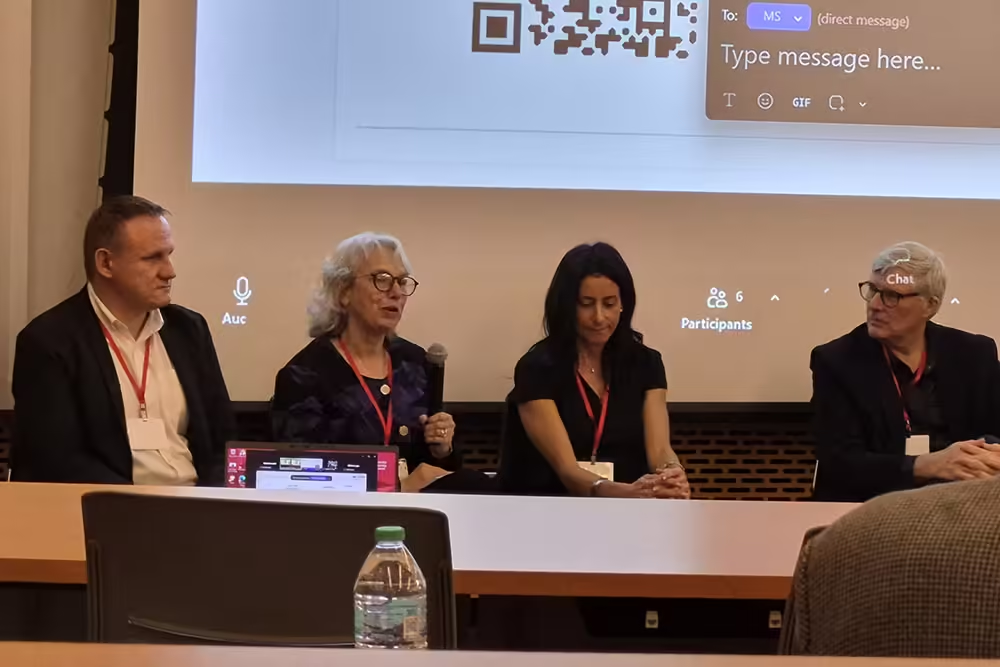
The afternoon’s industry-academic panel, moderated by Yvette Wohn, inaugural chair of Stony Brook’s Department of Technology, AI and Society (DTAS), brought Polak, Burkhardt and Scher together with Melissa Brown, managing director, investment decision research at SimCorp.
Brown’s team helps investors understand how unexpected economic developments might affect their portfolios. One exercise considered what could happen if the Federal Reserve lost its independence, potentially causing different parts of the bond market to react in different ways.
Previously, examining comparable market conditions meant spending hours searching historical data. Now her team can ask AI to identify when similar circumstances occurred.
“That takes five minutes rather than a day,” Brown said.
The discussion also turned to consumers who increasingly rely on AI for financial information. Scher described clients arriving with AI-generated tax analyses and asking her to confirm the results, even when the information may overlook changing regulations or individual circumstances.
Samir Das, chair of the Department of Computer Science, concluded the workshop by announcing a new AI Innovation Lab in partnership with Broadridge that will bring students, faculty, and industry experts together to tackle practical challenges in AI and fintech.
“A central focus is experiential learning, giving students opportunities to work with real industry problems and develop AI-powered solutions,” Das said. “We see this partnership as a model for how universities and industry can work together to advance technology and prepare the next generation of talent.”
— Beth Squire
Source: news.stonybrook.edu