
New York
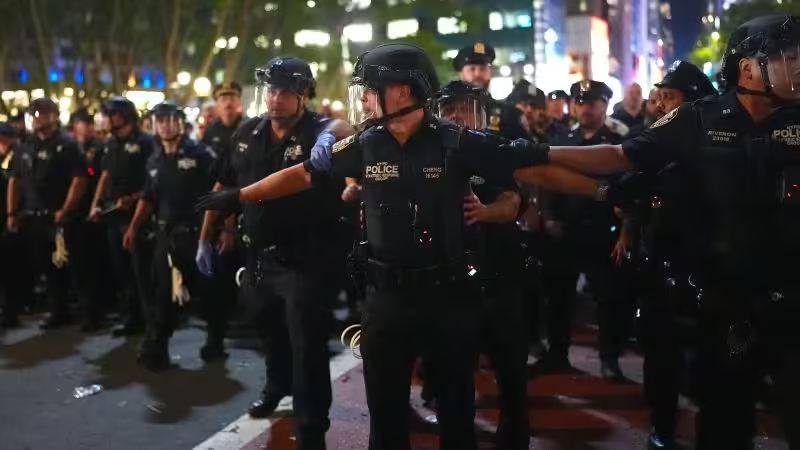
A controversial New York Police Department unit accused of using excessive force against protesters has been disbanded, Mayor Zohran Mamdani and NYPD Commissioner Jessica Tisch announced Monday, fulfilling a key campaign promise from the mayor to separate protest policing from counterterrorism.
Along with the elimination of the Strategic Response Group, certain aggressive crowd-management tactics are now banned and new dialogue-focused units will be established in the NYPD and the Mayor’s Office of Community Safety to ensure a coordinated response to protests, the mayor and commissioner said in a statement.
The new civilian-led “Community Dialogue and De-escalation Division” will not have weapons or arresting powers and will work with a new NYPD unit – The First Amendment Support Team – to prepare for and respond to protests. Both units will work with a new Patrol Support Division within the NYPD staffed by vetted officers who will receive specialized crowd control management training.
Mamdani’s directive will also formally ban kettling, an often-criticized crowd control tactic in which officers surround a group of people and physically restrict them to a certain area. Tear gas and the use of long guns will be prohibited during protests. Responding officers will no longer be allowed to deploy pepper spray as a crowd management tool, acoustic devices will be limited to 90 decibels and the use of bicycles as weapons will be allowed only when preventing death or physical injury to an officer or another person.
“During our campaign, I promised New Yorkers that we would disband the Strategic Response Group and separate counterterrorism from protest response, and today we are delivering on that promise,” Mamdani said in the statement. “New Yorkers exercising their constitutional right to protest should not be met with the same police response as a terrorism threat.”
Mamdani’s announcement will codify protest response policing practices even though some of the more controversial tactics, including the use of tear gas and long guns at police protests, have not been used in recent memory.
The reforms, which the Mamdani administration said have been under development since January, come after months of mounting criticism against the mayor from some of his most left-leaning supporters over concerns he had not done enough to reform public safety or the NYPD.
Created in 2015 with a focus on counterterrorism, the NYPD’s SRG unit has drawn controversy and scrutiny as it was frequently deployed to protests. Critics have accused officers of using excessive force and militarized tactics, including during the 2020 Black Lives Matter demonstrations in New York. The unit has also drawn a high number of complaints, lawsuits and expensive legal settlements over the years.
In the aftermath of the 2020 protests, the City’s Department of Investigation found the NYPD used excessive force in violation of demonstrators’ First Amendment rights and the SRG unit played a “central role” in helping to police protests at the time.
Supporters of the SRG, including law enforcement unions, have said the roughly 500-member unit’s specialized training makes it best equipped to handle violent demonstrations.
Mamdani’s disbanding of the SRG mirrors a legislative proposal by New York City Council member Chi Ossé known as the CURB Act. Ossé and Mamdani joined forces Monday to announce the changes in a social media video.
“These reforms accomplish the key changes called for by Councilmember Ossé’s CURB Act, a bill I am proud to support,” Mamdani says in the video. “Today is about a lot more than disbanding the SRG; we are building a new approach to public safety, one where all communities can trust that their safety and fundamental freedoms will be protected.”
The Strategic Response Group’s counterterrorism functions, including heavy weapons deployments at critical infrastructure, will now be consolidated within the NYPD’s Intelligence and Counterterrorism Bureau, the mayor and police commissioner said.
In a statement, commissioner Tisch expressed support for the changes, saying the new structure would preserve the NYPD’s ability to respond to serious threats while giving officers more support during protests and other major events.
“I believe strongly that the NYPD must always be willing to examine how we operate and make improvements,” Tisch said in the statement. “I would never support changes that diminish the NYPD’s ability to protect New Yorkers, or that put our officers in a position where they lack the resources necessary to confront a serious threat. These changes will make us a stronger, more effective department.”
Mamdani did not hold a news conference or take questions about the announcement Monday. In addition to the social media video, Mamdani and Tisch instead sat down for a joint interview with CNN affiliate WABC. Tisch emphasized the NYPD’s response to large crowds or civil disorder on city streets would not change.
“Nothing would change about the way that the NYPD responds to crowd control conditions, like, for example, the celebrations following the Knicks’ epic championship,” Tisch said. “And so New Yorkers can expect in crowd control-type situations to see the very same response that they are accustomed to.”
The optics are significant. Tisch and Mamdani have kept a working relationship despite their deep ideological differences. While Tisch has led the department during a period of record low shootings and overall crime in the city, the mayor’s base still views her with skepticism. The New York City chapter of the Democratic Socialists of America – with which Mamdani is aligned – has called on him to replace Tisch.
Patrick Hendry, president of the New York City Police Benevolent Association, which represents the NYPD’s rank-and-file officers, accused Mamdani of putting officers’ safety at risk to appease his base.
“So the next time your life is disrupted by demonstrators who are blocking bridges and roadways or causing chaos on our streets, remember: Mayor Mamdani is on their side, not yours,” Hendry said in a statement.
The changes come as Mamdani has tried to reshape the city’s approach to public safety. Following the implementation of the Mayor’s Office of Community Safety in March, Mamdani also launched a review of NYPD use-of-force policies and changes aimed at strengthening police accountability.
The administration said the new protest-response structure will be implemented without additional funding or changes to the size of the NYPD workforce.
Source: www.cnn.com