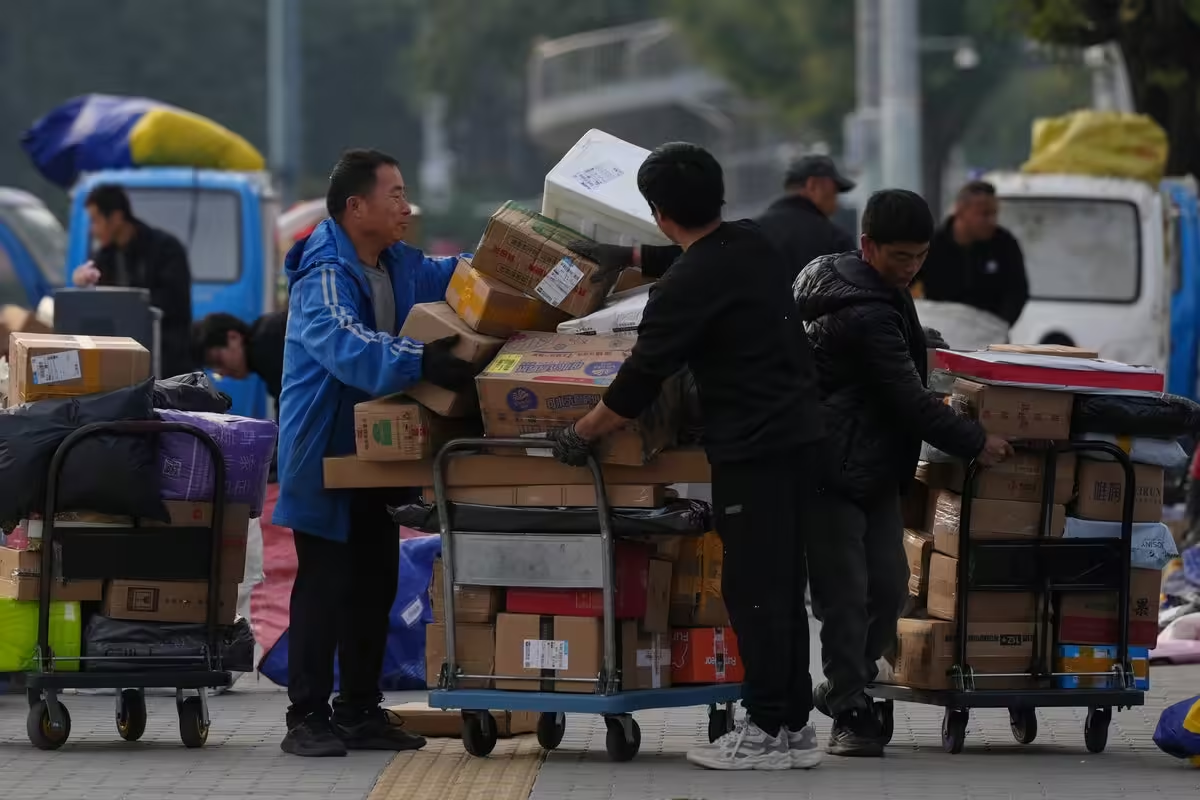

Signs so far show that Singles’ Day, China’s biggest online shopping festival, is failing to tempt worried consumers into spending more, even when offered bargains.
Singles’ Day, an emblematic discount campaign similar to the Black Friday sales and the Cyber Monday in USAfocuses on November 11, or 11-11, which falls on a Wednesday. But it starts weeks earlier and is considered a barometer of the overall economy.
Retail data platform Syntun said that as of Oct. 31, cumulative sales from this year’s festival were just over 1 trillion yuan ($154 billion), broadly similar to the same period last year.
Retailers have managed to boost sales mainly by making the festival last longer: Total Singles’ Day sales in 2025 hit a record high of nearly 1.7 trillion yuan ($254 billion).
But consumer demand in China has been subdued, as confidence has been hit by a prolonged slump in the real estate sector, among other factors. “Optimism about a recovery in domestic demand has faded. Improvements in sentiment have repeatedly proven to be short-lived,” said Max Zenglein, senior Asia-Pacific economist.Peaceful de The Conference Board.
E-commerce giants like Alibaba They have turned to artificial intelligence to try to get frugal shoppers to spend more. Alibaba platforms Taobao and Tmall, for example, were integrated this year with Alibaba’s Qwen AI even before the campaign began, to help with shopper orders and product recommendations.
For the first time, Singles’ Day AI token plans are being offered and prominently promoted. This month, a livestream by Li Jiaqi — dubbed the “Lipstick King” after selling huge quantities of lipsticks — saw sales roughly equivalent to 2 billion tokens in half an hour, according to Chinese media.
Consumers feel pressured
Although the overall economy continues to grow at a relatively steady pace, expanding 4.6% year-on-year between January and September, much of that boost came from an export boom. Retail sales of consumer goods increased just 1.1% compared to the same period a year earlier.
China’s huge domestic market has suffered as a multi-year property slump has left families feeling less well-off. House prices are down around 20% or more since the market peak in 2021, with smaller cities and the secondary market suffering the most.
Although home prices appear to be stabilizing in larger cities, many homeowners aren’t convinced they won’t fall further, said Andy Rothman, founder of the advisory firm Sinology.
In Foshan, a furniture manufacturing hub in the south, Gabby Liang said she is feeling cautious.
“I’ve been shopping a lot less online, especially when it comes to non-essential items,” the 24-year-old explained. “During the Singles Day festival last year, I bought quite a few skin care products. But this year I hope to buy less.”
Other buyers said they are cutting back on big expenses. Kong Min, resident in Beijingexpressed about this year’s Singles Day that “maybe I’m not as interested in chasing famous or high-end brands as before.”
Middle-class Chinese consumers have lost a lot of confidence, and many of the discounts offered during the festival are not as good as before, said Shaun Rein, managing director of China Market Research Group in Shanghai.
More shoppers are experiencing “discount fatigue,” said Yaling Jiang, founder of ApertureChina, a market research company. Discounts are offered year-round, so Singles’ Day momentum could be slowing, he added.
“If you look at what Singles’ Day was originally: a shopping festival where people used to wait for the biggest discounts of the year,” Jiang said. “That’s no longer true after it spread to multiple platforms and then became a month-long thing.”
Liang, who works in furniture sales, said high-end products such as cameras and video game consoles are off the list this year.
“We are going through a degradation of consumption,” he stated. “Even the amount we earn, in some ways, has also degraded.”
Domestic demand remains weak while exports soar
Liang said business has stagnated as Chinese buyers tighten their belts, despite increased exports to regions such as the Middle East and Africa.
Sales within China have suffered because an oversupply of many products — from cars and televisions to shoes and electronics — has intensified competition in saturated industries, prompting manufacturers to accelerate their expansion abroad.
Exports soared 35% year-on-year in October, boosted by high-tech items such as semiconductors and electric vehicles, and China is on track to surpass last year’s record of a $1.2 trillion trade surplus.
But in the domestic market, demand for high-value items, such as some luxury goods and automobiles, has been especially hit.
Passenger car sales within China have fallen for most of this year, with a decline of almost 25% between January and September, according to industry data. That’s partly due to reduced government subsidies this year.
It’s a stark contrast to the 71% jump in passenger car exports over the same period.
Purchases of luxury goods have also suffered. LVMH, which operates Louis Vuitton, Dior and Fendi, and Kering, whose brands include Gucci, Balenciaga and Saint Laurent, both reported that customer demand has declined in China in recent months.
Chinese leaders have been promising for years to drive faster growth in domestic demand. But strong export growth has tempered the sense of urgency to launch policies to help stimulate the domestic economy, analysts said.
Zenglein said: “As China continues to advance its industrial and technological ambitions, policymakers have little incentive to fundamentally rebalance the economy toward household demand.”
Still some bright spots as status symbols change
In retail, not all categories are suffering. The latest status symbols are increasingly related to health, lifestyle and experiences.
“It’s not a simple case of high-value items falling,” said Jacob Cooke, chief executive of Beijing-based consultancy WPIC Marketing + Technologies. Sales of health-related items are doing relatively well, he said.
According to WPIC data, in the 12 months ending in September, online sales of imported fish oil grew almost 43% year-on-year. Other supplements targeting sleep and joint and bone strength increased between 28% and 37%.
Cooke predicts some growth in Singles’ Day sales this year.
ApertureChina’s Jiang sees the defining trend in consumer culture this year as “just living life,” moving people away from grand gestures and returning the focus to “basic needs and inner fulfillment.”
Although many families are holding back, with youth unemployment around 18% and income growth lagging, household savings in China remain huge. With a population of 1.4 billion, it has immense spending potential, although consumer preferences and spending patterns are changing.
The story of consumption in China is not one of absolute weakness, according to Zenglein, the economist at The Conference Board, but rather one of growing divergence, with pockets of stronger demand despite a subdued general mood.
“It’s still enough to make a living, but there’s just not much extra left to indulge,” said Liang, from Foshan.
___
This story was translated from English by an AP editor with the help of a generative artificial intelligence tool.
Source: www.independentespanol.com