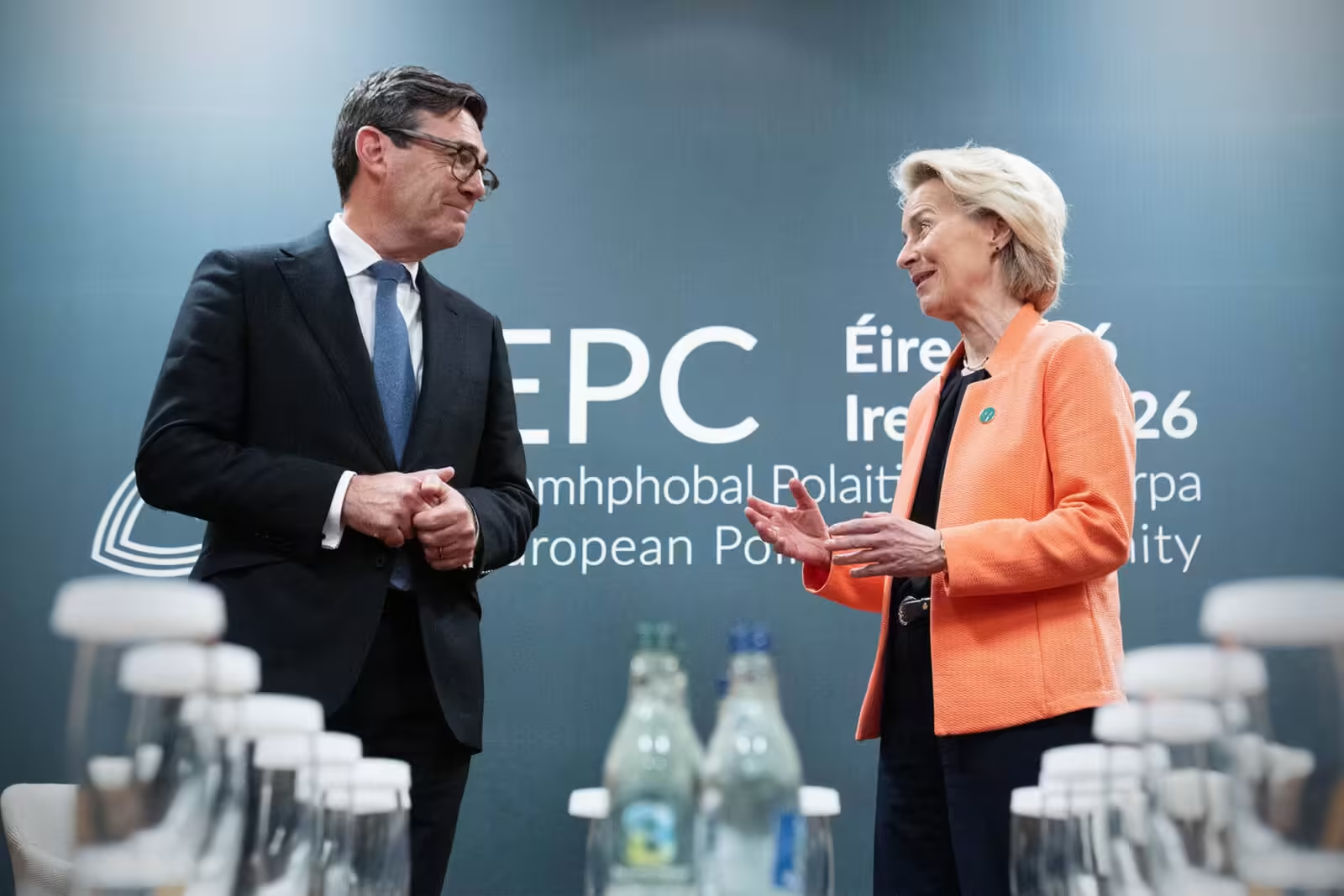

When it comes to the vexed question of Europe, Andy Burnham has floated more trial balloons than the Met Office. His call for an “honest discussion” about Brexit has drawn in ex-prime ministers Tony Blair and David Cameron. Speculation is rife that Labour might just be preparing to reverse the single most consequential British foreign policy decision in half a century.
Across European capitals, the reaction has been polite but wary. True, President Macron of France offered an enthusiastic “welcome back” – but he will be gone in a matter of months. Kaja Kallas, the EU’s chief diplomat, warned that many people in the bloc were still “traumatised” by the Brexit divorce. The same, incidentally, applies to the British body politic.
In Brussels, the institutional view is as immovable as the vast concrete blocks that house the European parliament, the Council of Ministers and the European Commission. Having chosen to leave the EU, the condemned traitor can expect no reprieve. There is scant appreciation that Burnham has taken a risk in reopening the Brexit debate.
“The UK is not on our radar,” says one of the EU’s top power-brokers, ticking off more pressing issues such as Ukraine, rampant populism, the cost of living crisis and managing the transatlantic alliance in light of a wounded President Trump. If the prime minister is serious, the official says, he should show his hand, starting with a long-promised keynote speech.
On Friday 20 November, Burnham will attend a UK-EU summit in Brussels. The headlines will be improved access for British food and drink manufacturers to the EU’s single market, and more mobility for young people to study and work in the UK and EU. The latter move is psychologically important. It speaks to the younger generation, though it comes with an unresolved price tag.
For Euro-optimists, the summit is a staging post on the road to something bigger and better: integration into the EU’s electricity market; a more favourable arrangement on data exchange, including access to the Schengen Information System (SIS) on wanted criminals and terrorist suspects; and closer co-operation on cybersecurity and defence.
Not so fast, reply the realpolitikers, especially in Paris: there must be no “cherry-picking”. The UK cannot accept some rules and reject others covering, say, AI standards or the City of London. With the economic benefits of the single market come the legal and political obligations of EU membership. The two are indivisible.
These are familiar arguments that obscure a more profound political reality. Ten years after the Brexit referendum, the world has simply moved on.
To return to Brussels, where I spent six years as chief correspondent of the Financial Times between 1992 and 1998, is to appreciate how much has changed – and how precarious the EU’s future is today.
At the end of the Cold War, Europe’s leaders – led by Jacques Delors, Helmut Kohl and François Mitterrand – forged a historic response to the fall of the Berlin Wall: a “deepening” of the EU around economic and monetary union, in tandem with a “widening” around enlargement to the former communist states of central and eastern Europe. The result was a united Germany, the birth of the euro and, in US president George HW Bush’s words, “a Europe whole and free”.
29th October 1971: City workers studying newspapers reporting the Commons vote on Common Market entry.
More than three decades on, the EU has grown to an unwieldy 27 member states – minus the UK. Obstreperous but usually pragmatic, sound on budget discipline and free trade, the British are still missed in Brussels, especially by the Dutch, Scandinavians and Germans. The UK provided a certain ballast, as well as a hotline to Washington.
Yet the geopolitical challenges are piling up: a growing loss of competitiveness in relation to China and the US; the gradual US disengagement from Europe; a revanchist Russia intent on subjugating Ukraine; and the wider crisis of liberal democracy on the continent.
In a world where, in the words of Mark Carney, the prime minister of Canada, “you are either at the table or on the menu”, it is unclear where the UK fits in. For here is the irony: just as the UK may be having second thoughts about EU membership, the EU itself is weak, divided and lacking strategic direction.
“We are completely under water,” says Jean-Claude Piris, head of the European Council’s legal services between 1988 and 2010. An indispensable fixer, Piris helped draft every treaty from Maastricht to Lisbon. “Where are we going? We don’t know.”
First, there is the real prospect of Marine Le Pen entering the Élysée after next spring’s presidential election in France. The vote is still four months away but Le Pen and her far-right National Rally party have a clear lead in the polls, with the far-left rabble-rouser Jean-Luc Mélenchon in second place.
France has been without a functioning government since Macron’s disastrous 2024 decision to dissolve the National Assembly. Some hope for a “winter surprise”, with a new centrist candidate emerging such as Christine “Madame Chanel” Lagarde, outgoing head of the European Central Bank and former head of the International Monetary Fund. Unless the centre unites, the country risks being left with a choice between two extremes in the second-round run-off.
“Le Pen is no [Giorgia] Meloni,” says Poul Skytte Christoffersen, Denmark’s former ambassador to the EU. Meloni, he notes, campaigned as a rightwing populist but has governed Italy for five years as a centre-right prime minister. Confounding sceptics, she backed the euro, Ukraine and President Zelensky.
By contrast, Le Pen leans toward Moscow, wants to cut France’s contributions to the EU budget and is pressing to repatriate powers from Brussels. She views European Commission president Ursula von der Leyen as a power-hungry bureaucrat who dances to the tune of the German government. Brussels veterans predict a political crisis in 2027, fuelled by the precarious state of France’s public finances and a bitter fight over money.
Other major EU member states are barely in better shape. Spain holds a national election later this month, with the favoured centre right dependent on the populist Vox to form a coalition government. Italy goes to the polls next year, with Meloni under pressure from a far-right former army general. In Germany, which must hold elections on or before 25 March 2029, chancellor Friedrich Merz is barely clinging on in the face of a surging far-right Alternative for Germany, now the biggest opposition party.
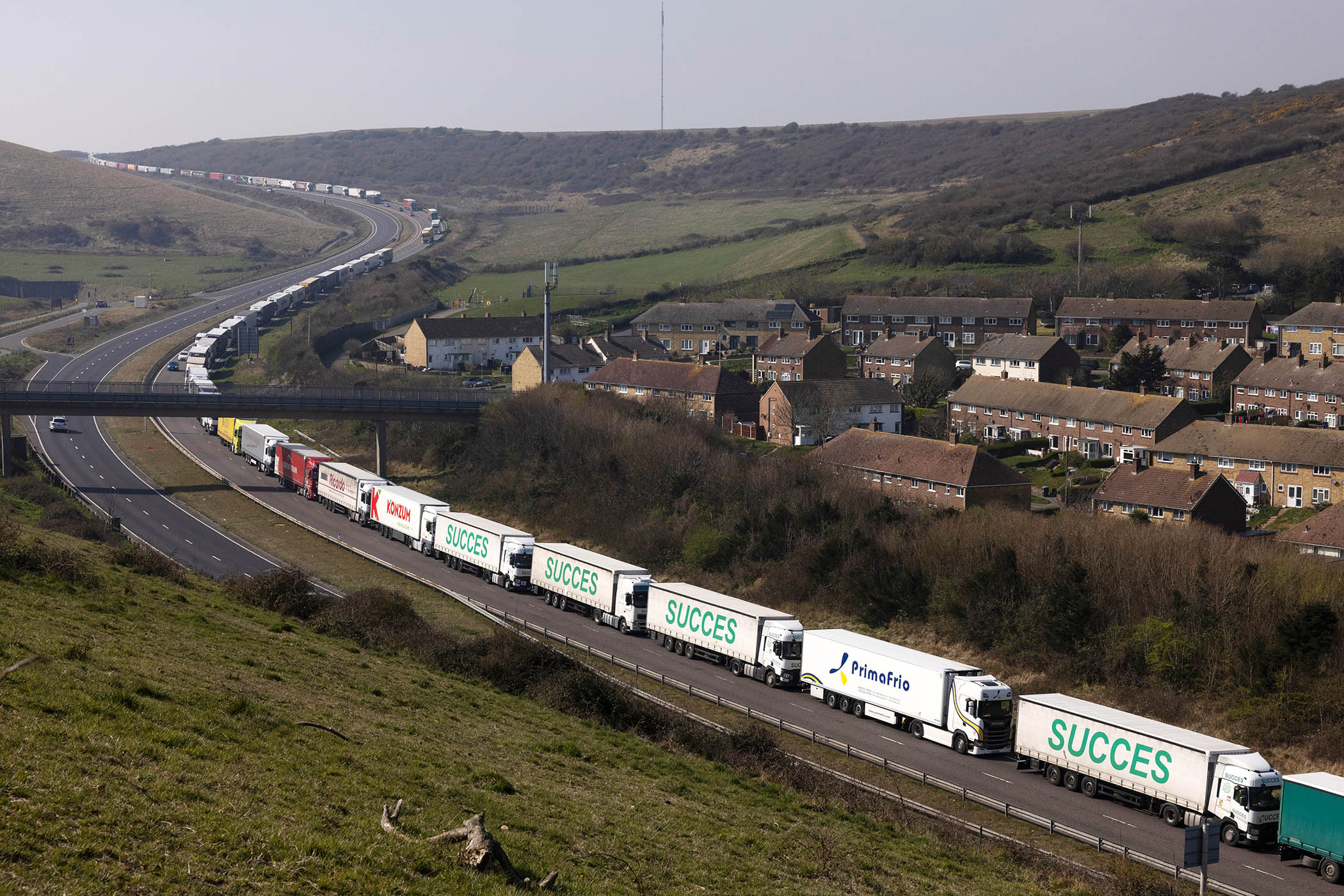
Lorries queueing at the port of Dover.
British diplomats pooh-pooh these electoral concerns as an excuse for inaction. But the stasis inside the EU is palpable. The much-lauded Draghi report on European competitiveness gathers dust, with barely one third of its recommendations enforced. The European Council – the key decision-making body – has turned into a talking shop. EU leaders have decided little since the breakthrough agreements on common borrowing to support economies during the pandemic and aid packages to Ukraine. An EU budget agreement by end of this year is the big test.
In the past, enlargement has provided impetus. Accession talks with Albania, Montenegro and Moldova are inching ahead but few believe there is a realistic chance of membership any time soon. Now in her second term as European Commission president, von der Leyen is keen on admitting tiny Montenegro, thus cementing a Balkan legacy. But enlargement requires unanimous approval and consent in all member states – a point sometimes missed by Euro-enthusiasts in the UK.
Pressed for answers, Eurocrats cite Jean Monnet, the founding father of the EU. “Europe will be forged in crises,” he wrote in his 1978 book Memoirs, “and will be the sum of the solutions adopted for those crises.”
For Team Burnham, the question is when will the crisis break – and can the UK be part of the solution?
Walking through the cavernous Justus Lipsius building, I bumped into Antonio Costa, president of the European Council. The jovial former Portuguese prime minister was wearing a sharp suit and blood-red tie, and was accompanied by the Nobel peace prize laureate and president of East Timor, José Ramos-Horta.
What expectations for the UK-EU summit? “Great expectations,” Costa replied, with a nod to Charles Dickens.
Veteran Portuguese diplomat João Vale de Almeida served as the EU’s first ambassador to the UK, after the Brexit divorce. During his stint in London, Almeida watched prime ministers come and go. Burnham’s call for a fresh debate on Europe is “a gamechanger”, he says.
Burnham has deftly turned his predecessor Sir Keir Starmer’s red lines – no to the EU customs union, no to the single market and no to EU membership – into a menu of options. Whether this adds up to more than a pre-election strategy to woo pro-European Greens and Lib Dems to cement his centre-left coalition is unclear. British politics remains unpredictable.
“We don’t want to be negotiating with Andy and then renegotiating with [Nigel] Farage in five years’ time,” says Almeida.
The scope and sequencing of any negotiations will be crucial. David Cameron, having rolled the dice and lost in the 2016 referendum, this week offered unsolicited advice to Burnham on how to proceed. In an interview with Bloomberg’s Mishal Husain, he urged the prime minister to avoid triggering a decade-long debate about the merits of EU membership.
“Instead of launching a debate about rejoining, which I think would be a very long and painful argument, and who knows where it would end up – instead of that, focus on how do we be the best friend, best neighbour and partner.”
Riccardo Perissich, a retired Italian Eurocrat, agrees that starting with membership would be “absolute nonsense”. It would be a re-run of the asymmetric negotiations between 2017 and 2020.
Back then, the Europeans were determined to avoid contagion at all costs, while Britain’s guiding principle was the restoration of an (illusionary) sovereignty captured by the slogan “Brexit means Brexit”. No surprise, says Perissich, that the EU emerged as “absolute victors”.
This leads to a second irony. Just as the UK under Boris Johnson embraced “Global Britain”, the world was turning away from globalisation and tariff-free trade. The new buzzwords are resilience and strategic autonomy, with heavy emphasis on “Made in Europe” investment to keep pace with China and the US in the technology arms race.
In the coming years, Europeans will be spending far more on defence to combat the Russian threat and compensate for the US’s tilt to the east. Indeed, Germany’s military budget will soon be the size of the French and UK budgets combined.
Britain, says Perissich, should be ready to make a serious offer on defence. This could cover joint procurement of weapons systems as well as individual alliances covering dual-use technologies with civilian and military application. A third basket might include a joint financing mechanism, capitalising on Germany’s newfound appetite for defence spending, which is partly driven by the need to convert its flagging car industry.
No doubt France would look askance at a bold British move on defence, viewing it as a ruse to gain access to the single market on preferential terms short of full EU membership. “There can be no trade-offs,” says a senior French official in Brussels.
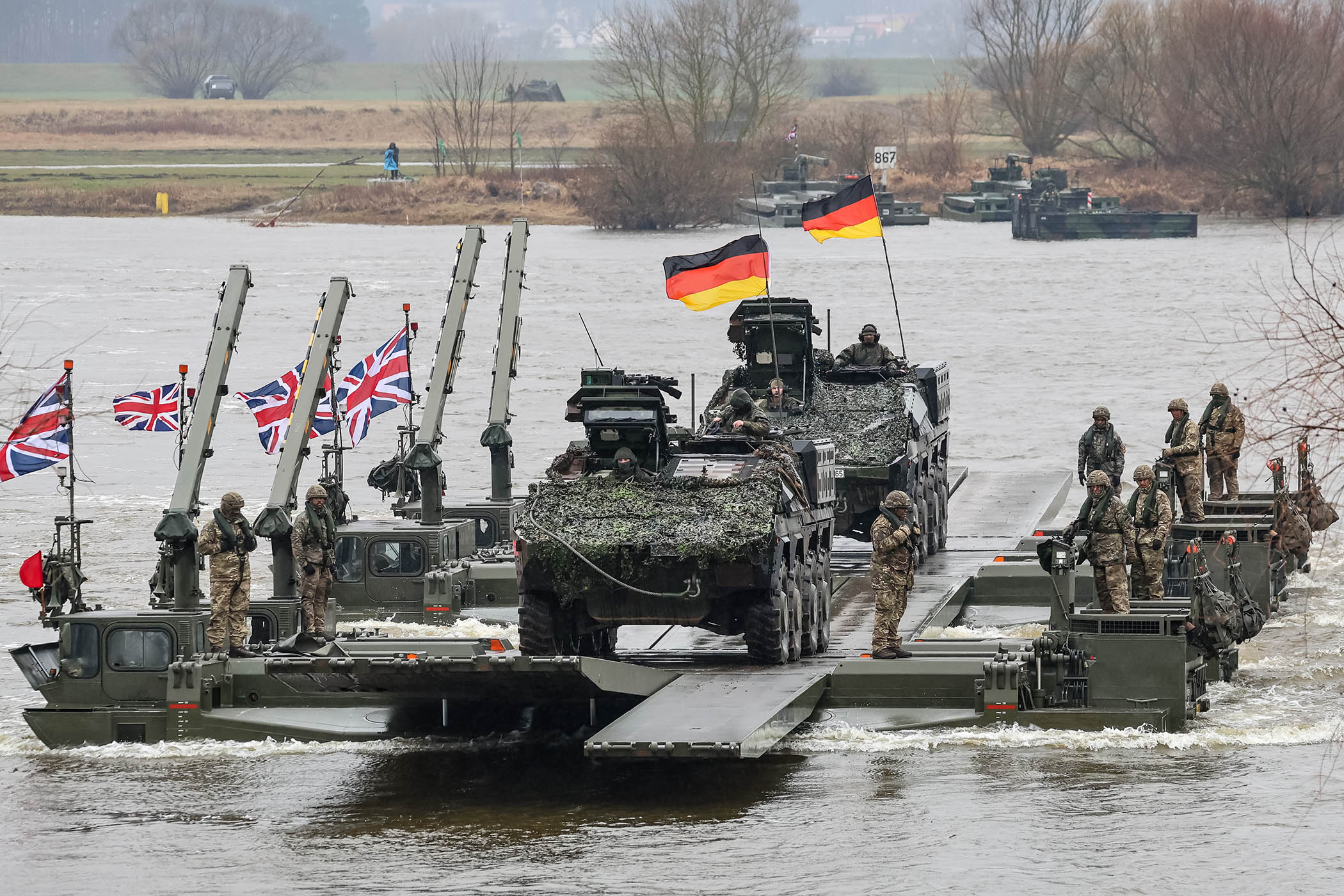
German and British troops participate in NATO exercises on the Vistula river in Poland.
But fresh ideas on the future of Europe are in desperately short supply given the shifting geopolitical landscape. At some point, the Ukraine war will end. What role will the Europeans play in the new security arrangements? If a bloodied, divided Ukraine is too poor to be admitted as a full member to the EU, what can it expect in terms of a relationship?
Brussels has toyed with the idea of “associate membership”, not just with Ukraine but also friendly Canada. The sacred rules in Brussels rule out flexibility; but a creative approach to Ukraine might also apply to the UK, says Jean-Claude Piris. “We cannot be sure what form or shape the EU will be in the next few years.”
Therein lies an opening for Burnham. All signs to date suggest he has an instinct rather than a plan. His first challenge, however, is to move from an anti-Brexit vote to something meaningful that either stops short of EU membership or pursues the ultimate prize, perhaps over Tony Blair’s proposed 10-year timetable.
To do so, however, requires seeking something greater than economic advantage. It involves making a sustained political commitment to Europe. That is something no government, bar a few months after joining in 1973, has managed to achieve in the past 60 years.
Lionel Barber was chief correspondent in Brussels for the Financial Times from 1992 to 1998, and editor of the Financial Times from 2005 to 2020
Photographs by Stefan Rousseau / AFP via Getty Images, Douglas Miller/Keystone/Getty Images, Dan Kitwood/Getty Images, Dominika Zarzycka/SOPA Images/LightRocket via Getty Images
Source: observer.co.uk