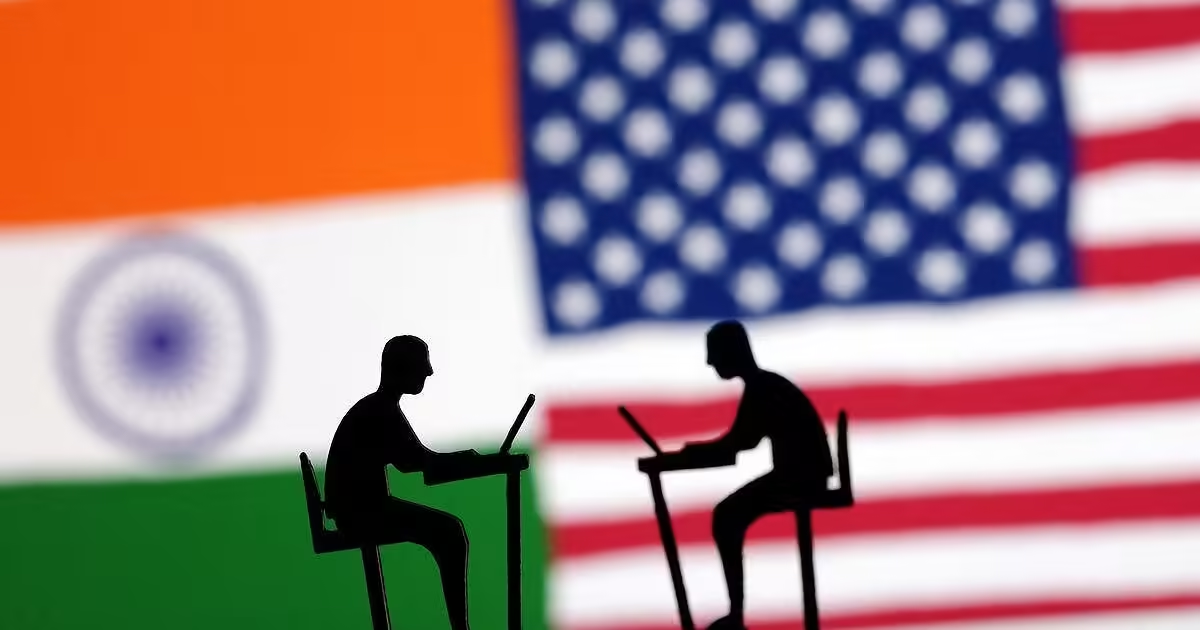

The highly anticipated interim trade deal between India and the United States is currently on hold, awaiting Washington’s finalisation of its internal tariff framework, even as the US has assured New Delhi of a crucial comparative tariff advantage over its global competitors.
Photograph: Dado Ruvic/Reuters
Key Points
- The interim trade deal between India and the US is pending the finalisation of Washington’s internal tariff framework.
- The US has assured India of a comparative tariff advantage over its competitors, a key demand from New Delhi.
- A US trade team recently visited Delhi for discussions on the Customs and trade facilitation chapter of the deal.
- India has sought safeguards allowing it to modify concessions if the US imposes additional tariffs beyond agreed terms.
- The Democratic Party’s victory in US midterm elections adds uncertainty, but both sides remain engaged in negotiations.
The interim trade deal between India and the US will be signed once Washington finalises its internal tariff framework, with the US assuring New Delhi of a comparative tariff advantage over its competitors, a senior government official said, requesting anonymity.
“The second (Section 301) investigation is still ongoing. The result has not come yet. We have to see how their (the US) tariff framework unfolds. Their tariff framework is still not final,” the official said, referring to the pending investigation report on structural excess capacity in trade partners by the United States Trade Representative.
US Tariff Framework and Section 301 Investigation
Under its first Section 301 investigation into the failure of trading partners to prohibit and effectively enforce bans on imports of goods produced using forced labour, the US imposed an additional 10 per cent tariff on Indian goods, placing India in the lower-tariff category, while several other economies faced a 12.5 per cent levy.
The official, however, confirmed that the US has assured India of a comparative advantage over its competitors under the proposed trade deal, addressing one of New Delhi”s key demands in the negotiations.
“That is what we discussed with the US side, and the US side assured us that will happen when the second investigation is completed. That will happen when the tariff frameworks are in place,” the official said.
Negotiations and Safeguards
The official said a US trade team was in Delhi for talks earlier this month.
“There is a chapter on Customs and trade facilitation. That was under negotiation. The US team came and they had a good discussion for two days. There was discussion on the text. Many parts of the text were read out,” the official said.
However, under the interim trade deal, there will not be any other chapter. “Others are part of the legal agreement and there will be annexures,” the official added.
The official said India also sought safeguards in case Washington imposed additional tariffs in the future beyond those agreed under the trade arrangement.
In such a situation, India would retain the right to modify the concessions extended to the US.
“In case there is any future tariff which goes beyond what is committed, then we also reserve the right to modify the concessions,” the official said, adding that this provision was already part of the February 6 joint statement for an interim trade deal.

Photograph: Reuters
Political Landscape and Trade Deal Differences
The Democratic party’s sweeping victory in the US midterm elections has created further uncertainty for the trade deal.
The official, however, said both sides are regularly engaged to finalise the trade deal at the earliest possible.
The mid-term outcome is expected to increase congressional scrutiny of the president’s trade policies and potentially constrain his ability to impose unilateral tariffs, although it is unlikely to bring an immediate change in Washington”s broader protectionist approach.
The trade deal India is negotiating with the US differs fundamentally from the free-trade agreements (FTAs) it has signed with other countries.
Under standard trade agreements, both countries reduce or eliminate their regular import duties, known as Most Favoured Nation (MFN) tariffs.
Under the February 6 US-India joint statement, Washington had pledged to lower reciprocal duties from 25 per cent to 18 per cent, while India was expected to eliminate or reduce MFN tariffs on most industrial goods and several agricultural products.
However, a subsequent US supreme court ruling overturned the reciprocal tariff regime.
Most US trading partners now face a 10 per cent tariff imposed under the guise of forced labour investigations under Section 301.
Feature Presentation: Rajesh Alva/Rediff
Source: www.rediff.com