
Puberty blockers should remain a clinical option for certain trans and gender diverse children, despite low-certainty evidence about their benefits and harms, according to long-awaited national advice.
But Queensland and the Northern Territory have already rejected the National Health and Medical Research Council (NHMRC) interim advice, vowing to maintain their bans or restriction of puberty blockers in the public system.
Gonadotropin-releasing hormone analogues (GnRHa) or puberty blockers, are injections that pause aspects of physical development by suppressing sex hormones.
They are a form of medical intervention prescribed to children with gender incongruence, a clinical term for a difference between a person’s gender and their sex recorded at birth.
Some people with gender incongruence also experience distress, which is known as gender dysphoria.
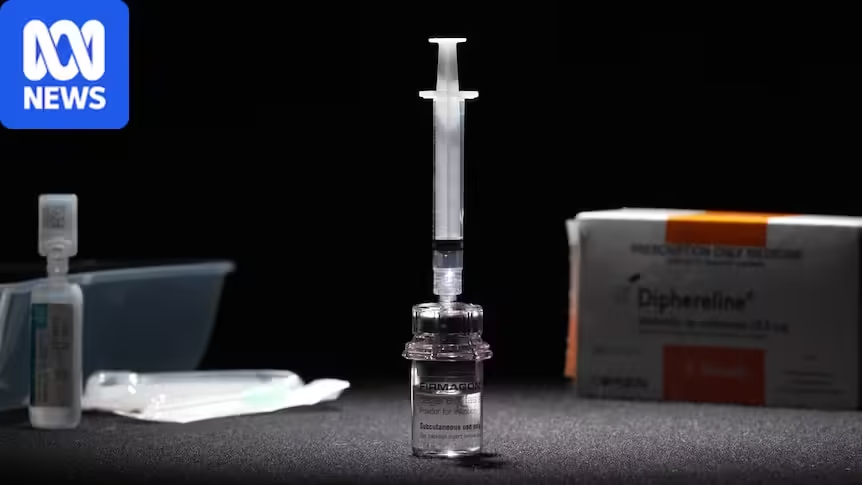
National guidelines on puberty blockers are due in 2028. (ABC News: Billy Cooper)
Advocates argue pausing puberty temporarily buys patients time to decide if they want to take the next steps towards transitioning with hormones like oestrogen or testosterone. However critics say the medication is experimental and potentially dangerous.
In 2025, Health Minister Mark Butler asked the NHMRC to develop national guidelines for the care of trans and gender diverse young people, including priority interim advice on puberty blockers.
The interim advice, released on Monday for public consultation, used what is known as the Grading of Recommendations Assessment, Development and Evaluation (GRADE) approach, which rates the certainty of evidence and how strong a recommendation for or against a healthcare option should be.
The Gender Guidelines Development Committee (GGDC) made a conditional recommendation for the use of the medication for certain young people.
It said conditional recommendations were more common than strong recommendations in clinical guidelines.
“A conditional recommendation is made in cases where shared decision-making is essential because different options may be appropriate for different individuals and they might make different choices, or where the overall certainty of available evidence is low. Both are the case here,” the report said.
The committee suggested that based on a shared decision between the patient, their carers and clinicians, puberty blockers could be considered for a young person who had gender incongruence with or without distress, were assessed as suitable for treatment and had begun puberty.
Puberty blockers have been used since the 1980s to treat young children who go through puberty early. (ABC News: Billy Cooper)
“Not all young people will want or need the same intervention at the same time or age, and care that is in one young person’s best interests may not suit another,” the report said.
The NHMRC review included 15 non-randomised studies, most with follow-up of six months to two years.
The committee found that the overall certainty of evidence was low, with studies largely observational and generally short-term.
“Although the available evidence indicates that serious adverse events are rare, a young person using GnRH agonists should be monitored for signs or symptoms that may warrant additional investigations and management,” the report said.
Puberty blockers have increasingly been the subject of fierce debate, with countries like the UK, Finland and many US states seeking to restrict its use. (ABC News: Billy Cooper)
The reviewers said the available evidence showed puberty blockers may improve psychosocial functioning and may reduce suicidality behaviours, and found no eligible evidence on the impact on fertility, fractures or other measures of bone health.
The advice isn’t legally mandatory
The medication has increasingly been the subject of fierce debate, with countries including the UK and Finland, as well as many US states, seeking to restrict its use.
The New Zealand government introduced a ban on new prescriptions of puberty blockers for children with gender dysphoria last year, however the High Court recently ruled the regulations unlawful, meaning doctors can prescribe them again.
Last year, Queensland became the first state in Australia to restrict access to puberty blockers for children with gender dysphoria who were not already on them in the public system.
The Northern Territory also banned puberty blockers in the public system for people under 18.
As it paused access to the medication, Queensland ordered an independent review by prominent psychiatrist Ruth Vine.
It found the evidence base about the use of puberty blockers for gender dysphoria and on the impact of fertility was limited, with evidence the medication could impact bone health in the short to medium term.
However, it found the effects were “reversible” and with proper oversight “there can be benefit for a young person” in accessing the medication.
The Queensland government said it would continue the pause until 2031, while awaiting the results of an upcoming UK trial known as PATHWAYS, which has been delayed because of safety concerns and legal challenges.
Because the NHMRC guidance is advisory rather than legally mandatory, states and territories can ultimately decide how they implement it.
Health Minister Mark Butler asked the NHMRC to develop national guidelines for the care of trans and gender diverse young people. (ABC News: Ian Cutmore)
Mr Butler said he expected all states and territories to give proper consideration to the NHMRC’s advice.
“I’m very confident that every state government, no matter their political persuasion, will consider the advice of our pre-eminent authority very closely. Whether that will lead to a change of policy by either the Queensland or NT government is really a matter for them,” he said.
Mr Butler said the topic of puberty blockers attracted “heightened” debate and public commentary that was not “always helpful” and he hoped this advice would provide younger Australians with the greatest possible confidence that clinicians treating them are using the best clinical guidelines.
However, Queensland and the Northern Territory have both been quick to rule out any changes.
“The Queensland government has already undertaken an independent review and made a clear decision on the provision of these treatments in our public hospitals,” Health Minister Tim Nicholls said.
“Our position remains unchanged, and we will continue to prioritise the health, safety and wellbeing of young Queenslanders.”
A Northern Territory government spokesperson said its position was “unchanged”.
“Our decision is consistent with Queensland, the United Kingdom and Finland, which have all taken a cautious approach,” they said.
The Endocrine Society recently examined the use of puberty blockers for children who go through puberty early, known as precocious puberty.
The reviewers also made a conditional recommendation for the use of the medication, based on very low certainty evidence.
Why is there low certainty evidence?
Ethical and practical limitations around the way research is conducted, particularly when it comes to children, means high certainty evidence about puberty blockers is very difficult to obtain.
The gold standard of scientific studies is known as randomised controlled trials, which compares two groups randomly selected. One is given the treatment, and the other is given something else, like a placebo, or even the same treatment at a different time.
However, this approach raises ethical concerns when it comes to puberty blockers, because it can mean delaying or withholding treatment for children.
The medication has been the subject of fierce debate and is restricted in parts of Australia and overseas. (ABC News: Billy Cooper)
In addition, double blind trials — where neither the participants nor researchers know who is receiving the treatment — are also off the table, because the drugs stop physical changes like menstruation, meaning people can guess if they are receiving them.
That has left a reliance on observational studies, where scientists observe individuals without manipulating the environment, however these are considered to be lower quality because without comparison, researchers cannot be sure what impact the treatment itself has had.
Proponents argue that low certainty evidence is very common for other areas of paediatrics, and does not mean an absence of evidence or evidence of harm.
But opponents interpret it as a reason for greater caution, saying the benefits have not been established with enough confidence to justify their use.
Critics have also condemned the lack of transparency about how many children are on puberty blockers nationwide.
Clinicians prescribing puberty blockers argue only a small portion of patients referred to gender clinics go on to take puberty blockers, however when the ABC approached every state and territory for the figures earlier this year, most declined to provide the information.
For the medication to be as effective as possible, it needs to be taken early in puberty.
However generally patients cannot access other medication, like hormones oestrogen or testosterone, until after they turn 16, while gender-affirming surgery is usually only available for adults.
The full national guidelines, covering broader clinical practice for the care of trans and gender diverse people under 18 who have gender dysphoria, will be released in 2028.
Loading…
Source: www.abc.net.au