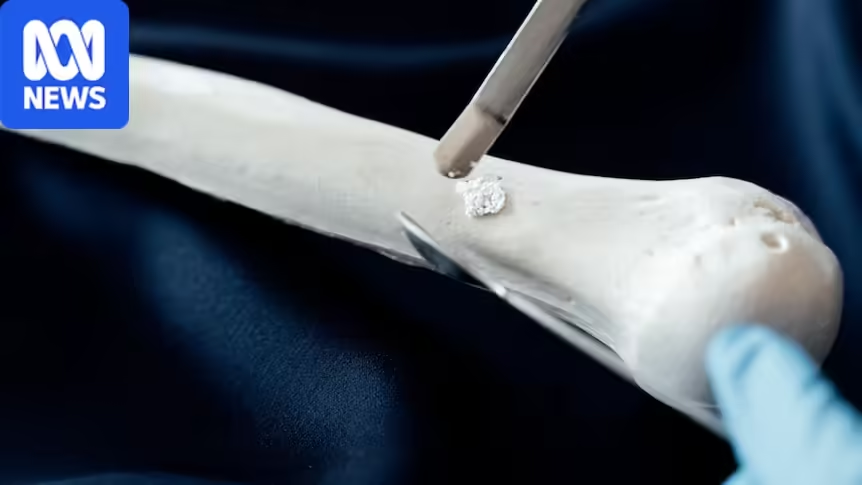

Mother-of-pearl harvested in Western Australia’s north could soon be used to fill bone fractures for patients in the United States.
WA biotech company Marine Biomedical has received clearance from the US Food and Drug Administration (FDA) for its bone graft substitute, PearlBone.
A manufacturing facility for PearlBone was built in Broome in 2022. (Supplied: Rolee Kumar)
The product is the first of its kind to be developed from nacre, commonly known as mother-of-pearl.
The iridescent material has been used for ornamental items, jewellery and even buttons.
But Marine Biomedical chief executive Rolee Kumar said it was also effective for bone repair and regeneration.
PearlBone will be used to repair bone fractures for patients in the United States. (Supplied: Rolee Kumar)
“The material of what the mother-of-pearl is made out of, all of these are actually building blocks of our bone too,” she said.
“So in a way, it’s not surprising when we do these studies we see PearlBone facilitates bone healing.”
The United States is the world’s largest orthopaedics market, with the bone grafts and substitutes sector valued at $US1.1 billion ($1.5 billion).
Ms Kumar said FDA clearance was an important first step in entering the US market, but there were more hurdles to be overcome before it could be sold.
Rolee Kumar says PearlBone is as safe and effective as existing bone repair materials. (Supplied: Rolee Kumar)
“We’ve gone through a process where PearlBone was compared against another existing bone graft that’s established itself in the market,” she said.
“We’ve been able to demonstrate PearlBone is as safe and efficacious as the predicate device.”
She said the company also hoped to bring the product to Australian customers in future and expand into other treatments like dental work.
‘Exciting’ opportunity for pearl industry
Marine Biomedical was established in 2021 through a partnership with local Broome pearling business Willie Creek Pearls and research expertise from the University of Western Australia (UWA).
Paul Birch says shells are prepped at the farm before being transported to the manufacturing facility in Broome. (Supplied: Willie Creek Pearls)
Willie Creek chief executive Paul Birch said the collaboration was an exciting opportunity for the pearling industry.
“I think it just opens everyone’s eyes to what can potentially be done,”
he said.
“And with more research, there might be other parts of the oyster that can be used for other biomedical technologies.”
The shells farmed by Willie Creek for pearl production undergo cleaning and preparations before being transported to the Marine Biomedical manufacturing facility in Broome.
Mr Birch said there was an abundance of pearl shell available at the farm to meet current requirements, but this could change as the product demand increased.
“So hopefully at one point in time, it might be something the entire industry is able to be involved in and supply to Marine Biomedical,” he said.
The shell is harvested at Willie Creek Pearls, off the Kimberley coast. (Supplied: Willie Creek Pearls)
UWA biomedical and health innovation director Kevin Pfleger said it was an exciting time for medical research in WA.
“Often people don’t realise we have some amazing innovations which are changing the world,”
he said.
The professor said it was common for products to gain approval in the United States market before returning to Australia.
“One of the big reasons is because even though we’re a very large country geographically, we’ve got a relatively small population,” Professor Pfleger said.
“So if we get approval in the US first, it means it’s much more economically viable for us to then come back and market in Australia.”
Willie Creek Pearls, based on the outskirts of Broome in WA’s north, will provide the product for PearlBone. (ABC Kimberley: Ben Collins)
Professor Pfleger said the clearance was an “inspiring” achievement for others in the industry.
“The next point is obviously making sales, getting patients and benefiting from that and getting surgeons using it,” he said.
“But regulatory approval is critical.”
Source: www.abc.net.au