
Evanston/Skokie School District 65 parents have mocked up two alternative budget examples ahead of the school board’s votes Monday, Nov. 16 that would advance the closure process for Dewey and Lincolnwood elementary schools. Parents have also raised substantial questions about the nature of the capital improvements the district says it needs.
District 65 administrators have said the school board must adopt the full budget cut plan as soon as possible to address the district’s structural financial crisis. For years, District 65 has adopted budgets in which expenditures outpaced revenues, causing a structural deficit.
Interim Superintendent Eric Witherspoon has repeatedly told the community that adopting the district’s proposed cuts is the best way to address the financial crisis.
“I would not advocate for changes of this magnitude if I did not believe they were necessary to put our district on a stronger path forward,” Witherspoon wrote in a guest essay published in the RoundTable Saturday.
But parents interviewed by the RoundTable have provided analyses that challenge those claims.
According to Dewey parent Alexandra Miller and Lincolnwood parent Esteban Quiñones (members of For a Brighter Evanston and the Legion of Data Nerds, respectively), if the district adjusted its capital expenditures to $4.7 million a year from the operating fund and kept schools open, the fund balance of the district would be approximately the same as if the district adopted its proposed plan, which would close Dewey and Lincolnwood.
The RoundTable sent detailed questions to District 65 officials about the claims made by parents, as well as additional inquiries based on the RoundTable’s own reporting. The district did not respond to any of the questions.
“We truly understand and wholeheartedly agree that our community deserves accurate, up-to-date information, and clarity is of the utmost importance given the difficult situation we find ourselves in,” District 65 Communications Chief Melissa Messinger wrote in an email to the RoundTable Friday, adding that she would circle back with administrators. The RoundTable has since received no communications from the district.
Alternative budget plans
Miller, who was part of the team that discovered the $17 million error in the district’s projections, which was later revised to be a $27.35 million error, worked again with fellow parents to put together an alternative budget proposal for the district and the board to consider.
Miller, along with Dewey parent Ben Van Laan and Lincolnwood parents Jean Clipperton, Kerrie Dvorak and Quiñones, used publicly available data and Claude (an artificial intelligence model) to put together an interactive spreadsheet that allows users to adjust revenue and expenditure assumptions. The sheet provides detailed information about each of the “financial levers” that can be adjusted in the plan.
District administrators have repeatedly emphasized that one of the biggest goals of the plan is to build the district’s fund balance to at least 90 days of cash on hand, or 25% of the district’s total operating budget.
In an interview with the RoundTable, Alexandra Miller argued that the slides presented by District 65 Chief Financial Officer Eric Miller (no relation) showed that the district’s plan “is not, in fact, a plan for long-term sustainability.”
“It is a short-term plan that very briefly gets us to a 25% fund balance … by fiscal year 2029, and then begins to fall off again,” Alexandra Miller said.
“In order to have true sustainability, we are going to need something like a referendum, whether that’s an operating referendum, a capital referendum, or a combination of both,” Alexandra Miller said. The structural challenge, she said, is based on the mismatch between what the district is allowed to tax and the district’s costs.
“So making cuts in the short term can sort of avert that for a few years, but those costs keep growing, right? And so you end up back in the same position,” Alexandra Miller said. She said that the district should be looking to adopt a plan that sets the district up for long-term success, which would likely mean seeking a referendum.
Alexandra Miller said that the financial model created by parents demonstrates the financial options available to the district, and argued the community could “put ourselves into a better position for the future by not closing schools today.”
There are several key differences between the plan the district has presented and the one proposed by parents.
The parent-created plan includes several revenue streams not explicitly mentioned in the district’s plan. The RoundTable asked the district if these revenues, including income from a Ryan Field concert ticket surcharge as well as revenue-sharing from the City of Evanston’s Five-Fifths tax increment financing district, were included in the district’s modeling, but did not receive a response. In a TIF district, taxes are frozen at a certain level and the rest — the increment — is placed into an account that can be spent or borrowed against for approved projects.
The alternative model proposed by parents also makes a few assumptions that the district isn’t making — for instance, that the district may negotiate with bargaining units to provide only 4% raises annually, as opposed to the 5% raises in the current District 65 Educators Council bargaining agreement. The parent plan also assumes annual growth in benefits to be two percentage points lower than the district’s plan. The district plan assumes a 12% increase in health care costs every year, whereas the parent one assumes a 10% increase.
The model proposed by parents also factors in revenues that could come with closing other Evanston TIFs early as well as factoring in separate capital and operating referenda. But the sheet allows anyone to make a copy and adjust the levers themselves.
“I think our concern, having looked at the sort of original cut plan … is that … we’re not seeing the long-term sustainability that was kind of originally claimed, it feels like, for this plan, right?” Alexandra Miller said.
The models presented by the district at the Nov. 9 meeting show the district’s fund balance declining after fiscal year 2029, even if the district does follow the proposed plan.
Alexandra Miller said that the structural issue is likely to return without a referendum.
“And so, if you are closing schools and you are closing the way to a referendum as a result, that’s a very shortsighted decision to make for two years of financial sustainability during which we get to a 25% fund balance once, right,” Alexandra Miller said. “That’s just not a worthwhile trade-off to make, in my opinion. And I think we should think really hard about what our options are and what the future-looking vision truly is for the district before taking the step.”
How much should the district be spending on capital expenses?
Alexandra Miller told the RoundTable that the alternative plan proposed by parents still set aside the same amount of money for capital expenditures as the district’s updated plan — about $8 million per year from the operating fund. (She noted that the total amount spent each year would be higher due to Health/Life Safety bonds — but that money does not come from the operating fund.)
But that number is not set in stone. The question of how much money to allocate toward building repairs and upgrades was a hot item of debate at the Nov. 9 school board meeting, when some board members disagreed with each other and administrators about the strategy the district should take when it comes to capital spending. Board President Nichole Pinkard said at that meeting that the number the district decides to allocate toward capital spending is “a choice.”
At that meeting, District 65 CFO Eric Miller repeatedly emphasized his concern that not investing in buildings could lead to other issues down the road. Multiple times, he cited a hypothetical example of a boiler bursting in the middle of winter, leaving a school without heat. Without adequate funds set aside for capital repairs, Eric Miller said, the district could be in real trouble.
Alexandra Miller worked with Quiñones to put together a model of the district’s plan as of Nov. 9, after the board approved a bargaining agreement that would preserve the School Age Child Care program. The model they assembled assumes that the district makes all other cuts, but adjusts capital spending to $4.7 million per year from the operating fund and keeps Dewey and Lincolnwood open. This year (fiscal year 2027), the district has planned to set aside $2.4 million from the operating fund toward capital expenditures; recommending $4.7 million per year is still an increase from the district’s current spending level, Alexandra Miller explained.
Their model shows that keeping schools open and adjusting capital spending puts the district in an almost identical position as closing the schools and spending close to $8 million annually on capital expenditures. District 65 administrators did not respond when sent the graph and asked for comment.

“I’m not sure that following this plan actually improves the district’s standing. There’s a mix of too many assumptions or holes … that makes me think that it would be very difficult to faithfully implement this plan,” Quiñones said. “And therefore that’s part of why I keep pushing in a sense for alternatives. I think we can do better … this is not my preferred plan, but even if we decide to close two schools and … two programs, I think we can have a much better plan of how to do that that sets us up … for success, right?”
What are the district’s real capital needs?
The question of how much to spend on capital was made more complicated once parents obtained the data from the StudioGC Master Facilities Plan, enumerating the cost of individual projects recommended for the district to complete over the next 49 years.
Dewey parent David Azari told the RoundTable he spent all of Saturday, Nov. 14, crunching the numbers. In an email to board members and the RoundTable Sunday, Azari said the StudioGC report figure of $598 million needed in repairs includes repairs that would be needed at the Dr. Bessie Rhodes School of Global Studies and Kingsley Elementary, which were both closed in June 2026 and which administrators have expressed a desire to sell.
In addition, Azari said that when limiting the needed expenditures to just the next 20 years and removing costs associated with Bessie Rhodes and Kingsley (assuming they will be sold), the figure drops to $493 million. Close to $100 million of those expenditures are earmarked for geothermal technology for heating and cooling — the most expensive option for improving heating and cooling, according to a March memo from district administrators.
Azari said that the district should consider revising the figure to account for installing central air conditioning, rather than geothermal technology, which Azari estimated would likely cost less than $100 million, since geothermal was the most expensive option. In addition, Azari pointed out that if the district is committed to installing geothermal technology, there are federal tax incentives available that could cut the cost.
Azari also said he thinks the plan duplicates some costs by counting them in multiple categories, including by assuming heating and cooling renovations that would only be necessary if the district did not install geothermal. The StudioGC report also puts $116 million in building “refreshes,” including replacing interior doors and hardware, floors and ceilings building-wide, which Azari argued should be shaved down to better reflect necessary expenditures.
Azari also said that, including Bessie Rhodes and Kingsley, $130 million of the total figure can be funded through Health/Life Safety bonds.
Azari said that these numbers are significant because “it is fairly easy to show that closing schools [and holding them] doesn’t save a meaningful amount of money.”
“And so what the school district falls back on is this trump card of, ‘Oh, but we have half a billion dollars of capital needs, and everything else is a drop in the bucket,’” Azari said. But he said it’s “very hard” to assess whether the district’s claim is true when speaking in such broad generalizations.
“And it turns out that if you do the analysis that I just described, which I’ve tried to do with the information available to me, the answer is that the picture doesn’t look nearly as bleak as the top line numbers that they’re using,” he said. “That’s not to say that there isn’t an investment needed. There absolutely is. But the question of what that implies for closing schools is completely different.”
The RoundTable did forward Azari’s assertions to board leadership and district administrators, but did not receive any response prior to publication.
School closure savings questions
Part of the conversation about whether school closures are really necessary is based on savings numbers from past school closures. At several school board meetings Clipperton has asserted that the closure of Kingsley and Bessie Rhodes in June saved the district just $500,000. The district has maintained that the school closures save the district close to $2.9 million in annual costs.
But Clipperton contends that, based on data provided by the district (in the image below), there are several hundred thousand dollars in savings that the district had no way to realize.
For example, Clipperton pointed out that the district says it saved $679,030 in costs for a principal and assistant principal at both Kingsley and Bessie Rhodes.
But the people who were principals last year — David Davis at Kingsley and Charlise Berkel at Bessie Rhodes — are still employed in District 65, at Lincoln and Foster elementary schools, respectively.

The district did eliminate an assistant principal at Willard (which was controversial) and one at Bessie Rhodes. But the assistant principal at Lincoln, Alexis Whaley, was moved to Foster, and the assistant principal at Kingsley, Tiffany Chapman, was moved to Lincoln. Although there are two fewer assistant principals in the district this year, only one of those was cut as a direct result of school closures.
The Willard cut came as the district moved Willard’s two-way Spanish/English immersion program to Foster, but the RoundTable was not able to verify whether the district counted the Willard position as part of the school closure savings.
The savings enumerated by the district also state cost savings from the elimination of library media specialists, school nurses, custodial support and interventionists. It is unclear whether Foster Elementary has those positions filled, since the District 65 directory has not been updated. But if those positions are filled there, the district would only realize the savings from cutting those positions from one school — not two.
The district did not respond to questions from the RoundTable about these staffing numbers.
Approaching the votes
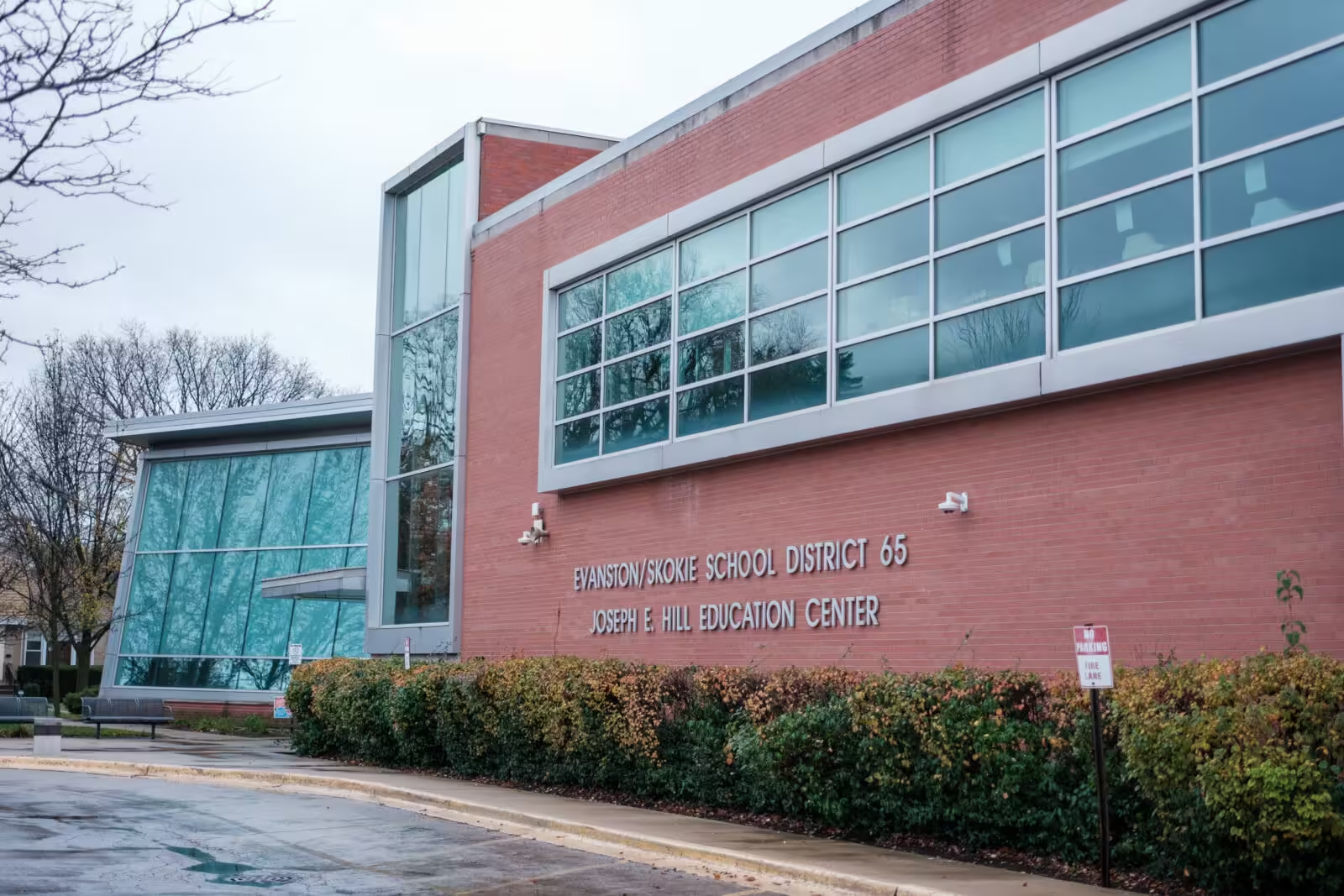
The District 65 school board is scheduled to vote Monday evening on whether to begin the process of closing Dewey and Lincolnwood elementary schools. The public portion of the meeting begins at 6 p.m. at the Joseph E. Hill Education Center, 1500 McDaniel Ave.
If the votes pass, it won’t immediately trigger the closure of the two schools, but it will kick-start the public hearing process. Illinois requires that three public hearings be held for each school proposed for closure, before an official vote on closure can be taken.
Parents interviewed for this piece agreed that the district needed to take action to address the district’s financial issues, but disagreed with the district’s strategy.
“… We need to do something,” Quiñones said. “But you can make things a lot worse by doing something, in a sense, that I think isn’t well thought out.”
Related Stories
Source: evanstonroundtable.com