
Tulane University researchers are making ultralight solar cells that could one day help power equipment on the moon. They’re creating tiny devices that can manipulate beams of light on a microchip. And they’re developing synthetic red blood cells designed to squeeze through the human body’s tiniest blood vessels.
To build these advanced technologies, researchers face the same challenge: working at extraordinarily small scales where even an invisible speck of dust can interfere with the process.
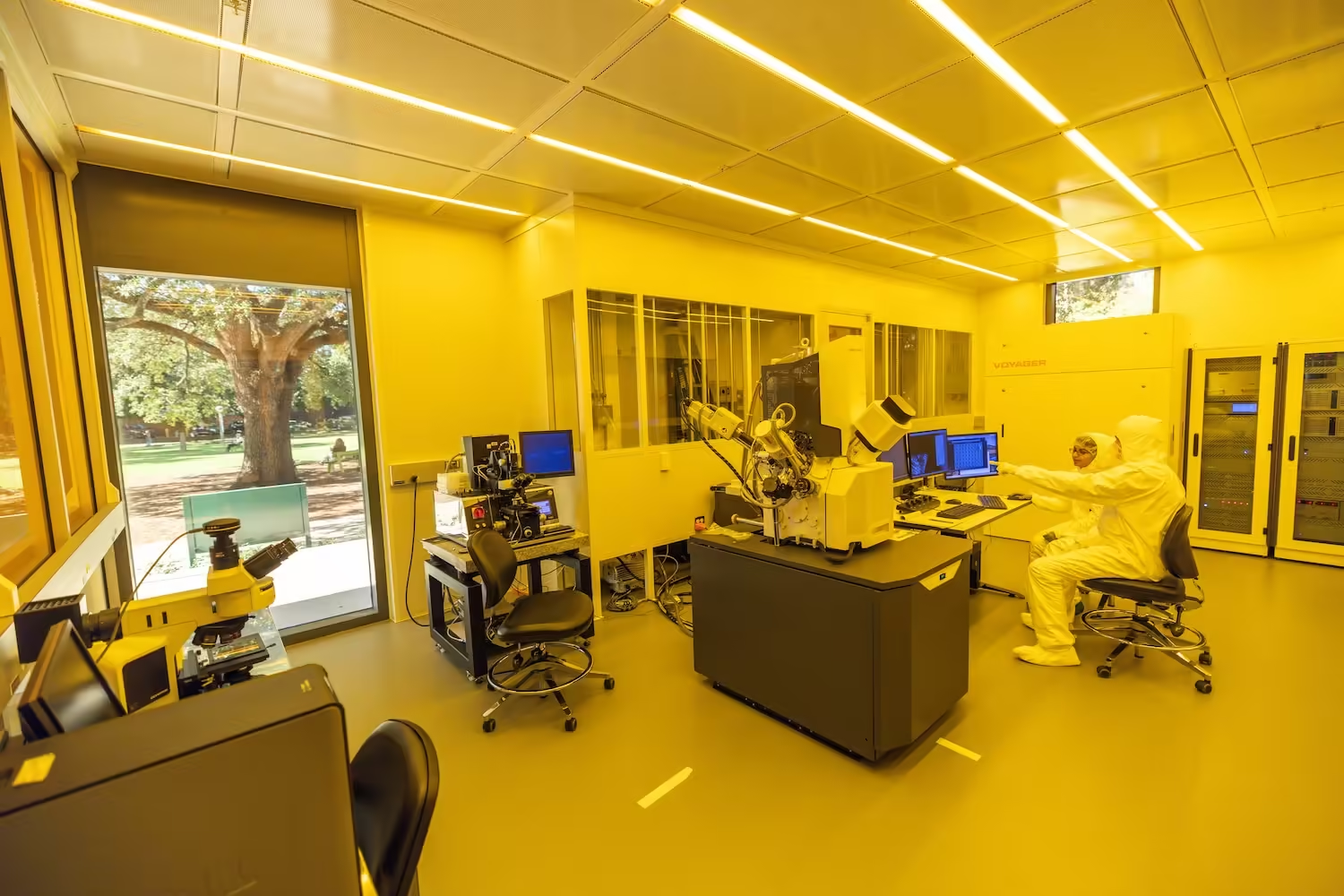
On Monday, Nov. 16, Tulane leaders, surrounded by cheering students, faculty and staff from throughout the university, cut the ribbon on a new 2,900-square-foot Micro/Nanofabrication Facility, or cleanroom, located on the first floor of Steven and Jann Paul Hall for Science and Engineering. The cleanroom will enable researchers and industry collaborators to fabricate materials at scales smaller than 10 nanometers — thousands of times narrower than a strand of human hair — in support of advanced semiconductor and materials science research and development.
Besides serving the Tulane community, the cleanroom will provide shared access and workforce training for regional universities, including Xavier and LSU New Orleans, as well as for Gulf South startups and industry partners.
“This facility will be the most advanced cleanroom of its kind in the Gulf South between Atlanta and Houston,” said Tulane President Michael A. Fitts. “It is part of Tulane’s commitment to provide the latest, state-of-the-art technology for our researchers and students. This setting will create extraordinary opportunities to accelerate innovation across disciplines and spur life-changing collaboration with universities and businesses in our region and beyond.”
State and federal officials committed $5 million in 2023 to fund the new cleanroom. Louisiana lawmakers appropriated $3 million for construction, while U.S. Sen. Bill Cassidy helped secure approximately $2 million from the National Institute of Standards and Technology for advanced semiconductor research equipment.
Fitts acknowledged Cassidy’s support for the cleanroom as well as that of Louisiana Senate President Cameron Henry and state Sen. Royce Duplessis. Henry and Duplessis were present at the ribbon cutting.
“This cleanroom is a wonderful example of the contributions a great research university can make to a city, a facility that supports faculty who are making transformational advances across biotech, energy, computer engineering and many other fields; creates educational opportunities to prepare our students to be leaders on the frontiers of nanoscience; and makes New Orleans an attractive home for private companies carrying out cutting-edge research and product development,” said Senior Vice President for Academic Affairs and Provost Robin Forman.
The cleanroom is part of the Tulane Instrumentation for Nanoscience and Innovation, or TINI, a network of shared research facilities in the School of Science and Engineering.
“Great research universities need more than great ideas — they need the infrastructure to turn those ideas into reality,” said Patrick Norton, senior vice president, chief operating officer and treasurer. “From the transformation of the former Charity Hospital building to highly specialized facilities like this cleanroom, Tulane is taking a deliberate, long-term approach to investing in its physical campus. We are building the capacity to support increasingly complex research and ensuring that our facilities keep pace with the ambitions of our university.”
Among other emerging technologies, the cleanroom will support work in quantum materials, energy, photonics, biosensing and environmental remediation.
“The new cleanroom represents a substantial commitment to the future of the School of Science and Engineering,” said Hridesh Rajan, dean of the School of Science and Engineering. “It will serve as a magnet for top-tier researchers and a hub for cross-disciplinary collaboration. Just as importantly, it will give our students hands-on experience with technologies that are shaping the future.”
In the lab of Matthew Escarrafaculty director of the cleanroom and professor of physics and engineering physics in the School of Science and Engineering, students are already using the facility to develop solar cells made from two-dimensional nanomaterials with potential for very high-power generation relative to their weight and volume, a valuable characteristic for aerospace applications where every ounce of payload matters.
Students synthesize the materials in an auxiliary cleanroom on the third floor of Steven and Jann Paul Hall for Science and Engineering before bringing them down to the main first-floor cleanroom where they fabricate the materials into working devices, then test and refine them.
Escarra’s group is also using the facility to develop integrated photonic devices — tiny structures designed to manipulate light on a chip — as well as solar technologies that can generate electricity and useful heat simultaneously.
Michael Greenassistant professor of biomedical engineering, is using the cleanroom to develop synthetic red blood cells that could eventually offer an alternative to donated blood, which is frequently in short supply.
Other Tulane researchers are preparing to use the facility to build nanoscale transistors for studying quantum materials, create microscopic devices that will allow scientists to examine interactions among individual microbes and explore new technologies for quantum computing, advanced sensors, critical mineral recovery and converting waste into useful chemicals and fuels.
Publisher Pesikaprofessor of chemical and biomolecular engineering in the School of Science and Engineering and co-director of TINI, plans to use the cleanroom to develop next-generation self-healing armor designed for space and lunar missions.
The new facility was built into Paul Hall with systems that continuously filter the air, regulate temperature and humidity, minimize vibration and provide highly purified water and gases for sensitive fabrication. This allows researchers to perform delicate processes with far greater precision and reliability.
Besides spurring discoveries, Escarra said the cleanroom is vital to building the local workforce of tomorrow.
“I want to see high-tech industries in this region supported, so they don’t have to go elsewhere to do this kind of work,” Escarra said. “We want Tulane to be the place where universities, startups and industry across the region can come when they need really high-level micro- and nanofabrication capabilities.”
Source: news.tulane.edu