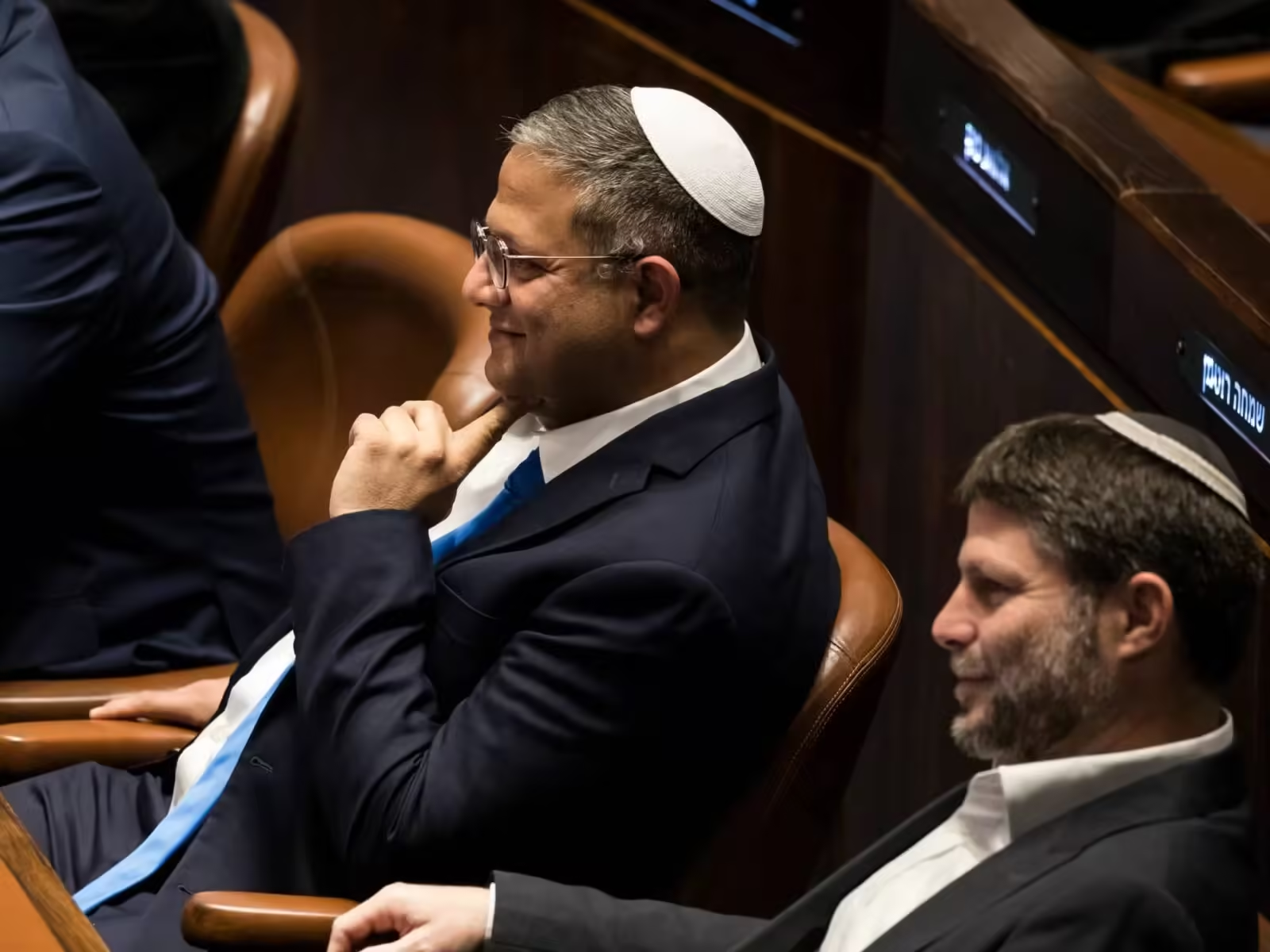

As Israel’s opposition looks to unseat Prime Minister Benjamin Netanyahu, speculation has centred on the possible fate of the current government’s more hardline, right-wing elements, including the parties led by the unapologetically pro-settler Finance Minister Bezalel Smotrich and National Security Minister Itamar Ben-Gvirconvicted of inciting terrorism.
While all members of Netanyahu’s cabinet, with the unflinching backing of the opposition politicians hoping to supplant them, have supported Israel’s genocidal war on Gaza and attacks on regional states, it is Smotrich and Ben-Gvir who have been the focus of international attention and lightning rods for criticism by Western governments.
Recommended Stories
list of 4 itemsend of list
With talk of Netanyahu looking to form a unity government with Eisenkot, both ministers have publicly opposed a government led by the former chief of staff.
In the run-up to the vote, Ben-Gvir took the unusual step of claiming that Netanyahu now has a choice of selecting himself to “save Israel”, or Eisenkot.
Smotrich, meanwhile, has warned his ultra-Orthodox political allies against entering negotiations with Eisenkot, saying he will “dump them” once he uses their votes to oust Netanyahu.
Legacy of hate
Netanyahu formed a coalition government with Ben-Gvir’s far-right Otzma Yehudit (Jewish Power) and Smotrich’s Religious Zionist Party in 2022, giving both several of Israel’s most important cabinet positions. Smotrich became finance minister, granting him control over the Israeli budget and a number of institutions in the occupied West Bank, while Ben-Gvir was named national security minister.
Drawing on a wellspring of hardline Zionism, Jewish supremacy and what critics describe as unapologetic racism, Ben-Gvir and Smotrich have exploited their political leverage to advance Israel’s most hardline policies over the past three years. They have also transformed their ministries to reflect their hardline ideological projects.
Both have been enthusiastic proponents of Israel’s genocidal war on Gaza, repeatedly threatening to withdraw their support from the government when it appeared Netanyahu might falter in the face of international pressure about the huge number of civilians killed, famine, and withholding of aid.
In September 2025Ben-Gvir threatened to bring down the government if Hamas remained in existence following the release of the captives under United States President Donald Trump’s proposed Gaza plan. Both ministers have repeatedly called for the annexation, settlement and ethnic cleansing of Gaza.
Smotrich has encouraged the expansion of illegal settlements within the West Bank and, in the eyes of his opponents, bears culpability for the explosion of settler violence and pogroms across the occupied territory.
In June 2025, Smotrich and Ben-Gvir were sanctioned by a wave of Western countries. Ireland and the Netherlands imposed travel bans on the two ministers, while other countries froze their assets. Irish Taoiseach Micheal Martin said these measures were taken due to their shared “desire to see the elimination of Palestinians from Palestine”.
However, analysts said the ministers and their movements should not be treated as a homogeneous entity or be isolated from Israeli policy in general.
“I would argue that we should not treat Ben-Gvir and Smotrich as a single bloc, since exclusion from government would affect them in opposite ways,” Arie Perliger, of the University of Massachusetts Lowell, who has led studies into the far right in Israel, Europe and the US, told Al Jazeera. “Ben-Gvir’s power is populist and performative, and opposition suits him.”
Ben-Gvir’s roots in the outlawed Kahanist movement had, in tandem with many right-wing movements, relied upon their historical exclusion from power as evidence of a betrayal by the establishment, he added.
Smotrich, meanwhile, had used his position as finance minister to co-opt part of the settlement programme and force through his explicitly Zionist agenda. This means he would have more to lose if he were “cut off from budgets, portfolios and control over settlement policy”.
“Smotrich’s case is the reverse. His achievements were bureaucratic rather than rhetorical,” Perliger said.

Lasting damage
Both figures have been accused of transforming their ministries in ways that will linger long after they leave government.
As part of the 2022 deal with Netanyahu that secured his finance portfolio, Smotrich was given the additional role as a minister in the Ministry of Defence. This gave him sweeping powers over much of the occupied West Bank’s Israeli-led civilian administration.
From there, he used his position to establish a separate Settlement Administration and to rapidly accelerate illegal settlement expansion across the occupied territory. In August 2025, he announced the revival of the E1 settlement planwhich he boasted would bury “the idea of a Palestinian state”.
Ben-Gvir has been accused of rapidly politicising the Israeli police force under his command and essentially fashioning it to mirror his own hard-right outlook. He has also introduced sweeping changes to the prison service, including severe restrictions on the conditions and rights of Palestinian prisoners, whose institutional legacy could last for years.
“These are personnel, procedures and facts on the ground and reversing them requires sustained political will,” Perliger added. He is sceptical that an opposition government would override the changes introduced by the ministers.
Ejecting the pair from the mainstream of Israeli politics was also unlikely to dent support for the groups, according to Roi Zur, an assistant professor in the Department of Government at Essex University.
Smotrich’s Religious Zionist movement goes back to the war of 1967 and, together with Ben-Gvir’s Otzma Yehudit, has the support of about 10 percent of the Israeli electorate.
“They are stable and will be there for many years … [They] cater to very similar kinds of people in Israel,” Zur told Al Jazeera.

Their lasting legacy may be the official sanction of hatred towards Palestinians which, long festering, exploded in the wake of the Hamas-led October 7 attacks. Through their actions, and those of other right-wing members of Netanyahu’s coalition, the value of Palestinian lives in the eyes of Israelis has sunk to unprecedented lows.
The widely publicised killing of more than 74,000 people in the genocidal war on Gaza, the willful neglect of Palestinian townships within Israel’s borders, where crime and murder have become a virtual epidemic, and the brutal conditions imposed on Palestinian prisoners have not been hidden so much as celebrated. Ben-Gvir was a leading figure in the passage through the Knesset of a death penalty law that solely targets Palestinians.
Meanwhile, the pogroms against Palestinians and their property across the occupied West Bank have continued without any meaningful government sanction.
“Violence is a constant danger,” said Aida Touma-Suleiman, the Palestinian former member of parliament for the left-wing Hadash party. “People are scared on the street, on the bus, everywhere. You have to be careful just to speak Arabic, wherever you are.”
Under the most recent Netanyahu government, apartheid against Palestinians, which had long existed in Israel, had become engrained and a version of fascism, Touma-Suleiman said.
“Apartheid is a series of laws that discriminate on the basis of race. Fascism is when the discrimination and the racism are carried in the soul,” she told Al Jazeera.
“Netanyahu and his allies haven’t just given permission to be racist; they’ve made it almost proof of patriotism – it’s expected.”
Source: www.aljazeera.com