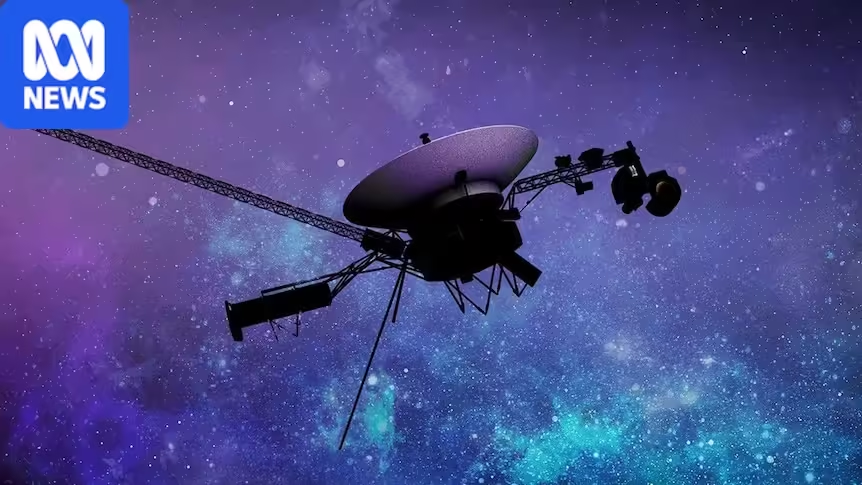

Earth’s alien envoy is about to hit a history-making milestone for space exploration.
NASA’s Voyager 1 spacecraft will be one light-day, or 25.9 billion kilometres, from Earth later today.
After almost 50 years in space, the spacecraft is the farthest human-made object from Earth.
NASA Voyager project scientist Linda Spilker said it was an “incredible milestone to celebrate”.
“One light-day is not a time so much as a distance,” Dr Spilker said.
Loading…
At a distance of one light-day, Voyager 1 will be exactly 24 hours away from Earth at the speed of light.
“In other words, if you sent a radio signal from the Earth, it would take exactly 24 hours to reach Voyager 1,” she said.
With the spacecraft living long past its retirement date and its systems starting to fail, it is a landmark many at NASA never thought it would reach.
Voyager changed our view of the Solar System
Voyager 1 and 2 were launched in 1977 to explore Jupiter and Saturn. Voyager 2 also flew by Uranus and Neptune.
The probes were then kept in operation to explore the outer reaches of the Solar System.
Both Voyagers were extremely high-tech in the 70s, built to withstand incredibly high levels of radiation.
But they were also limited by the technology at the time, as each probe relies on an eight-track tape player to record data.
Loading…
Even with its old tech, the Voyager spacecraft provided a whole new view of the Solar System.
Planetary Society chief scientist Bruce Betts was inspired to become a scientist as a child after seeing images beamed back from the spacecraft.
“[The Voyager probes] weren’t the first to Jupiter, but they were by far the best images we’d ever had,” Dr Betts said.
“It made those places real in a lot of people’s minds.“
The mission was originally expected to last only a decade, but both spacecraft are 49 years into their far-flung trip to the outer edges of the Solar System.
Voyager 1 took high quality and close-up pictures of Jupiter in the late 1970s. (Supplied: NASA/JPL-Caltech)
Where is Voyager 1 now?
In 2012, Voyager 1 entered interstellar space, with Voyager 2 following behind in 2018.
While this is beyond the reach of the Sun’s magnetic field, it is still a long way away from the ring of icy objects known as the Oort Cloud, which marks the final boundary of the Solar System.
Voyager 1 has travelled one light-day, about 173 astronomical units, from Earth. (Supplied: NASA/JPL-Caltech)
Voyager 1’s position and condition is tracked by NASA’s Deep Space Network of telescopes in Canberra, California and Madrid.
NASA predicts the spacecraft, travelling at 61,000km/h, will be one light-day away from Earth at 9:16pm AEDT on November 18.
Voyager 2, which can only now communicate with Canberra, is not expected to make the light-day milestone until 2035.
Getting close to ‘retirement’
Dr Spilker was part of the Voyager program for 12 years, from the spacecraft’s launch in 1977.
She rejoined the team in 2020 expecting it to last just a few more years.
“If we talked to anybody from headquarters, it was ‘Oh … it could go any day,’ but here we are coming up on the 50th [anniversary],” she said.
“They are well past the nine lives of your typical cat. It just keeps going.”
In the past few decades, NASA has turned off almost all the equipment aboard the spacecraft and had to switch off heaters to conserve power from a dwindling nuclear battery.
“We’ve got enough power and thermal to make it, we think, to about the early 2030s. But we also have thrusters that are clogging,” Dr Spilker said.
“The spacecraft is getting colder and colder as the power decreases.”
Only two instruments, which measure the Sun’s magnetic field and plasma, still work.
“That will probably go off in the next year or so.”
The Voyager 2 spacecraft still has enough power to continue operating three science instruments. (Credit: NASA/JPL-Caltech)
Dr Spilker said the longer the spacecraft travelled, the more things could go wrong.
Last month, NASA lost communication with Voyager 1 for about 48 hours. The spacecraft came back online before they could send commands to troubleshoot.
But one day, they won’t be so lucky.
“We’ll be waiting to hear from Voyager … and there won’t be anything,” Dr Spilker said.
“You turn things on and off, until finally you say … ‘We can’t think of anything else to try.’ That’ll be a tough day.“
For Dr Betts, Voyager 1’s light-day milestone is a testament to the engineers and other people who worked on the project.
“It’s just unbelievable that we’re talking about two spacecraft that this coming year will be 50 years in space. It’s unprecedented for working spacecraft to have that type of longevity,” he said.
“If you … have enough money, resources and good people to make that happen, you can keep spacecraft going for a very long time.”
A never-ending mission?
Even when all contact with the Voyager probes is lost, the spacecraft will still be out there, travelling with a golden record filled with “the sights and sounds of Earth”.
“Then they become humanity’s silent ambassadors,” Dr Spilker said.
Each Voyager spacecraft carries a golden record with instructions on reaching Earth. (Supplied: NASA)
The record, which has instructions on how to find Earthgreetings in more than 100 languages and a playlist of classical and popular music, was described by its co-creator Carl Sagan as launching a “bottle into the cosmic ocean”.
Dr Spilker said the gold-plated record was made from an inert material, so it wouldn’t change much and may even “outlast our civilisation”.
“We are giving a piece of ourselves and hoping someone finds it,” Dr Spilker said.
Source: www.abc.net.au