
Europe is debating how to restore its industrial competitiveness, strengthen economic resilience and navigate one of the most profound transformations of the automotive sector in decades. Yet one part of that debate still receives too little attention: what happens to a vehicle during the many years after it leaves the production line.
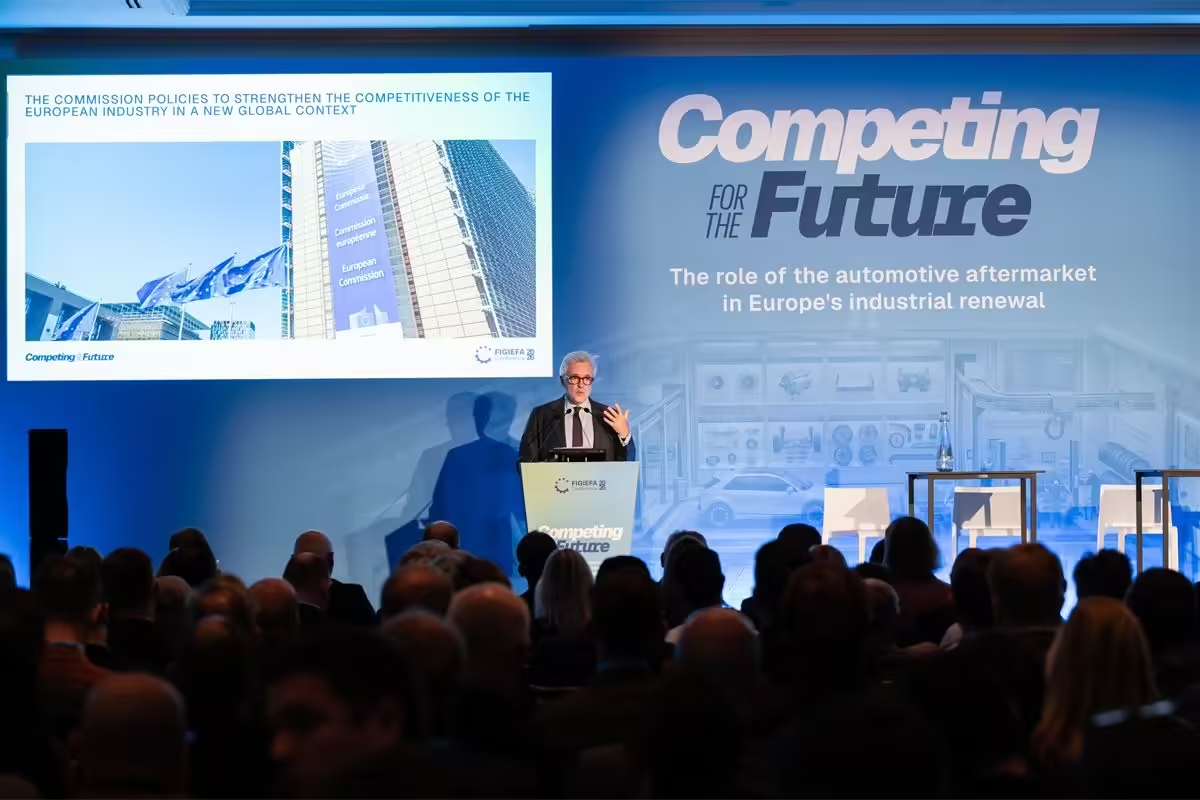
That was one of the clearest messages to emerge from FIGIEFA’s 70th Anniversary Conference, held in Brussels on 3-4 November and bringing together more than 260 policymakers, industry leaders and automotive aftermarket stakeholders. The discussions came at a moment when electrification, software-defined vehicles, artificial intelligence, geopolitical competition and sustainability requirements are simultaneously reshaping the automotive ecosystem.
Innovation must not become a reason to close markets. Digitalisation and AI should create more opportunities for competition, not fewer
As FIGIEFA President Mads Engberg reminded participants, Europe’s automotive sector encompasses far more than vehicle manufacturing. Maintenance and repair, parts distribution, diagnostics, remanufacturing, data services and increasingly AI-enabled services determine whether vehicles remain safe, affordable and operational throughout their lifetimes.
For European policymakers, this distinction matters. An industrial policy that concentrates primarily on manufacturing risks overlooking substantial economic value generated during the use phase of a vehicle.
The economic value hidden beyond the factory gate
A new Roland Berger study unveiled at the Conference provides striking evidence of that contribution. The European independent aftermarket represents a market of around €100 billion and accounts for approximately 64% of the European aftermarket. But its economic relevance extends well beyond its direct turnover.
Europe’s automotive future will not be decided only by the vehicles it manufactures
According to the study, maintenance and repair provided by the independent aftermarket enable approximately 314 billion additional vehicle-kilometres every year. By helping vehicles retain their value, the sector also increases the resources consumers can eventually put towards purchasing another vehicle by around €65 billion. Reduced vehicle downtime creates a further estimated €23 billion in economic benefit.
These figures change the perspective through which the aftermarket should be viewed. Repair and maintenance are not simply costs occurring at the end of the automotive value chain. They enable mobility, preserve assets and help sustain demand elsewhere in the automotive economy.
This importance is likely to increase as Europeans keep their vehicles for longer. The average age of passenger cars in Europe rose from 11.9 years in 2020 to 12.9 years in 2024, reinforcing the importance of efficient and competitive maintenance throughout a vehicle’s lifetime.
Innovation needs competition
The Conference also made clear that this economic contribution cannot be taken for granted.
In his keynote, Valère Moutarlier, Deputy Director-General of DG GROW at the European Commission, placed the discussion within Europe’s wider competitiveness agenda, including the need to strengthen industrial resilience and innovation in an increasingly challenging global environment.
The question is particularly important as cars themselves become digital platforms.
A first industry panel, bringing together representatives from Temot International, ZF, Jifeline and Cleevely Electric Vehicles, examined where value will be created in tomorrow’s aftermarket. Software, diagnostics, vehicle data, remote services, technical expertise and stronger collaboration across the value chain are rapidly becoming as important as the physical components traditionally associated with repair and maintenance.
Repair and maintenance are not simply costs occurring at the end of the automotive value chain
This transition also puts the regulatory framework under renewed scrutiny. In a keynote addressing EU competition law, Thomas G. Funke of Geradin Partners explored the importance of competition rules, including the Motor Vehicle Block Exemption Regulation, in ensuring that increasingly connected and software-defined vehicles do not translate into increasingly closed markets.
The policy challenge is therefore not to protect existing business models from technological change. It is to ensure that innovation takes place in a market where different businesses can genuinely compete.
From digitalisation to an AI-powered aftermarket
The same principle becomes even more important with artificial intelligence.
A dedicated panel involving the European Commission, ATR International, Bosch Mobility Aftermarket, Topmotive and SPREAD explored how AI could improve diagnostics, maintenance, workshop efficiency and the development of entirely new automotive services. But AI does not operate in a vacuum. Its effectiveness depends on access to high-quality data, interoperability and the ability of different actors to develop services on fair terms.
Europe consequently faces a strategic choice. Future AI-enabled automotive services can develop on open, competitive foundations that allow European SMEs and independent operators to innovate, or they can become increasingly dependent on closed ecosystems controlling vehicle data, software and interfaces. This was also one of the central questions identified ahead of the Conference.
For the EU, ensuring competitive access to the necessary technical resources is therefore not a niche aftermarket concern. It is connected directly to Europe’s ambitions on digital sovereignty, innovation and competitiveness.

Repair is also industrial and environmental policy
The Conference also underlined that keeping products in use for longer is central to the circular economy. Stijn Vervoort of the Forum on Automotive Aftermarket Sustainability highlighted how repair, maintenance, refurbishment and remanufacturing can extend the lifetime of vehicles and components, reduce waste and improve resource efficiency.
That link should become increasingly relevant as European industrial policy seeks to reconcile competitiveness with ambitious environmental objectives.
After seventy years representing the independent sector, FIGIEFA’s message from Brussels was therefore fundamentally forward-looking. Technologies and business models will continue to evolve, but innovation and competition must evolve together.
As FIGIEFA Chief Executive Sylvia Gotzen put it in closing the Conference: “Innovation must not become a reason to close markets. Digitalisation and AI should create more opportunities for competition, not fewer.”
Europe’s automotive future will not be decided only by the vehicles it manufactures. It will also depend on whether those vehicles can be maintained, repaired, upgraded and kept on the road affordably in a competitive market.
Recognising the automotive aftermarket as part of Europe’s industrial strategy is therefore not simply recognition for an important sector. It is part of building a more competitive, resilient and sustainable European mobility ecosystem.
Follow the developments shaping Europe
Subscribe to The Continental to receive The Parliament’s latest reporting, analysis and opinion to your inbox, delivered every weekday morning. Sign up for free here.
Source: www.theparliamentmagazine.eu