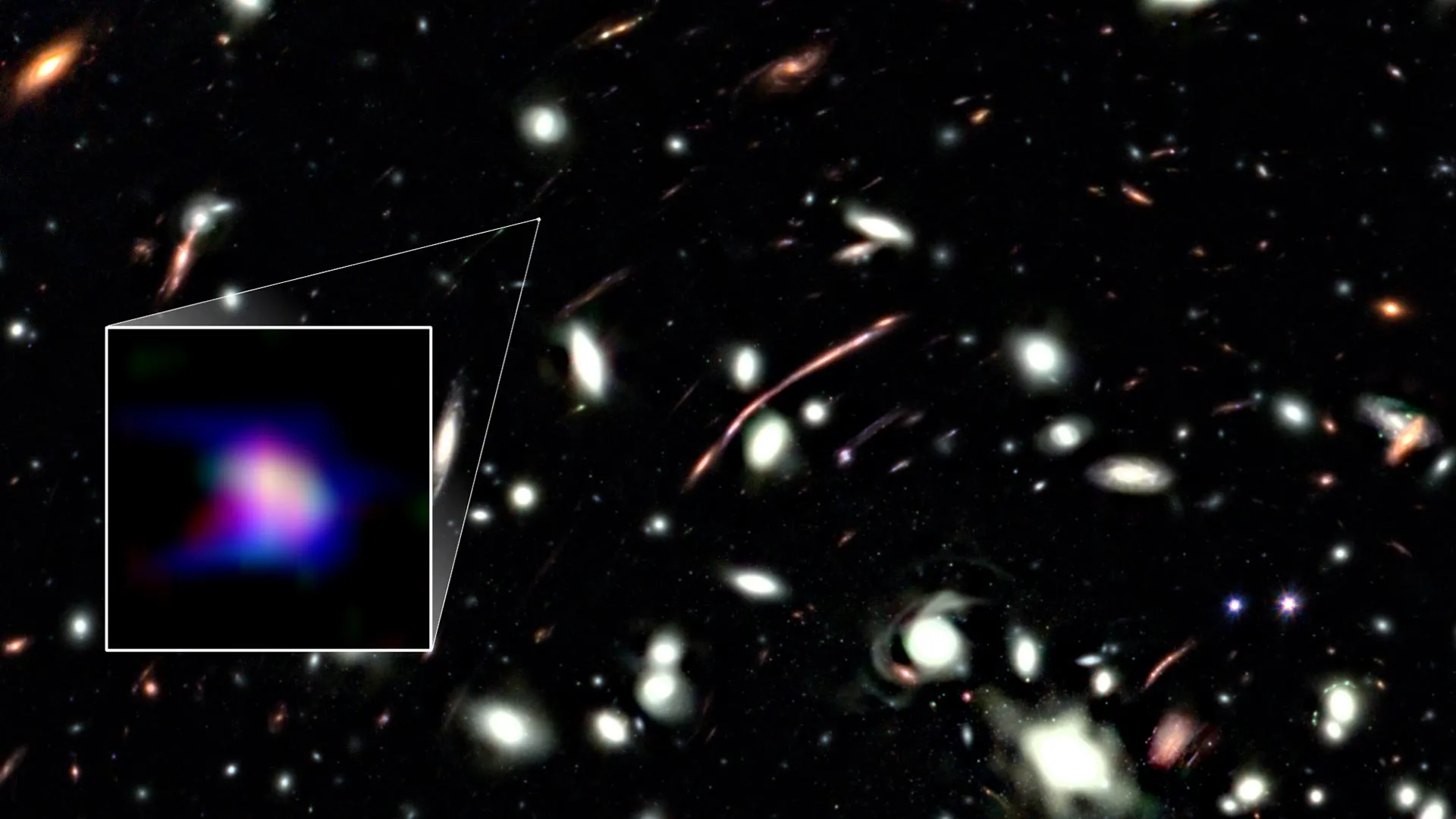

Astronomers using the James Webb Space Telescope have discovered an extraordinarily primitive galaxy from 13 billion years ago that may preserve the chemical fingerprints of the universe’s first stars. The discovery could also solve a long-standing mystery surrounding some of the oldest and faintest galaxies near our Milky Way.
An international research team led by Associate Professor Kimihiko Nakajima of Kanazawa University used Webb and a natural magnifying effect known as gravitational lensing to examine LAP1-B, a tiny, ultra-faint galaxy that existed just 800 million years after the Big Bang.
Building on earlier observations, the researchers determined that the galaxy has an oxygen abundance of approximately 1/240th that of the Sun, making it the most chemically primitive star-forming galaxy discovered to date.
Its unusual chemical composition, intense ionizing radiation, and dominant dark matter halo suggest that LAP1-B represents the long-sought “ancestor” of mysterious ancient galaxies found near the Milky Way today. The discovery provides an unprecedented opportunity to investigate the earliest stages of galaxy formation and how the chemical ingredients necessary for life first spread throughout the cosmos.
Searching for the Universe’s First Elements
Immediately after the Big Bang, the universe consisted almost entirely of light elements such as hydrogen and helium. Heavier elements, including the carbon and oxygen essential for life as we know it, had yet to form. These elements were later produced through nuclear reactions inside the universe’s earliest stars.
Known as Population III stars, these first-generation stars were fundamentally different from the stars we see today. They formed from nearly pristine cosmic gas containing no heavy elements. Their emergence ended the period known as the “Cosmic Dark Ages” and initiated the chemical transformation of the universe.
When massive early stars exploded, they released newly created elements into their surroundings. Over successive generations, this material accumulated in galaxies and eventually provided the raw ingredients for rocky planets and living organisms.
For decades, astronomers have searched for direct evidence of this crucial period in cosmic history. However, the earliest galaxies were generally so small, faint, and distant that measuring their chemical composition was considered nearly impossible.
The James Webb Space Telescope is now making such observations possible. Launched in 2021, Webb is the largest and most powerful infrared space telescope ever constructed, allowing astronomers to investigate some of the faintest and most distant objects in the observable universe.
A Natural Cosmic Magnifying Glass Reveals an Ancient Galaxy
The research team focused its observations on an exceptionally faint galaxy named LAP1-B. Although the galaxy would ordinarily be extremely difficult to study, a massive foreground galaxy cluster magnified its light by a factor of 100.
This phenomenon, known as “gravitational lensing,” occurs when the gravity of a massive object bends and magnifies light from more distant objects behind it. In effect, the intervening galaxy cluster acts as a giant “natural magnifying glass” in space, extending Webb’s already remarkable observational capabilities.
The researchers observed LAP1-B for more than 30 hours, using a technique called spectroscopy to investigate its chemical composition. Spectroscopy separates light into its individual wavelengths, much like a prism separates visible light into a rainbow. By examining these distinctive “barcodes of light,” astronomers can identify the elements present in distant objects, determine their relative abundances, measure their distances, and study their motion through space.
The observations placed LAP1-B at a redshift of 6.625 ± 0.001, corresponding to a time when the universe was only about 800 million years old.
Webb Discovers a Record-Breaking Lack of Oxygen
The measurements revealed that the oxygen abundance in the galaxy’s gas was just 0.42% of the solar value, or approximately 1/240th that of the Sun. This makes LAP1-B the most chemically primitive star-forming galaxy identified so far.
Oxygen abundance is measured by comparing the number of oxygen (O) atoms with the number of hydrogen (H) atoms, expressed as (O/H). Because hydrogen has been present since the earliest moments of the universe, it provides a useful reference for measuring how much a galaxy has evolved chemically.
As successive generations of stars form, evolve, and die, they enrich their surroundings with heavier elements. A galaxy with such an extreme shortage of oxygen has therefore experienced relatively little chemical enrichment, offering astronomers a rare glimpse of conditions close to those in which the first galaxies formed.
“I was instantly thrilled by the extreme lack of oxygen revealed in the data,” says Associate Professor Nakajima, the research team leader. “Finding a galaxy in such a primitive state is astonishing. It’s a chemical signature that clearly indicates a primordial galaxy caught in the moments shortly after its formation.”
Chemical Fingerprints of the Universe’s First Stars
The extraordinarily low oxygen abundance was not the only unusual feature of LAP1-B. The researchers also discovered that the galaxy contained a disproportionately large amount of carbon relative to oxygen, given its overall scarcity of heavy elements.
This distinctive chemical fingerprint closely matches theoretical predictions of the elements released by stars that originally formed from gas containing no heavy elements.
The team also detected an exceptionally energetic field of ionizing radiation, meaning that the radiation carries enough energy to strip electrons from atoms. The characteristics of this radiation are inconsistent with those expected from chemically enriched stellar populations or actively feeding black holes. Instead, they agree with theoretical predictions for a population of stars containing exceptionally small quantities of heavy elements.
Together, these findings provide compelling evidence that LAP1-B may preserve the chemical legacy of the universe’s first generation of stars.
Until now, much of what astronomers have learned about these early stars has come from examining the chemical composition of ancient stars closer to home. Webb is allowing scientists to investigate the gas in a primordial galaxy as it existed more than eight billion years before the solar system formed.
“Usually, we act like ‘cosmic archaeologists,’ trying to guess the past by looking at old stars in our own neighborhood. But now, we can analyze the gas directly from the original scene 13 billion years ago,” emphasizes Nakajima. “We are witnessing the moment when a galaxy first inherited the chemical building blocks created by the universe’s earliest stars.”
A Tiny Galaxy Dominated by Invisible Dark Matter
LAP1-B also stands out for its extraordinarily small stellar mass. Because the researchers could not detect the continuous glow produced by its stars, they were able to constrain their combined mass to less than 3,300 times the mass of the Sun.
However, measurements of the motion of gas within the galaxy revealed that its total gravitational mass exceeds the combined mass of its stars and gas. This indicates that LAP1-B is embedded within a dominant halo of invisible dark matter.
Dark matter does not emit light and accounts for roughly 85% of all matter in the universe. Although scientists have yet to determine exactly what it is made of, its presence can be inferred from the gravitational influence it exerts on visible matter.
The combination of an exceptionally small stellar mass, a dominant dark matter halo, and a remarkably primitive chemical composition makes LAP1-B a close match for the predicted ancestors of the “Ultra-Faint Dwarf galaxies (UFDs)” found near our Milky Way today.
Solving the Mystery of the Milky Way’s Cosmic Fossils
Ultra-faint dwarf galaxies are among the smallest and dimmest galaxies known to astronomers. They contain relatively few stars, many of which formed more than 12 billion years ago, and have experienced very little chemical evolution.
These ancient systems are often described as “cosmic fossils” because they preserve evidence of the conditions that existed during the universe’s formative years. Astronomers have long suspected that they originated from some of the earliest galaxies, but obtaining direct observational evidence of their ancestors has remained a major challenge.
LAP1-B offers a rare opportunity to observe what one of these ancient galaxies may have looked like during its infancy. The researchers describe it as a ‘fossil in the making’, linking the earliest stages of galaxy formation to the ancient dwarf galaxies that still exist in the modern universe.
“UFDs are not only the faintest galaxies; they are composed of ancient stars over 12 billion years old and are often described as ‘fossils of the universe,'” explains Professor Masami Ouchi (NAOJ/University of Tokyo), a member of the research team. “Astronomers suspected they might be the remains of the universe’s earliest galaxies because they lack heavy elements, but astronomers never had a direct link – until we found LAP1-B.”
Professor Ouchi continues: “It is a profound surprise to find that LAP1-B looks exactly like the ‘ancestor’ we had only imagined in theories. This helps us solve the mystery of why these cosmic fossils have survived in their current form to the present day.”
Tracing the Cosmic Origins of the Building Blocks of Life
The discovery establishes a new way for astronomers to investigate the origins of heavy elements and reconstruct how the universe’s earliest structures developed. By examining galaxies that have experienced exceptionally little chemical enrichment, researchers can study the processes that transformed a cosmos dominated by hydrogen and helium into one capable of supporting planets and life.
The team plans to continue using the James Webb Space Telescope to search for even more primitive celestial objects, with the ultimate goal of identifying the very first galaxies that formed after the Big Bang.
Associate Professor Nakajima concludes: “We hope this discovery marks a historic step in understanding how the elements that make up our own bodies were first born and accumulated across the Universe.”
Source: www.sciencedaily.com